 Add to Chrome
 Add to Firefox
 Add to Edge
AIForge-Doc: A Benchmark for Detecting AI-Forged Tampering in Financial and Form Documents
Feb 24, 2026
We present AIForge-Doc, the first dedicated benchmark targeting exclusively diffusion-model-based inpainting in financial and form documents with pixel-level annotation. Existing document forgery datasets rely on traditional digital editing tools (e.g., Adobe Photoshop, GIMP), creating a critical gap: state-of-the-art detectors are blind to the rapidly growing threat of AI-forged document fraud. AIForge-Doc addresses this gap by systematically forging numeric fields in real-world receipt and form images using two AI inpainting APIs -- Gemini 2.5 Flash Image and Ideogram v2 Edit -- yielding 4,061 forged images from four public document datasets (CORD, WildReceipt, SROIE, XFUND) across nine languages, annotated with pixel-precise tampered-region masks in DocTamper-compatible format. We benchmark three representative detectors -- TruFor, DocTamper, and a zero-shot GPT-4o judge -- and find that all existing methods degrade substantially: TruFor achieves AUC=0.751 (zero-shot, out-of-distribution) vs. AUC=0.96 on NIST16; DocTamper achieves AUC=0.563 vs. AUC=0.98 in-distribution, with pixel-level IoU=0.020; GPT-4o achieves only 0.509 -- essentially at chance -- confirming that AI-forged values are indistinguishable to automated detectors and VLMs. These results demonstrate that AIForge-Doc represents a qualitatively new and unsolved challenge for document forensics.

AquaSAM: Underwater Image Foreground Segmentation
Aug 08, 2023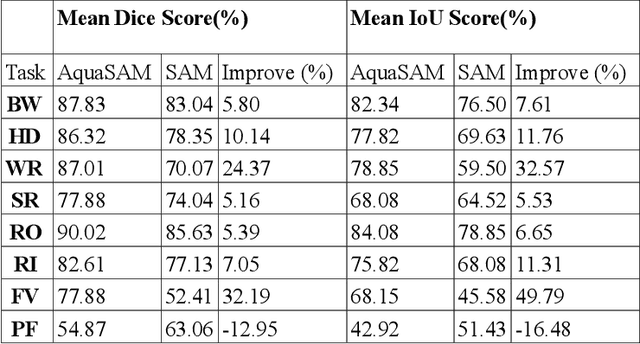
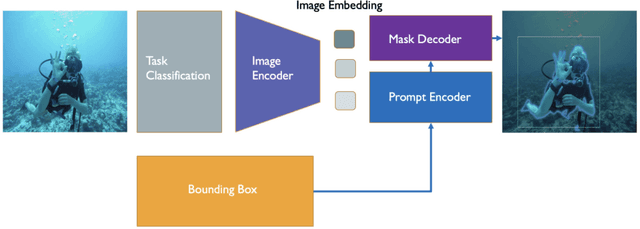
The Segment Anything Model (SAM) has revolutionized natural image segmentation, nevertheless, its performance on underwater images is still restricted. This work presents AquaSAM, the first attempt to extend the success of SAM on underwater images with the purpose of creating a versatile method for the segmentation of various underwater targets. To achieve this, we begin by classifying and extracting various labels automatically in SUIM dataset. Subsequently, we develop a straightforward fine-tuning method to adapt SAM to general foreground underwater image segmentation. Through extensive experiments involving eight segmentation tasks like human divers, we demonstrate that AquaSAM outperforms the default SAM model especially at hard tasks like coral reefs. AquaSAM achieves an average Dice Similarity Coefficient (DSC) of 7.13 (%) improvement and an average of 8.27 (%) on mIoU improvement in underwater segmentation tasks.