 Add to Chrome
 Add to Firefox
 Add to Edge
Structuring Sparsity: Block-Sparse Featurizers Capture Visual Concept Manifolds
Jun 23, 2026
What is the geometry of a visual percept? The most widely used protocols for decomposing neural network representations into interpretable parts treat concepts as isolated directions, yet recent work shows that concepts are often realized as geometric structures in low dimensional regions of activation space. We turn to the literature of Structured sparsity to close this gap, and show that block sparsity, which groups directions into blocks, is the prior matched to a generative model in which a representation is a sparse sum of low-dimensional manifolds: the modern, learned form of a classical idea in visual neuroscience, where a visual feature is carried by a coordinated group of neurons rather than a single tuned one. We implement three variants of block-sparse featurizers (BSFs) and, through a minimum-description-length analysis, show that all three describe activations more compactly than direction-based featurizers, with the recovered concepts typically two- to four-dimensional. We then use BSFs to (i) recontextualize prior work, showing that curve detectors in InceptionV1 actually read from a single continuous curve manifold, (ii) discover novel manifolds including shadows and lighting in DINOv3, and (iii) support interpretable control of image generation in diffusion models (SDXL) via manifold steering.

A Unifying View of Attention Sinks: Two Algorithms, Two Solutions
Jun 06, 2026When attention concentrates on a single token, a sink, what is the model actually computing? Attention sinks are ubiquitous in softmax transformers, yet this shared visual signature can hide fundamentally different algorithms. We show that visually similar sink patterns can reflect two distinct mechanisms: {i} adaptive nop, where a head suppresses its update by routing to a null token, and {ii} broadcast, where a sink aggregates and redistributes global information. In that case, sinks serve an analogous role: a safe destination when there is nothing useful to compute. Proposed interventions like gating or registers work because they implicitly target one or the other, revealing a duality between method and assumed mechanism: gating implicitly assumes nop; registers implicitly assume broadcast. Each mechanism leaves distinct traces (nop sinks exhibit negligible value norms; broadcast sinks induce low-rank outputs) which we formalize on synthetic tasks and use to derive practical diagnostics. Applied to pretrained vision transformers, these diagnostics reveal that both mechanisms exist at scale: sinks transition from CLS in early layers to patches in deeper layers, and concentrate in specialized heads. Strikingly, register tokens, designed for broadcast, are repurposed to also serve nop, confirming that neither intervention alone suffices. Combining gating with registers yields complementary gains in stability and performance. Overall, we find that the same attention pattern can reflect two very different computations and effective intervention requires first asking what the model is actually computing.
Block-Recurrent Dynamics in Vision Transformers
Dec 23, 2025
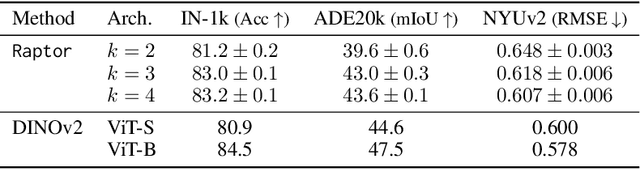
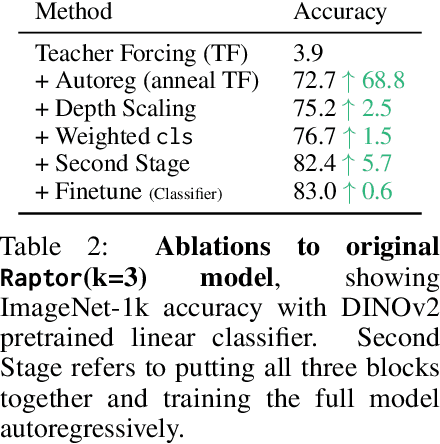
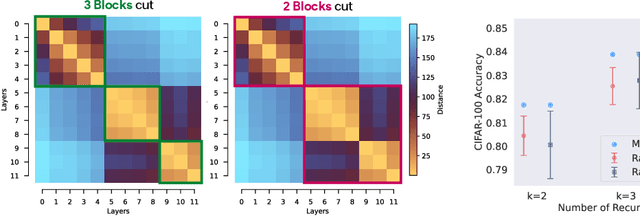
As Vision Transformers (ViTs) become standard vision backbones, a mechanistic account of their computational phenomenology is essential. Despite architectural cues that hint at dynamical structure, there is no settled framework that interprets Transformer depth as a well-characterized flow. In this work, we introduce the Block-Recurrent Hypothesis (BRH), arguing that trained ViTs admit a block-recurrent depth structure such that the computation of the original $L$ blocks can be accurately rewritten using only $k \ll L$ distinct blocks applied recurrently. Across diverse ViTs, between-layer representational similarity matrices suggest few contiguous phases. To determine whether these phases reflect genuinely reusable computation, we train block-recurrent surrogates of pretrained ViTs: Recurrent Approximations to Phase-structured TransfORmers (Raptor). In small-scale, we demonstrate that stochastic depth and training promote recurrent structure and subsequently correlate with our ability to accurately fit Raptor. We then provide an empirical existence proof for BRH by training a Raptor model to recover $96\%$ of DINOv2 ImageNet-1k linear probe accuracy in only 2 blocks at equivalent computational cost. Finally, we leverage our hypothesis to develop a program of Dynamical Interpretability. We find i) directional convergence into class-dependent angular basins with self-correcting trajectories under small perturbations, ii) token-specific dynamics, where cls executes sharp late reorientations while patch tokens exhibit strong late-stage coherence toward their mean direction, and iii) a collapse to low rank updates in late depth, consistent with convergence to low-dimensional attractors. Altogether, we find a compact recurrent program emerges along ViT depth, pointing to a low-complexity normative solution that enables these models to be studied through principled dynamical systems analysis.
Traveling Waves Integrate Spatial Information Into Spectral Representations
Feb 09, 2025Traveling waves are widely observed in the brain, but their precise computational function remains unclear. One prominent hypothesis is that they enable the transfer and integration of spatial information across neural populations. However, few computational models have explored how traveling waves might be harnessed to perform such integrative processing. Drawing inspiration from the famous ``Can one hear the shape of a drum?'' problem -- which highlights how spectral modes encode geometric information -- we introduce a set of convolutional recurrent neural networks that learn to produce traveling waves in their hidden states in response to visual stimuli. By applying a spectral decomposition to these wave-like activations, we obtain a powerful new representational space that outperforms equivalently local feed-forward networks on tasks requiring global spatial context. In particular, we observe that traveling waves effectively expand the receptive field of locally connected neurons, supporting long-range encoding and communication of information. We demonstrate that models equipped with this mechanism and spectral readouts solve visual semantic segmentation tasks demanding global integration, where local feed-forward models fail. As a first step toward traveling-wave-based representations in artificial networks, our findings suggest potential efficiency benefits and offer a new framework for connecting to biological recordings of neural activity.
HyperSINDy: Deep Generative Modeling of Nonlinear Stochastic Governing Equations
Oct 07, 2023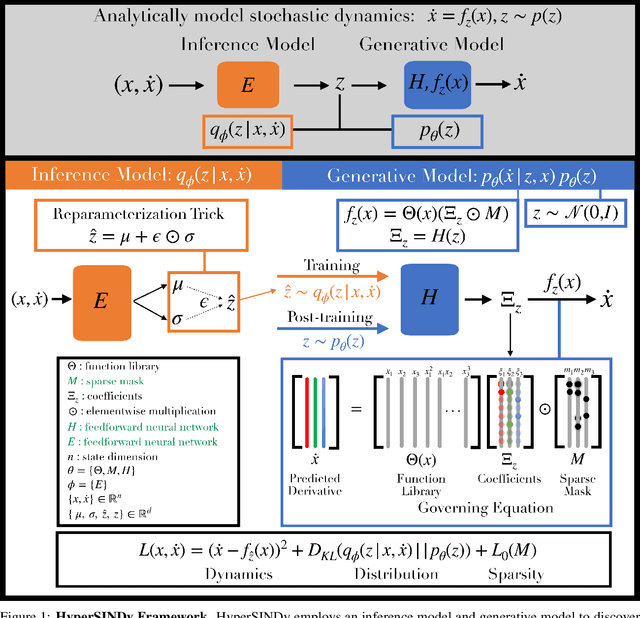
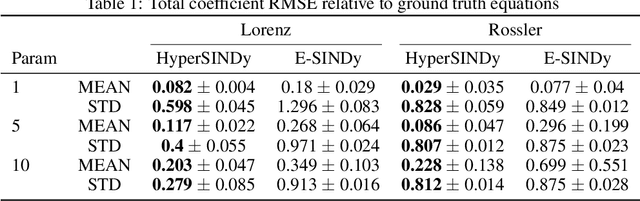
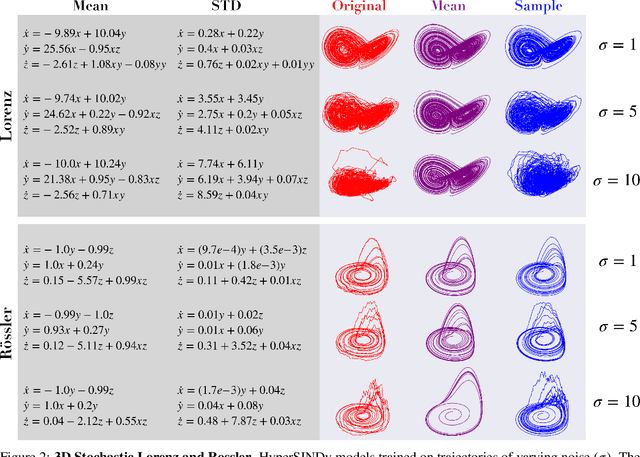

The discovery of governing differential equations from data is an open frontier in machine learning. The sparse identification of nonlinear dynamics (SINDy) \citep{brunton_discovering_2016} framework enables data-driven discovery of interpretable models in the form of sparse, deterministic governing laws. Recent works have sought to adapt this approach to the stochastic setting, though these adaptations are severely hampered by the curse of dimensionality. On the other hand, Bayesian-inspired deep learning methods have achieved widespread success in high-dimensional probabilistic modeling via computationally efficient approximate inference techniques, suggesting the use of these techniques for efficient stochastic equation discovery. Here, we introduce HyperSINDy, a framework for modeling stochastic dynamics via a deep generative model of sparse governing equations whose parametric form is discovered from data. HyperSINDy employs a variational encoder to approximate the distribution of observed states and derivatives. A hypernetwork \citep{ha_hypernetworks_2016} transforms samples from this distribution into the coefficients of a differential equation whose sparse form is learned simultaneously using a trainable binary mask \citep{louizos_learning_2018}. Once trained, HyperSINDy generates stochastic dynamics via a differential equation whose coefficients are driven by a Gaussian white noise. In experiments, HyperSINDy accurately recovers ground truth stochastic governing equations, with learned stochasticity scaling to match that of the data. Finally, HyperSINDy provides uncertainty quantification that scales to high-dimensional systems. Taken together, HyperSINDy offers a promising framework for model discovery and uncertainty quantification in real-world systems, integrating sparse equation discovery methods with advances in statistical machine learning and deep generative modeling.