 Add to Chrome
 Add to Firefox
 Add to Edge
TACTIC-KG: Toward Small Agent Teams for Cyber Threat Intelligence Knowledge Graph Construction
Jul 06, 2026
Cyber Threat Intelligence (CTI) reports are predominantly unstructured, heterogeneous, and noisy, which limits their direct usability for automated analysis and reasoning. Cybersecurity Knowledge Graphs (CSKGs) provide a structured representation of adversarial entities, actions, and relations, but constructing such graphs from free-text CTI remains a challenge. Recent approaches rely on monolithic Large Language Models (LLMs) to perform end-to-end extraction and completion, leading to high cost, limited controllability, and unstable performance. This paper introduces TACTIC-KG, an agentic framework for CSKG construction that decomposes the task into modular, specialized LLM agents responsible for extraction, typing, verification, and curation. Using lightweight models (3B--8B), TACTIC-KG improves stability, recall, and graph consistency while reducing deployment cost. We implement and evaluate TACTIC-KG against recent state-of-the-art systems. Experiments on human-annotated CTI reports show that agent specialization consistently outperforms larger monolithic in-context-learning (ICL) baselines in extraction F1-score, typing accuracy, and structural graph similarity.

Automated Byzantine-Resilient Clustered Decentralized Federated Learning for Battery Intelligence in Connected EVs
May 20, 2026Federated learning (FL) has emerged as a promising paradigm for managing electric vehicle (EV) battery data in intelligent transportation systems (ITS), enabling privacy-preserving tasks such as anomaly detection and capacity estimation. However, most existing frameworks rely on centralized aggregation schemes, which pose critical limitations in terms of security and trust. To address these challenges, we propose ABC-DFL, an automated Byzantine-resilient clustered decentralized federated learning (C-DFL) framework for connected EVs. The proposed incentive-driven C-DFL system replaces the central server with an open-permissioned blockchain, featuring a new dynamic Quorum Byzantine Fault Tolerance (QBFT) protocol and an oracle-based aggregation layer, to enhance trust, security, and automation. At the core of ABC-DFL lies FLECA (Filtered Layered Enhanced Clustering Aggregation), a robust hierarchical aggregation protocol that mitigates Byzantine attacks by having each EV filter malicious updates using an adaptive threshold based on deviations from its reference model update. Oracle nodes, responsible for inter-group aggregation, employ robust clustering to isolate and aggregate model updates from trustworthy EV groups. Comprehensive experimental evaluations demonstrate that FLECA matches FedProx convergence under benign conditions and significantly outperforms existing defenses with attack impact scores below 0.10 in adaptive adversarial scenarios. Furthermore, several learning experiments with multitask models confirm the effectiveness and fairness of the incentive mechanism. Finally, on-chain and off-chain benchmarks validate the practicality of ABC-DFL.
AutoDFL: A Scalable and Automated Reputation-Aware Decentralized Federated Learning
Jan 08, 2025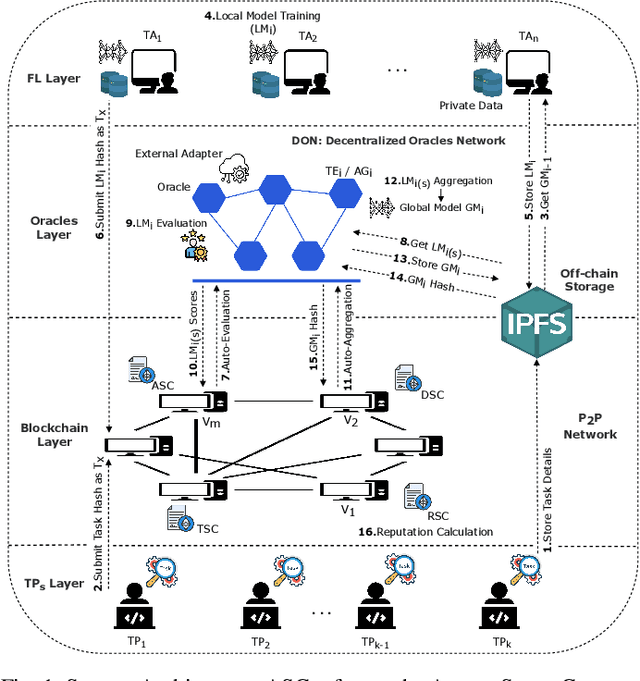
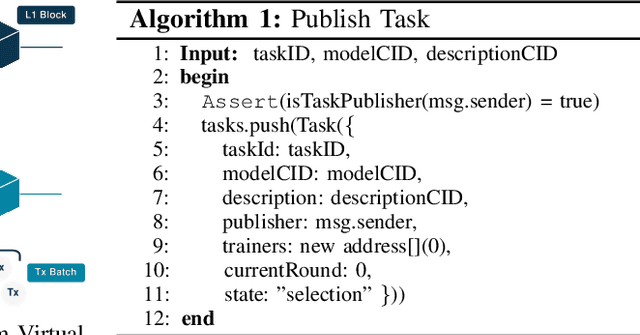
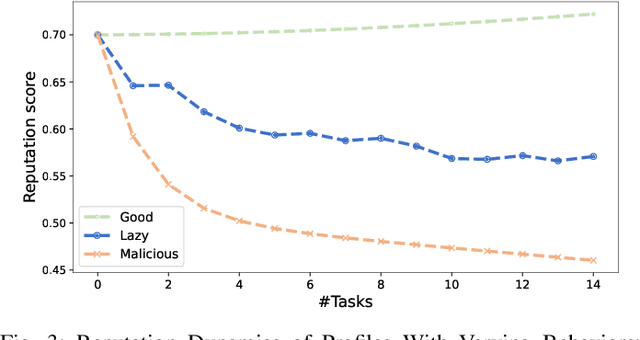
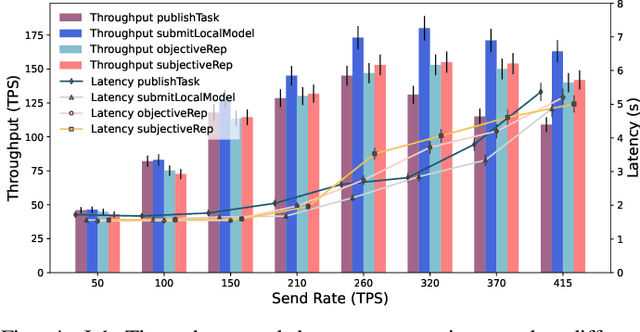
Blockchained federated learning (BFL) combines the concepts of federated learning and blockchain technology to enhance privacy, security, and transparency in collaborative machine learning models. However, implementing BFL frameworks poses challenges in terms of scalability and cost-effectiveness. Reputation-aware BFL poses even more challenges, as blockchain validators are tasked with processing federated learning transactions along with the transactions that evaluate FL tasks and aggregate reputations. This leads to faster blockchain congestion and performance degradation. To improve BFL efficiency while increasing scalability and reducing on-chain reputation management costs, this paper proposes AutoDFL, a scalable and automated reputation-aware decentralized federated learning framework. AutoDFL leverages zk-Rollups as a Layer-2 scaling solution to boost the performance while maintaining the same level of security as the underlying Layer-1 blockchain. Moreover, AutoDFL introduces an automated and fair reputation model designed to incentivize federated learning actors. We develop a proof of concept for our framework for an accurate evaluation. Tested with various custom workloads, AutoDFL reaches an average throughput of over 3000 TPS with a gas reduction of up to 20X.
VerifBFL: Leveraging zk-SNARKs for A Verifiable Blockchained Federated Learning
Jan 08, 2025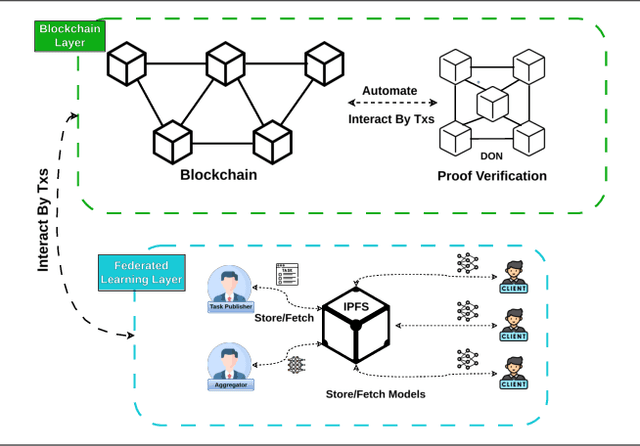
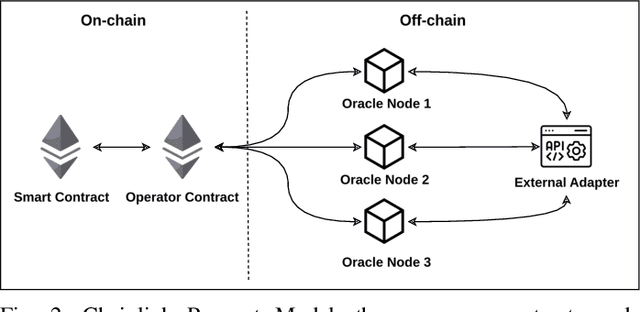
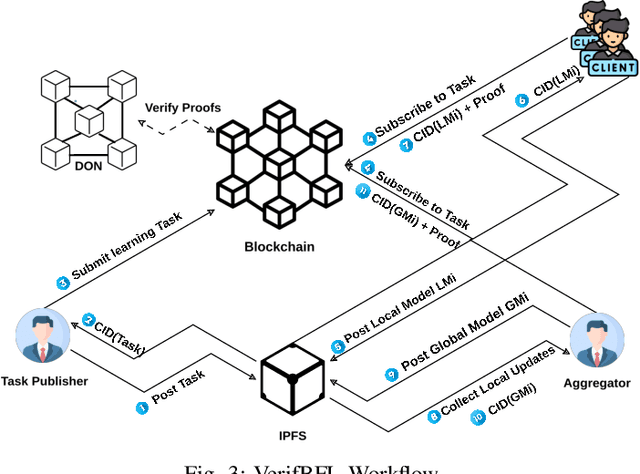

Blockchain-based Federated Learning (FL) is an emerging decentralized machine learning paradigm that enables model training without relying on a central server. Although some BFL frameworks are considered privacy-preserving, they are still vulnerable to various attacks, including inference and model poisoning. Additionally, most of these solutions employ strong trust assumptions among all participating entities or introduce incentive mechanisms to encourage collaboration, making them susceptible to multiple security flaws. This work presents VerifBFL, a trustless, privacy-preserving, and verifiable federated learning framework that integrates blockchain technology and cryptographic protocols. By employing zero-knowledge Succinct Non-Interactive Argument of Knowledge (zk-SNARKs) and incrementally verifiable computation (IVC), VerifBFL ensures the verifiability of both local training and aggregation processes. The proofs of training and aggregation are verified on-chain, guaranteeing the integrity and auditability of each participant's contributions. To protect training data from inference attacks, VerifBFL leverages differential privacy. Finally, to demonstrate the efficiency of the proposed protocols, we built a proof of concept using emerging tools. The results show that generating proofs for local training and aggregation in VerifBFL takes less than 81s and 2s, respectively, while verifying them on-chain takes less than 0.6s.