 Add to Chrome
 Add to Firefox
 Add to Edge
Computationally Efficient Replicable Learning of Parities
Feb 10, 2026
We study the computational relationship between replicability (Impagliazzo et al. [STOC `22], Ghazi et al. [NeurIPS `21]) and other stability notions. Specifically, we focus on replicable PAC learning and its connections to differential privacy (Dwork et al. [TCC 2006]) and to the statistical query (SQ) model (Kearns [JACM `98]). Statistically, it was known that differentially private learning and replicable learning are equivalent and strictly more powerful than SQ-learning. Yet, computationally, all previously known efficient (i.e., polynomial-time) replicable learning algorithms were confined to SQ-learnable tasks or restricted distributions, in contrast to differentially private learning. Our main contribution is the first computationally efficient replicable algorithm for realizable learning of parities over arbitrary distributions, a task that is known to be hard in the SQ-model, but possible under differential privacy. This result provides the first evidence that efficient replicable learning over general distributions strictly extends efficient SQ-learning, and is closer in power to efficient differentially private learning, despite computational separations between replicability and privacy. Our main building block is a new, efficient, and replicable algorithm that, given a set of vectors, outputs a subspace of their linear span that covers most of them.

Fast and Bayes-consistent nearest neighbors
Oct 07, 2019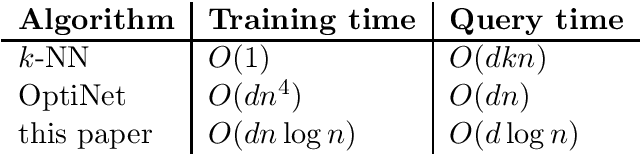
Research on nearest-neighbor methods tends to focus somewhat dichotomously either on the statistical or the computational aspects -- either on, say, Bayes consistency and rates of convergence or on techniques for speeding up the proximity search. This paper aims at bridging these realms: to reap the advantages of fast evaluation time while maintaining Bayes consistency, and further without sacrificing too much in the risk decay rate. We combine the locality-sensitive hashing (LSH) technique with a novel missing-mass argument to obtain a fast and Bayes-consistent classifier. Our algorithm's prediction runtime compares favorably against state of the art approximate NN methods, while maintaining Bayes-consistency and attaining rates comparable to minimax. On samples of size $n$ in $\R^d$, our pre-processing phase has runtime $O(d n \log n)$, while the evaluation phase has runtime $O(d\log n)$ per query point.