 Add to Chrome
 Add to Firefox
 Add to Edge
On the CRLB for Blind Receiver I/Q Imbalance Estimation in OFDM Systems: Efficient Computation and Closed-Form Bounds
Mar 16, 2026
Modern mobile communication receivers are often implemented with a direct-conversion architecture, which features a number of advantages over competing designs. A notable limitation of direct-conversion architectures, however, is their sensitivity to amplitude and phase mismatches between the in-phase and quadrature signal paths. Such in-phase and quadrature-phase (I/Q) imbalances introduce undesired image components in the baseband signal, degrading link performance -- most notably by increasing the bit-error ratio. Considerable research effort has therefore been devoted to digital techniques for estimating and mitigating these impairments. Existing approaches generally fall into two categories: data-aided methods that exploit known pilots, preambles, or training sequences, and blind techniques that operate without such prior information. For data-aided estimation, Cramér-Rao lower bounds (CRLBs) have been established in the literature. In contrast, the derivation of a CRLB for the blind I/Q-imbalance estimation case is considerably more challenging, since the received data is random and typically non-Gaussian in the frequency domain. This work extends our earlier conference contribution, which introduced a CRLB derivation for the blind estimation of frequency-independent (FID) receiver I/Q imbalance using central limit theorem (CLT) arguments. The extensions include a computationally efficient method for calculating the bound, reducing complexity from cubic in the number of samples to linear in the fast-Fourier transform (FFT) size, along with a simplified closed-form approximation. This approximation provides new insights into the allocation dependent performances of existing estimation methods, motivating a pre-estimation filtering modification that drastically improves their estimation performance in certain scenarios.

Tx and Rx IQ Imbalance Compensation for JCAS in 5G NR
Apr 14, 2025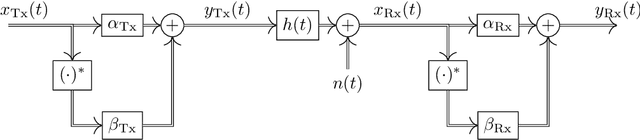
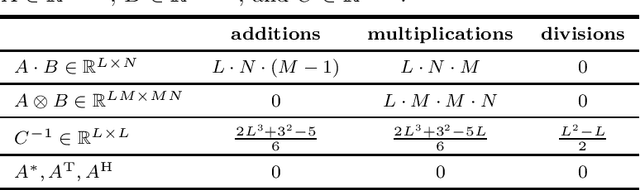
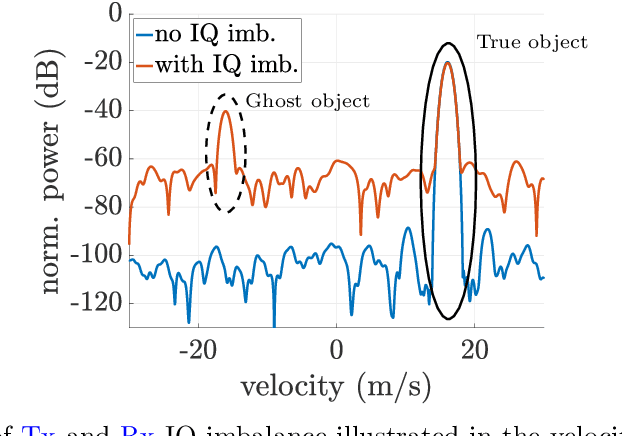
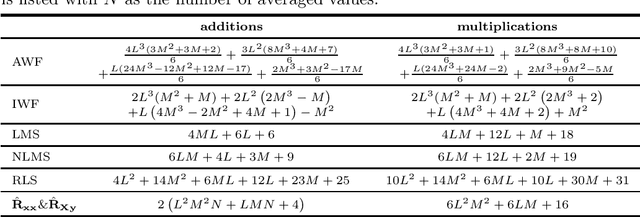
Beside traditional communications, joint communications and sensing (JCAS) is gaining increasing relevance as a key enabler for next-generation wireless systems. The ability to accurately transmit and receive data is the basis for high-speed communications and precise sensing, where a fundamental requirement is an accurate in-phase (I) and quadrature-phase (Q) modulation. For sensing, imperfections in IQ modulation lead to two critical issues in the range-Doppler-map (RDM) in form of an increased noise floor and the presence of ghost objects, degrading the accuracy and reliability of the information in the RDM. This paper presents a low-complex estimation and compensation method to mitigate the IQ imbalance effects. This is achieved by utilizing, amongst others, the leakage signal, which is the direct signal from the transmitter to the receiver path, and is typically the strongest signal component in the RDM. The parameters of the IQ imbalance suppression structure are estimated based on a mixed complex-/real-valued bilinear filter approach, that considers IQ imbalance in the transmitter and the receiver of the JCAS-capable user equipment (UE). The UE uses a 5G New Radio (NR)-compliant orthogonal frequency-division multiplexing (OFDM) waveform with the system configuration assumed to be predefined from the communication side. To assess the effectiveness of the proposed approach, simulations are conducted, illustrating the performance in the suppression of IQ imbalance introduced distortions in the RDM.
OFDM-based Waveforms for Joint Sensing and Communications Robust to Frequency Selective IQ Imbalance
Nov 16, 2023Orthogonal frequency-division multiplexing (OFDM) is a promising waveform candidate for future joint sensing and communication systems. It is well known that the OFDM waveform is vulnerable to in-phase and quadrature-phase (IQ) imbalance, which increases the noise floor in a range-Doppler map (RDM). A state-of-the-art method for robustifying the OFDM waveform against IQ imbalance avoids an increased noise floor, but it generates additional ghost objects in the RDM [1]. A consequence of these additional ghost objects is a reduction of the maximum unambiguous range. In this work, a novel OFDM-based waveform robust to IQ imbalance is proposed, which neither increases the noise floor nor reduces the maximum unambiguous range. The latter is achieved by shifting the ghost objects in the RDM to different velocities such that their range variations observed over several consecutive RDMs do not correspond to the observed velocity. This allows tracking algorithms to identify them as ghost objects and eliminate them for the follow-up processing steps. Moreover, we propose complete communication systems for both the proposed waveform as well as for the state-of-the-art waveform, including methods for channel estimation, synchronization, and data estimation that are specifically designed to deal with frequency selective IQ imbalance which occurs in wideband systems. The effectiveness of these communication systems is demonstrated by means of bit error ratio (BER) simulations.