 Add to Chrome
 Add to Firefox
 Add to Edge
Towards Context-Aware Clinical Motion Understanding in Daily Living at Home: Freezing of Gait Detection with Egocentric Vision
Aug 13, 2026
Understanding motion in daily living requires context beyond kinematics, because similar inertial patterns during activities of daily living (ADLs) can reflect intentional stopping, object interaction, or pathological movement impairment. Egocentric vision provides task-related context that may help disambiguate these cases. We investigate this challenge through freezing of gait (FOG) detection in Parkinson's disease (PD), a symptom strongly influenced by contextual factors during ADLs. Using synchronized egocentric video, wearable IMUs, and expert-annotated FOG labels collected from 13 PD participants in their homes, we evaluate frozen representations from pretrained ego-video and time-series foundation models, alongside an IMU-based TCN trained from scratch, under leave-one-subject-out evaluation. The IMU-based TCN achieved the strongest event-detection performance, reaching 42.3 F1 and 83.0 AUROC, compared with 32.6 F1 and 77.2 AUROC for V-JEPA2 ego-video features. Although ego-video alone did not outperform IMU-based sensing, it showed above-chance discrimination, and qualitative analyses suggest that egocentric vision may capture FOG-relevant information independent of IMUs. Together, these results support the use of pretrained ego-video representations to add contextual information to wearable-sensor-based clinical motion understanding in daily living.

CARE-PD: A Multi-Site Anonymized Clinical Dataset for Parkinson's Disease Gait Assessment
Oct 05, 2025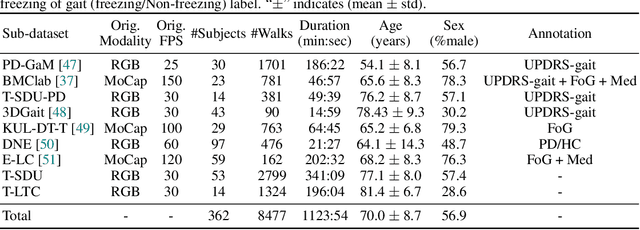
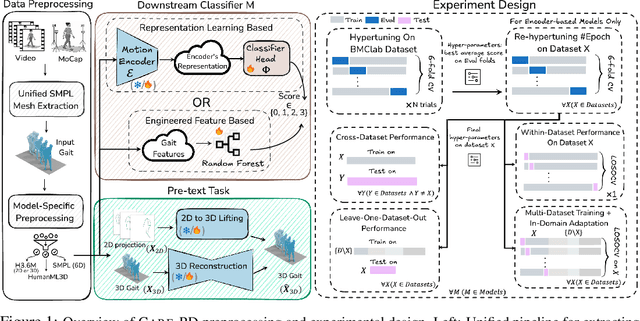
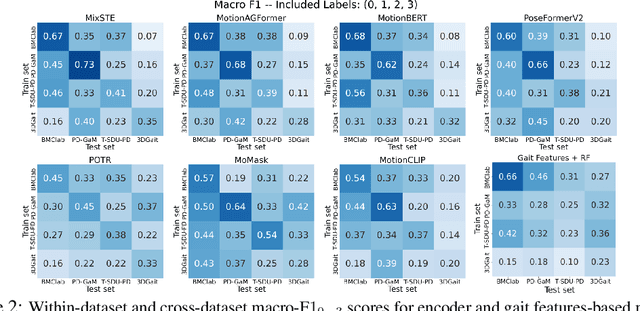
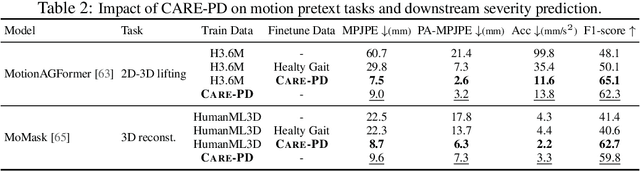
Objective gait assessment in Parkinson's Disease (PD) is limited by the absence of large, diverse, and clinically annotated motion datasets. We introduce CARE-PD, the largest publicly available archive of 3D mesh gait data for PD, and the first multi-site collection spanning 9 cohorts from 8 clinical centers. All recordings (RGB video or motion capture) are converted into anonymized SMPL meshes via a harmonized preprocessing pipeline. CARE-PD supports two key benchmarks: supervised clinical score prediction (estimating Unified Parkinson's Disease Rating Scale, UPDRS, gait scores) and unsupervised motion pretext tasks (2D-to-3D keypoint lifting and full-body 3D reconstruction). Clinical prediction is evaluated under four generalization protocols: within-dataset, cross-dataset, leave-one-dataset-out, and multi-dataset in-domain adaptation. To assess clinical relevance, we compare state-of-the-art motion encoders with a traditional gait-feature baseline, finding that encoders consistently outperform handcrafted features. Pretraining on CARE-PD reduces MPJPE (from 60.8mm to 7.5mm) and boosts PD severity macro-F1 by 17 percentage points, underscoring the value of clinically curated, diverse training data. CARE-PD and all benchmark code are released for non-commercial research at https://neurips2025.care-pd.ca/.
Identification of EEG Dynamics During Freezing of Gait and Voluntary Stopping in Patients with Parkinson's Disease
Feb 06, 2021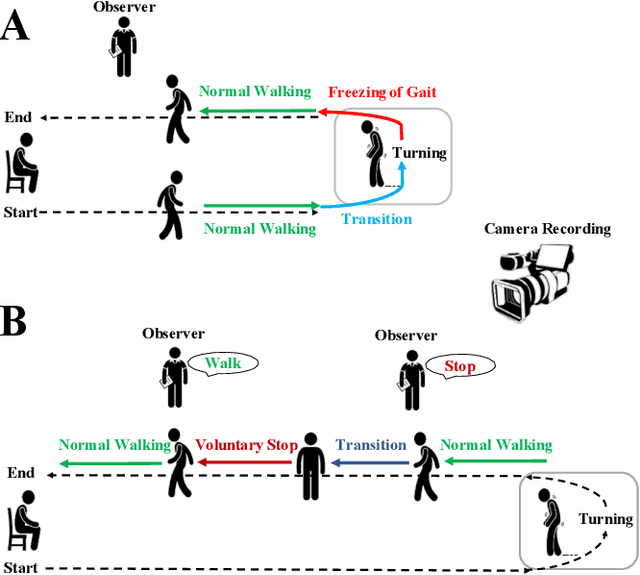
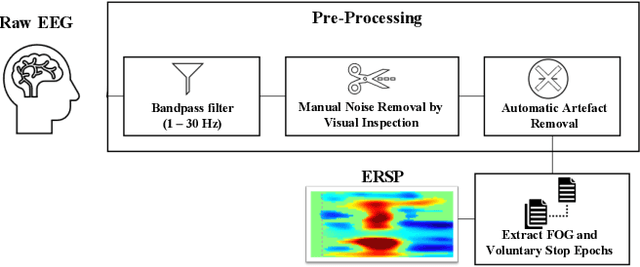
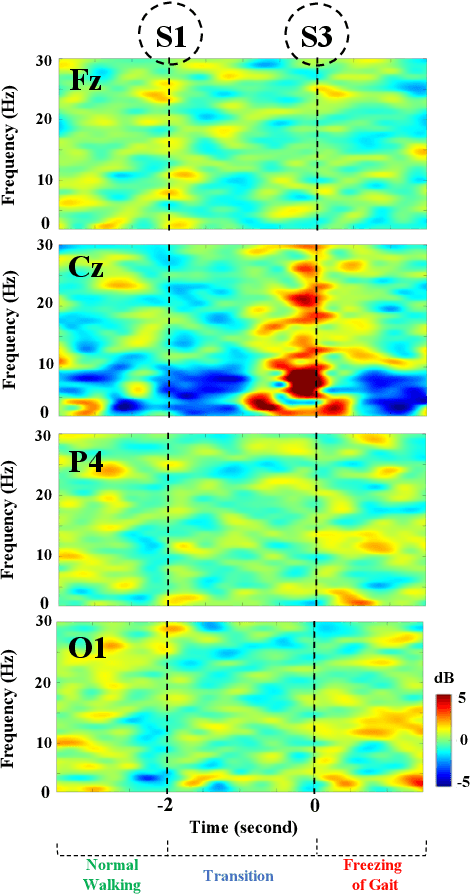
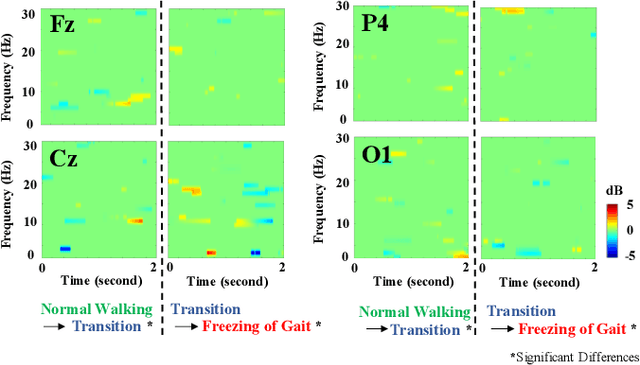
Mobility is severely impacted in patients with Parkinson's disease (PD), especially when they experience involuntary stopping from the freezing of gait (FOG). Understanding the neurophysiological difference between "voluntary stopping" and "involuntary stopping" caused by FOG is vital for the detection and potential intervention of FOG in the daily lives of patients. This study characterised the electroencephalographic (EEG) signature associated with FOG in contrast to voluntary stopping. The protocol consisted of a timed up-and-go (TUG) task and an additional TUG task with a voluntary stopping component, where participants reacted to verbal "stop" and "walk" instructions by voluntarily stopping or walking. Event-related spectral perturbation (ERSP) analysis was used to study the dynamics of the EEG spectra induced by different walking phases, which included normal walking, voluntary stopping and episodes of involuntary stopping (FOG), as well as the transition windows between normal walking and voluntary stopping or FOG. These results demonstrate for the first time that the EEG signal during the transition from walking to voluntary stopping is distinguishable from that of the transition to involuntary stopping caused by FOG. The EEG signature of voluntary stopping exhibits a significantly decreased power spectrum compared to that of FOG episodes, with distinctly different patterns in the delta and low-beta power in the central area. These findings suggest the possibility of a practical EEG-based treatment strategy that can accurately predict FOG episodes, excluding the potential confound of voluntary stopping.