 Add to Chrome
 Add to Firefox
 Add to Edge
SimBEV2X: A Large-Scale Dataset and Data Generation Tool for Multi-Task Vehicle-to-Everything Cooperative Perception
Jul 27, 2026
Cooperative perception through vehicle-to-everything (V2X) communication can overcome the inherent physical limitations of individual autonomous vehicles, such as occlusions and limited sensor range. However, the development of robust V2X algorithms, particularly those relying on unified spatial representations like bird's-eye view (BEV) representation, is hampered by the lack of large-scale, multi-modal, multi-task datasets. Moreover, collecting and annotating a large set of synchronized, real-world multi-agent data is prohibitively expensive. This has resulted in a landscape where existing V2X datasets are notably limited in both size and scope. To overcome this, we introduce SimBEV2X, an advanced synthetic data generation tool built on the CARLA simulator. SimBEV2X automatically creates randomized driving scenarios to collect multi-modal sensor data alongside various types of ground truth including 3D bounding boxes with unique track IDs, HD map information, BEV segmentation maps, and semantic occupancy voxel grids from both vehicles and RSUs. We also present the SimBEV2X dataset, the largest V2X perception dataset to date. The dataset comprises 258 scenes, each involving up to 8 connected vehicles and up to 4 RSUs across a variety of road networks. The SimBEV2X dataset is an order of magnitude larger than existing V2X datasets and contains 102,200 frames, 588,520 lidar point clouds, more than 3 million images, over 27 million bounding boxes, and a comprehensive set of other annotations. Finally, we establish a strong baseline on the SimBEV2X dataset using CoopDet3D and propose CoBEVFusion, a novel architecture that combines CoopDet3D with fused axial attention (FAX) for context-aware multi-agent feature aggregation, resulting in superior performance. SimBEV2X, the SimBEV2X dataset, and CoBEVFusion are available at https://simbev2x.org and https://github.com/GoodarzMehr/SimBEV2X.

An Assessment of Safety-Based Driver Behavior Modeling in Microscopic Simulation Utilizing Real-Time Vehicle Trajectories
Oct 17, 2022
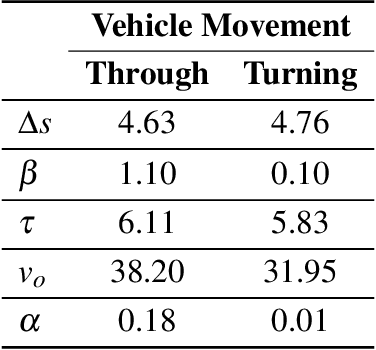


Accurate representation of observed driving behavior is critical for effectively evaluating safety and performance interventions in simulation modeling. In this study, we implement and evaluate a safety-based Optimal Velocity Model (OVM) to provide a high-fidelity replication of safety-critical behavior in microscopic simulation and showcase its implications for safety-focused assessments of traffic control strategies. A comprehensive simulation model is created for the site of study in PTV VISSIM utilizing detailed vehicle trajectory information extracted from real-time video inference, which are also used to calibrate the parameters of the safety-based OVM to replicate the observed driving behavior in the site of study. The calibrated model is then incorporated as an external driver model that overtakes VISSIM's default Wiedemann 74 model during simulated car-following episodes. The results of the preliminary analysis show the significant improvements achieved by using our model in replicating the existing safety conflicts observed at the site of the study. We then utilize this improved representation of the status quo to assess the potential impact of different scenarios of signal control and speed limit enforcement in reducing those existing conflicts by up to 23%. The results of this study showcase the considerable improvements that can be achieved by utilizing data-driven car-following behavior modeling, and the workflow presented provides an end-to-end, scalable, automated, and generalizable approach for replicating the existing driving behavior observed at a site of interest in microscopic simulation by utilizing vehicle trajectories efficiently extracted via roadside video inference.
A Framework for Real-time Traffic Trajectory Tracking, Speed Estimation, and Driver Behavior Calibration at Urban Intersections Using Virtual Traffic Lanes
Jun 18, 2021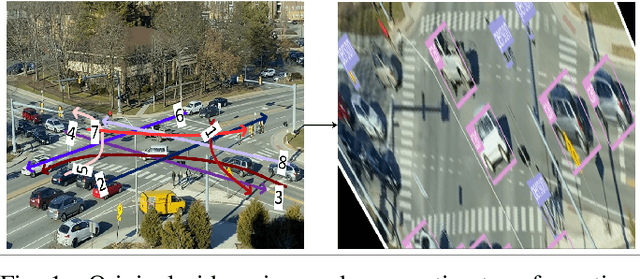
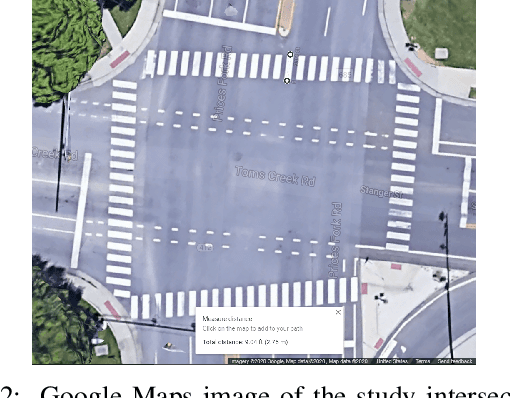
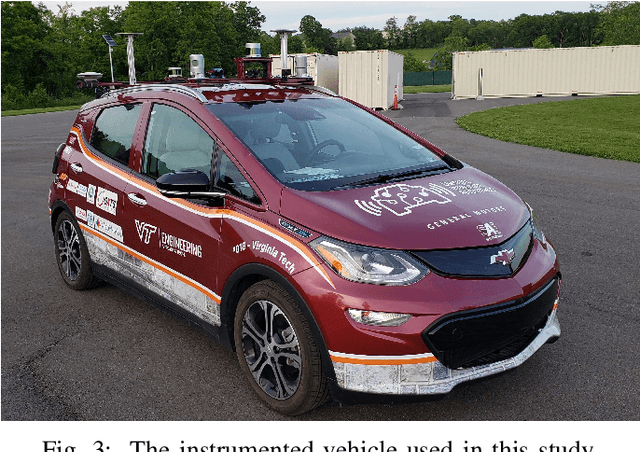
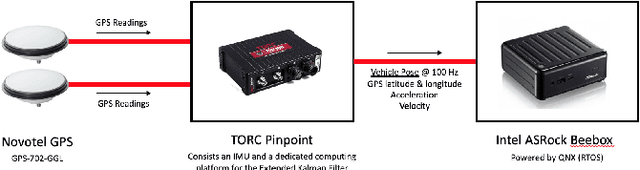
In a previous study, we presented VT-Lane, a three-step framework for real-time vehicle detection, tracking, and turn movement classification at urban intersections. In this study, we present a case study incorporating the highly accurate trajectories and movement classification obtained via VT-Lane for the purpose of speed estimation and driver behavior calibration for traffic at urban intersections. First, we use a highly instrumented vehicle to verify the estimated speeds obtained from video inference. The results of the speed validation show that our method can estimate the average travel speed of detected vehicles in real-time with an error of 0.19 m/sec, which is equivalent to 2% of the average observed travel speeds in the intersection of the study. Instantaneous speeds (at the resolution of 30 Hz) were found to be estimated with an average error of 0.21 m/sec and 0.86 m/sec respectively for free-flowing and congested traffic conditions. We then use the estimated speeds to calibrate the parameters of a driver behavior model for the vehicles in the area of study. The results show that the calibrated model replicates the driving behavior with an average error of 0.45 m/sec, indicating the high potential for using this framework for automated, large-scale calibration of car-following models from roadside traffic video data, which can lead to substantial improvements in traffic modeling via microscopic simulation.