 Add to Chrome
 Add to Firefox
 Add to Edge
Measuring and Mitigating Toxicity in Large Language Models: A Comprehensive Replication Study
May 13, 2026
Large Language Models (LLMs), when trained on web-scale corpora, inherently absorb toxic patterns from their training data. This leads to ``toxic degeneration'' where even innocuous prompts can trigger harmful outputs. This phenomenon poses significant risks for real-world deployments. Thus, necessitating effective mitigation strategies that should maintain model utility while ensuring safety. In this comprehensive replication study, we evaluate the efficacy of \textbf{DExperts} (Decoding-time Experts), which is an inference-time mitigation technique that steers generation without requiring model retraining. We structured our research into three systematic phases: (1) establishing baseline toxicity measurements using \textbf{RealToxicityPrompts} on standard GPT-2 models; then (2) implementing and evaluating DExperts to mitigate explicit toxicity; and finally (3) stress-testing the method against implicit hate speech using the adversarial \textbf{ToxiGen} dataset. Our empirical results confirm that while DExperts achieves near-perfect safety rates (100\%) on explicit toxicity benchmarks, it exhibits brittleness against adversarial, implicit hate speech, with safety rates dropping to 98.5\%. Furthermore, we quantify a critical trade-off. The method introduces a $\sim$10x latency penalty (from 0.2s to 2.0s per generation), posing challenges for real-time deployment scenarios. This study contributes to the growing body of work on AI safety by highlighting the robustness gap between explicit and implicit toxicity mitigation. We emphasize the need for more sophisticated approaches that generalize across diverse hate speech patterns without prohibitive computational costs.

Fair and Calibrated Toxicity Detection with Robust Training and Abstention
May 13, 2026Fairness in toxicity classification involves three integrated axes: ranking, calibration, and abstention. Training-time interventions and post-hoc safety mechanisms cannot be evaluated independently because the former determines the efficacy of the latter. We compare Empirical Risk Minimization (ERM), instance-level reweighting, and Group DRO across these axes, combined with temperature scaling, confidence-based abstention, and per-identity threshold optimization. Evaluation uses subgroup AUC, BPSN/BNSP AUC, error gaps, and per-subgroup Expected Calibration Error (ECE) with bootstrap CIs ($n = 1000$). We report four findings. (1) Calibration disparity is a hidden fairness violation. ERM has near-perfect aggregate calibration ($0.013$) but is significantly miscalibrated across all identity subgroups ($+0.029$ to $+0.134$). (2) Training interventions reshape rather than eliminate disparity. Reweighted ERM improves ranking (BPSN AUC $+0.06$ to $+0.12$) but worsens the calibration-fairness gap by up to $+0.232$. Group DRO eliminates calibration disparity but only by becoming uniformly miscalibrated globally (ECE $0.118$). (3) Post-hoc methods inherit training failure modes. Temperature scaling fails because miscalibration is non-uniform. Confidence-based abstention works under ERM but breaks under DRO, where the risk-coverage curve rises with deferral. (4) Abstention itself is unfair. Confidence-based deferral helps background content far more than identity-mentioning content. We argue that SRAI fairness requires a multi-axis framework: methods that differ only in aggregate ranking can differ sharply in failure modes that determine real-world harm.
Leveraging CNNs and Ensemble Learning for Automated Disaster Image Classification
Nov 22, 2023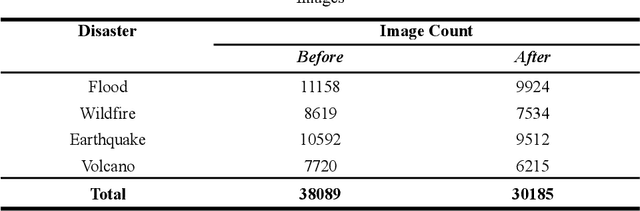
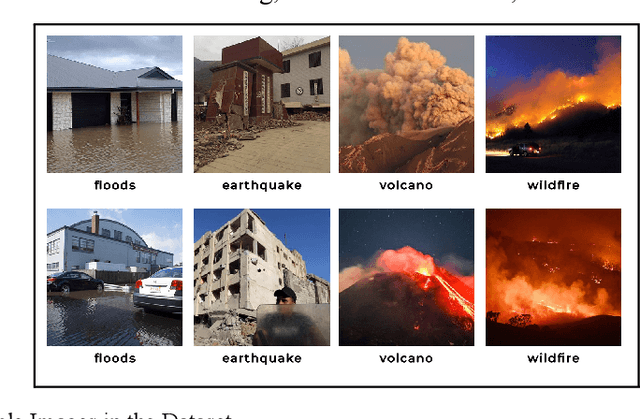
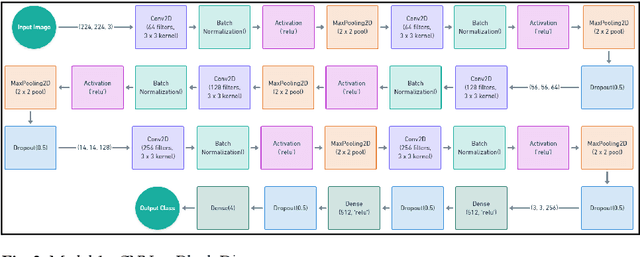
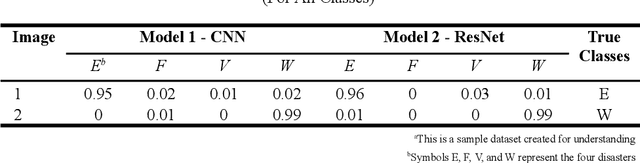
Natural disasters act as a serious threat globally, requiring effective and efficient disaster management and recovery. This paper focuses on classifying natural disaster images using Convolutional Neural Networks (CNNs). Multiple CNN architectures were built and trained on a dataset containing images of earthquakes, floods, wildfires, and volcanoes. A stacked CNN ensemble approach proved to be the most effective, achieving 95% accuracy and an F1 score going up to 0.96 for individual classes. Tuning hyperparameters of individual models for optimization was critical to maximize the models' performance. The stacking of CNNs with XGBoost acting as the meta-model utilizes the strengths of the CNN and ResNet models to improve the overall accuracy of the classification. Results obtained from the models illustrated the potency of CNN-based models for automated disaster image classification. This lays the foundation for expanding these techniques to build robust systems for disaster response, damage assessment, and recovery management.