 Add to Chrome
 Add to Firefox
 Add to Edge
PolypVision: A Three-Stage Hierarchical Deep Learning Framework for Classification and Segmentation of Colorectal Polyps
Aug 11, 2026
Colorectal cancer (CRC) remains one of the leading causes of cancer-related mortality worldwide, predominantly arising from precancerous polyps. Accurate detection, segmentation, and endoscopic and histological classification of colorectal polyps are crucial for timely clinical intervention. In this study, we present PolypVision, a three-stage hierarchical deep learning framework that sequentially performs: (Stage 1) binary classification of polyps as adenomatous or hyperplastic, with simultaneous Paris and JNet classification, using EfficientNetV2-M with Focal Loss; (Stage 2) polyp segmentation with recommended resection method using a UNet++ decoder with the Stage 1 backbone as encoder, optimized with Dice and BCE losses; and (Stage 3) adenoma subtype classification (tubular, tubulovillous, villous) using EfficientNetV2-M with transfer learning from Stage 2. Evaluated on three public datasets -- PolypGen, Kvasir-SEG, and CVC-ClinicDB -- PolypVision achieves an AUC of approximately 0.99 for frame classification and a detection mAP@50 of 94.4% on Kvasir-SEG, outperforming or matching state-of-the-art methods. Gradient-weighted Class Activation Maps (Grad-CAM) confirm that the model attends to clinically relevant lesion features. The framework is device-independent, operating across diverse endoscopic imaging systems without hardware-specific adaptation. These results demonstrate that a hierarchical, transfer-learning-driven pipeline with task-specific loss functions offers a robust, device-independent, and clinically meaningful approach to automated colorectal polyp analysis. PolypVision is freely available as a web application at https://polypvision.com, a DataBioX initiative, with a free usage tier open to all users.

GIM-ENDO: A Multimodal Endoscopic Image and Video Dataset for Gastric Intestinal Metaplasia Morphology and Pathology
Jun 18, 2026Gastric intestinal metaplasia (GIM) is a precursor lesion to gastric dysplasia and adenocarcinoma whose early detection is crucial for intervening in the carcinogenesis cascade. Artificial intelligence (AI) holds considerable promise for real-time endoscopic detection and characterization of GIM. However, development of reliable AI models has been constrained by the absence of publicly available, histopathologically validated datasets that combine detailed endoscopic annotations, histological subtype (complete and incomplete), standardized grading systems, and normal mucosal patterns. GIM-ENDO was designed to fill this gap. The dataset comprises demographic data, endoscopic findings, histopathological results, and H. pylori status acquired using the Olympus EVIS X1 system with white-light endoscopy (WLE) and image-enhanced endoscopy (IEE), including narrow-band imaging (NBI) and magnifying NBI (M-NBI), along with images and video clips from 24 patients (22 GIM-positive, 2 normal controls). Annotations cover six primary IEE endoscopic signs -- light blue crest (LBC), marginal turbid band (MTB), white opaque substance (WOS), TV pattern (Fusion), atrophy, and map-like erythema (MLE) -- plus two additional endoscopic findings (AHP and GA) recorded where present. GIM subtypes (complete and incomplete) are annotated for all GIM-positive cases; OLGA and OLGIM staging are provided where complete histological sampling was available. The dataset is publicly accessible at https://doi.org/10.5281/zenodo.20707267. For the latest updates and further information regarding this dataset, readers are referred to the DataBioX website: https://databiox.com A short version of this work has been submitted to MICCAI 2026 Open Data Track.
ERCPMP: An Endoscopic Image and Video Dataset for Colorectal Polyps Morphology and Pathology
Jul 28, 2023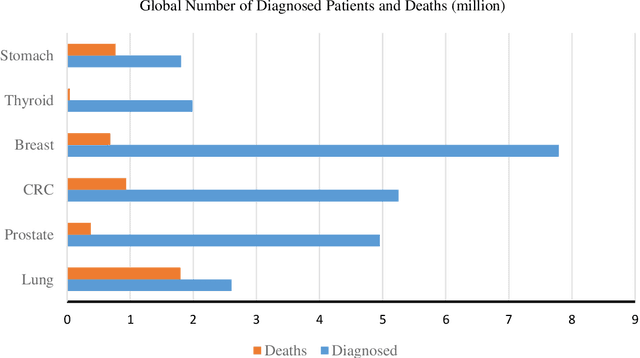
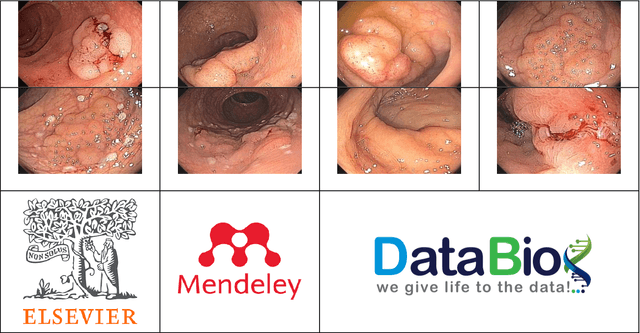
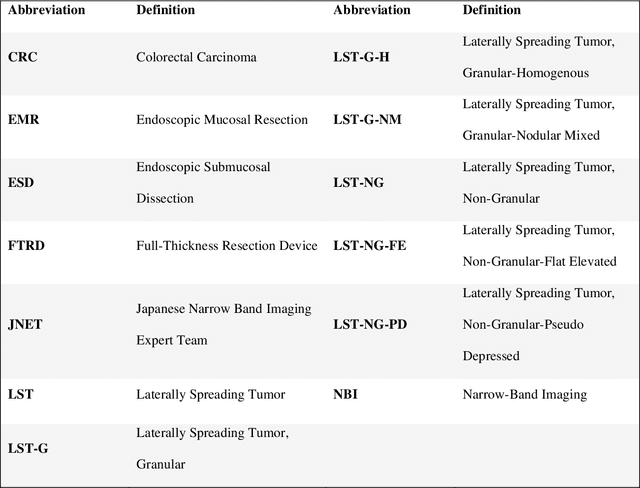
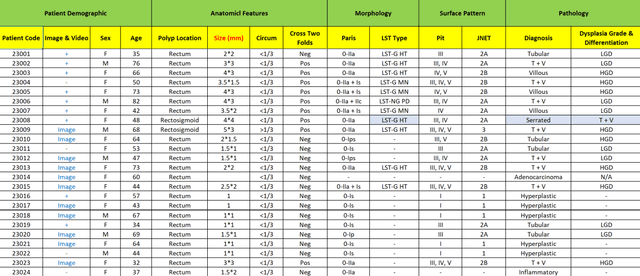
In the recent years, artificial intelligence (AI) and its leading subtypes, machine learning (ML) and deep learning (DL) and their applications are spreading very fast in various aspects such as medicine. Today the most important challenge of developing accurate algorithms for medical prediction, detection, diagnosis, treatment and prognosis is data. ERCPMP is an Endoscopic Image and Video Dataset for Recognition of Colorectal Polyps Morphology and Pathology. This dataset contains demographic, morphological and pathological data, endoscopic images and videos of 191 patients with colorectal polyps. Morphological data is included based on the latest international gastroenterology classification references such as Paris, Pit and JNET classification. Pathological data includes the diagnosis of the polyps including Tubular, Villous, Tubulovillous, Hyperplastic, Serrated, Inflammatory and Adenocarcinoma with Dysplasia Grade & Differentiation. The current version of this dataset is published and available on Elsevier Mendeley Dataverse and since it is under development, the latest version is accessible via: https://databiox.com.