 Add to Chrome
 Add to Firefox
 Add to Edge
Co-Existence of Private 5G Network and Wireless Hospital Systems
Dec 24, 2025
This paper investigates the feasibility of deploying private 5G networks in hospital environments, with a focus on the operating room at the brand new Oulu University Hospital, Finland. The study aims to evaluate the interference risk with other wireless systems, and electromagnetic safety of a private 5G network in the 3.9-4.1 GHz band, while ensuring compatibility with legacy wireless systems, such as LTE and Wi-Fi. We conducted a measurement campaign, employing state-of-the-art instrumentation and a methodology that combined high resolution and long-duration spectrum scans. The results demonstrate no measurable interference between the hospital's private 5G network with adjacent LTE (4G) or Wi-Fi bands, confirming the spectral isolation of the 5G transmissions, and vise versa. Additionally, RF exposure levels in the operating room were found to be well below ICNIRP, WHO, and IEEE safety thresholds, ensuring that the network poses negligible biological risk to patients and hospital staff. The study also proposes spectrum management strategies for private 5G networks in hospitals, focusing on adaptive sensing and guardband planning. These findings provide a solid foundation for the integration of private 5G infrastructure in hospitals environments, supporting digital transformation in patient care without compromising electromagnetic compatibility or patient safety. The results also contribute to ongoing discussions around private 5G network deployments in sensitive sectors and provide actionable guidelines for future hospitals' wireless systems planning.

Analyzing Self-Driving Cars on Twitter
Apr 05, 2018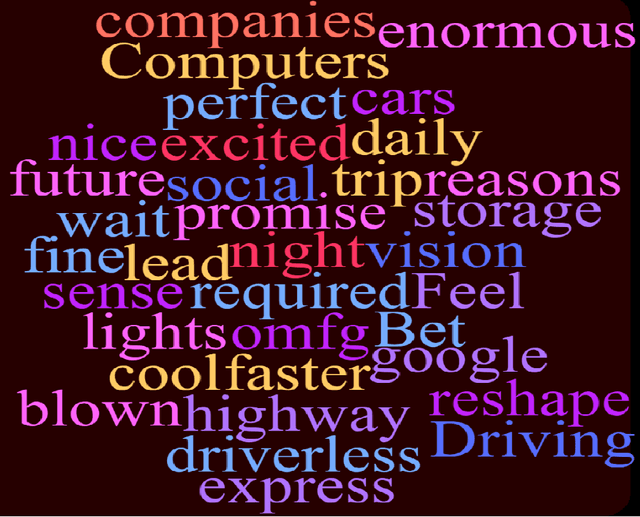
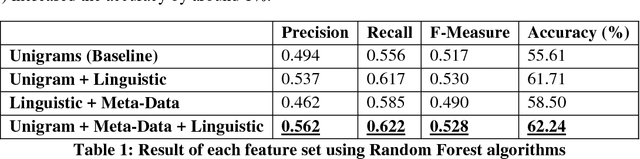
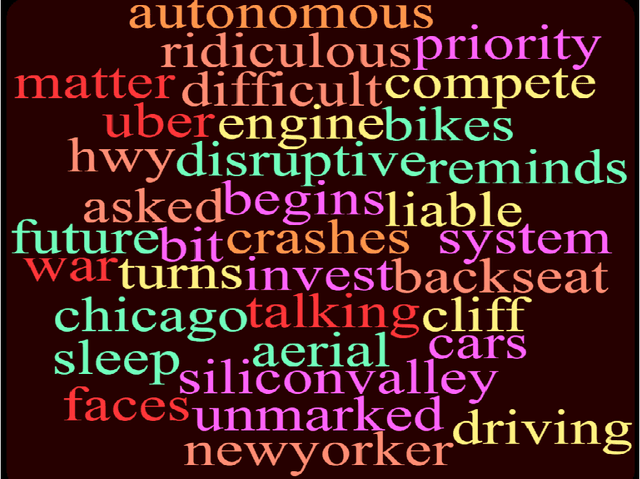
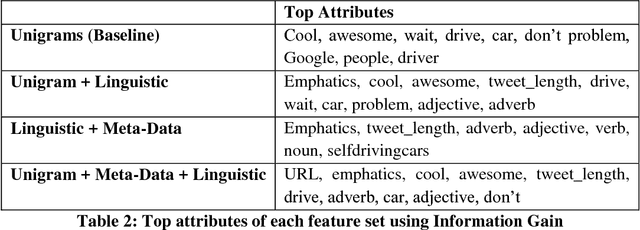
This paper studies users' perception regarding a controversial product, namely self-driving (autonomous) cars. To find people's opinion regarding this new technology, we used an annotated Twitter dataset, and extracted the topics in positive and negative tweets using an unsupervised, probabilistic model known as topic modeling. We later used the topics, as well as linguist and Twitter specific features to classify the sentiment of the tweets. Regarding the opinions, the result of our analysis shows that people are optimistic and excited about the future technology, but at the same time they find it dangerous and not reliable. For the classification task, we found Twitter specific features, such as hashtags as well as linguistic features such as emphatic words among top attributes in classifying the sentiment of the tweets.