 Add to Chrome
 Add to Firefox
 Add to Edge
A Few Teacher Steps Go a Long Way: Cost-Efficient On-Policy Data Augmentation for Agent Post-Training
Jul 06, 2026
For LLM agents, supervised fine-tuning is not only about teacher labels' quality, but also about which interaction contexts those labels condition on. Pure behavioral cloning uses full teacher demonstrations, creating a mismatch between teacher-induced contexts seen in training and student-induced contexts encountered at test time. Recent work addresses this mismatch by querying a teacher at contexts reached by the student, often with increasingly elaborate filtering of the teacher's continuations. We instead frame on-policy data construction as a budget-allocation problem: under matched supervision resources, should teacher output be spent on more start-to-finish demos, longer continuations, outcome filtering, or broader coverage of learner-induced contexts? We formalize this design space through the rollout policy, switch-time distribution, continuation horizon, filtering rules, and two complementary costs: teacher inference generated before filtering and teacher supervision retained for SFT. Across HotpotQA, ALFWorld, and Terminal-Bench-Dev, bounded unfiltered teacher continuations at learner-induced contexts improve over pure behavioral cloning at matched budgets. On HotpotQA and ALFWorld, where we run the full comparison, few-step continuations match or exceed success-filtered and critical-context-filtered alternatives. Our findings suggest that a few teacher steps, placed at learner-induced contexts, can be a more cost-efficient supervision allocation than longer or more heavily curated teacher completions.

Annealed Softmax Greedy in Many-Armed Bayesian Bandits
May 29, 2026Reinforcement learning with verifiable rewards (RLVR) and group-based policy optimization methods such as GRPO update a stochastic policy by sampling multiple completions per prompt and increasing the policy's probability on those with higher reward, regularized by a KL penalty toward a reference policy. These updates do not include explicit mechanisms that track epistemic uncertainty. This paper studies a stylized explanation for why such uncertainty-agnostic updates can nevertheless be effective. We analyze an annealed softmax (Boltzmann) policy that selects actions according to a softmax of empirical mean rewards in a many-armed Bayesian Bernoulli bandit. Under a linear upper-tail condition on the prior (the $β=1$ case of $β$-regularity), which implies an abundance of near-optimal arms, we prove that annealed softmax greedy achieves Bayes regret $\tilde{O}(m + T/m)$, and in particular $\tilde{O}(\sqrt{T})$ when the number of arms scales as $m = Θ(\sqrt{T})$. This is the near-optimal Bayes regret rate in this regime, attained also by empirical-mean greedy. Under $β$-regularity, many arms maintain empirical means close to the optimum throughout learning, so when softmax samples an arm other than the empirically best, that arm tends to be another near-optimal one rather than a clearly inferior one. By contrast, with a small number of arms, the same kind of softmax policy can suffer linear regret. The result also provides a structural analogy to RLVR, where a base policy with a non-negligible probability of producing a correct completion plays the role of $β$-regularity.
Calibrating Conservatism for Scalable Oversight
May 27, 2026Agentic AI systems capable of autonomous planning and extended environmental interaction pose a fundamental control problem: how can humans maintain meaningful oversight of systems that may exceed their own capabilities? Existing approaches to scalable oversight rely on complex assumptions, remain largely heuristic, or lack practical methods for sequential settings with statistical guarantees. We introduce Calibrated Collective Oversight (CCO), which aggregates diverse auxiliary scoring functions into a penalty measuring deviation from a conservative baseline. Inspired by Attainable Utility Preservation, CCO enables collective conservatism: actions face a penalty proportional to overseer concern, so high-utility actions are still selected when overseers find them unobjectionable and overridden only when concern accumulates. CCO calibrates this conservatism online using Conformal Decision Theory, ensuring that undesirable outcomes remain below a user-specified target threshold with finite-time bounds and no distributional assumptions. On a modified version of SWE-bench, weaker overseers successfully constrain an adversarially misaligned stronger agent; on MACHIAVELLI, CCO substantially reduces ethical violations while preserving reward. In both settings, empirical violation rates closely match the specified targets, as predicted by the theory.
Text-to-Distribution Prediction with Quantile Tokens and Neighbor Context
Apr 22, 2026Many applications of LLM-based text regression require predicting a full conditional distribution rather than a single point value. We study distributional regression under empirical-quantile supervision, where each input is paired with multiple observed quantile outcomes, and the target distribution is represented by a dense grid of quantiles. We address two key limitations of current approaches: the lack of local grounding for distribution estimates, and the reliance on shared representations that create an indirect bottleneck between inputs and quantile outputs. In this paper, we introduce Quantile Token Regression, which, to our knowledge, is the first work to insert dedicated quantile tokens into the input sequence, enabling direct input-output pathways for each quantile through self-attention. We further augment these quantile tokens with retrieval, incorporating semantically similar neighbor instances and their empirical distributions to ground predictions with local evidence from similar instances. We also provide the first theoretical analysis of loss functions for quantile regression, clarifying which distributional objectives each optimizes. Experiments on the Inside Airbnb and StackSample benchmark datasets with LLMs ranging from 1.7B to 14B parameters show that quantile tokens with neighbors consistently outperform baselines (~4 points lower MAPE and 2x narrower prediction intervals), with especially large gains on smaller and more challenging datasets where quantile tokens produce substantially sharper and more accurate distributions.
Causal Effects with Unobserved Unit Types in Interacting Human-AI Systems
Mar 02, 2026We study experiments on interacting populations of humans and AI agents, where both unit types and the interaction network remain unobserved. Although causal effects propagate throughout the system, the goal is to estimate effects on humans. Examples include online platforms where human users interact alongside AI-driven accounts. We assume a human-AI prior that gives each unit a probability of being human. While humans cannot be distinguished at the unit level, the prior allows us to compute the average human composition within large subpopulations. We then model outcome dynamics through a causal message passing (CMP) framework and analyze sample-mean outcomes across subpopulations. We show that by constructing subpopulations that vary in expected human composition and treatment exposure, one can consistently recover human-specific causal effects. Our results characterize when distributional knowledge of population composition (without observing unit types or the interaction network) is sufficient for identification. We validate the approach on a simulated human-AI platform driven by behaviorally differentiated LLM agents. Together, these results provide a theoretical and practical framework for experimentation in emerging human-AI systems.
Scalably Enhancing the Clinical Validity of a Task Benchmark with Physician Oversight
Dec 22, 2025Automating the calculation of clinical risk scores offers a significant opportunity to reduce physician administrative burden and enhance patient care. The current standard for evaluating this capability is MedCalc-Bench, a large-scale dataset constructed using LLM-based feature extraction and rule-based aggregation. However, treating such model-generated benchmarks as static oracles risks enshrining historical model errors as evaluation gold standards, a problem dangerously amplified when these datasets serve as reward signals for Reinforcement Learning (RL). In this work, we propose viewing benchmarks for complex tasks such as clinical score computation as ''in-progress living documents'' that should be periodically re-evaluated as the processes for creating them improve. We introduce a systematic, physician-in-the-loop pipeline that leverages advanced agentic verifiers to audit and relabel MedCalc-Bench, utilizing automated triage to reserve scarce clinician attention for the most contentious instances. Our audit reveals that a notable fraction of original labels diverge from medical ground truth due to extraction errors, calculator logic mismatches, and clinical ambiguity. To study whether this label noise meaningfully impacts downstream RL training, we fine-tune a Qwen3-8B model via Group Relative Policy Optimization (GRPO) and demonstrate that training on corrected labels yields an 8.7% absolute improvement in accuracy over the original baseline -- validating that label noise materially affects model evaluation. These findings underscore that in safety-critical domains, rigorous benchmark maintenance is a prerequisite for genuine model alignment.
Estimating Total Effects in Bipartite Experiments with Spillovers and Partial Eligibility
Nov 14, 2025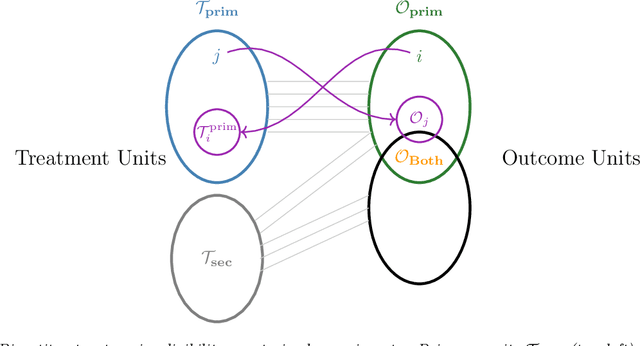
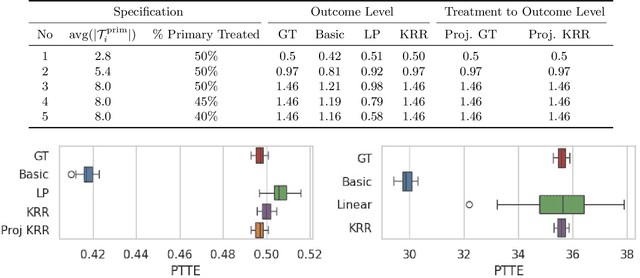
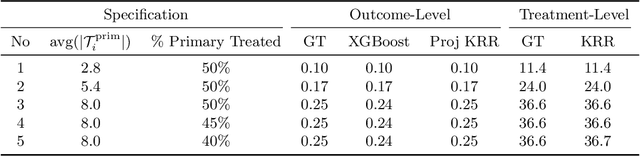
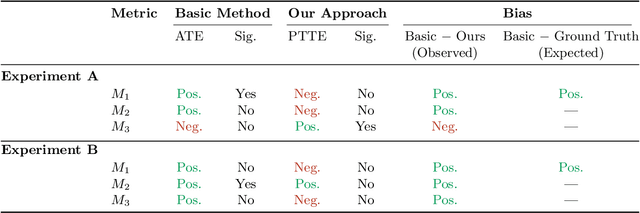
We study randomized experiments in bipartite systems where only a subset of treatment-side units are eligible for assignment while all units continue to interact, generating interference. We formalize eligibility-constrained bipartite experiments and define estimands aligned with full deployment: the Primary Total Treatment Effect (PTTE) on eligible units and the Secondary Total Treatment Effect (STTE) on ineligible units. Under randomization within the eligible set, we give identification conditions and develop interference-aware ensemble estimators that combine exposure mappings, generalized propensity scores, and flexible machine learning. We further introduce a projection that links treatment- and outcome-level estimands; this mapping is exact under a Linear Additive Edges condition and enables estimation on the (typically much smaller) treatment side with deterministic aggregation to outcomes. In simulations with known ground truth across realistic exposure regimes, the proposed estimators recover PTTE and STTE with low bias and variance and reduce the bias that could arise when interference is ignored. Two field experiments illustrate practical relevance: our method corrects the direction of expected interference bias for a pre-specified metric in both studies and reverses the sign and significance of the primary decision metric in one case.
The Oversight Game: Learning to Cooperatively Balance an AI Agent's Safety and Autonomy
Oct 30, 2025As increasingly capable agents are deployed, a central safety question is how to retain meaningful human control without modifying the underlying system. We study a minimal control interface where an agent chooses whether to act autonomously (play) or defer (ask), while a human simultaneously chooses whether to be permissive (trust) or to engage in oversight (oversee). If the agent defers, the human's choice determines the outcome, potentially leading to a corrective action or a system shutdown. We model this interaction as a two-player Markov Game. Our analysis focuses on cases where this game qualifies as a Markov Potential Game (MPG), a class of games where we can provide an alignment guarantee: under a structural assumption on the human's value function, any decision by the agent to act more autonomously that benefits itself cannot harm the human's value. We also analyze extensions to this MPG framework. Theoretically, this perspective provides conditions for a specific form of intrinsic alignment. If the reward structures of the human-agent game meet these conditions, we have a formal guarantee that the agent improving its own outcome will not harm the human's. Practically, this model motivates a transparent control layer with predictable incentives where the agent learns to defer when risky and act when safe, while its pretrained policy and the environment's reward structure remain untouched. Our gridworld simulation shows that through independent learning, the agent and human discover their optimal oversight roles. The agent learns to ask when uncertain and the human learns when to oversee, leading to an emergent collaboration that avoids safety violations introduced post-training. This demonstrates a practical method for making misaligned models safer after deployment.
Simulating and Experimenting with Social Media Mobilization Using LLM Agents
Oct 30, 2025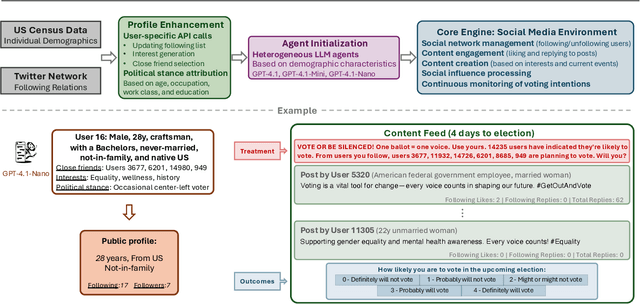
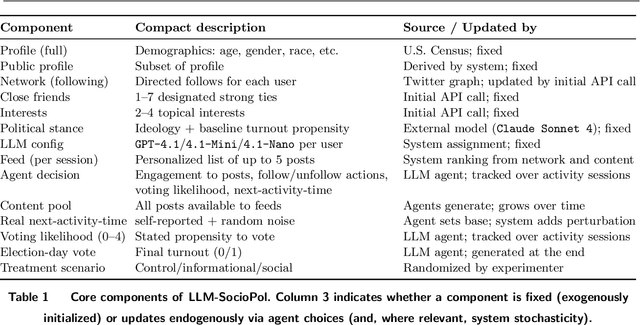

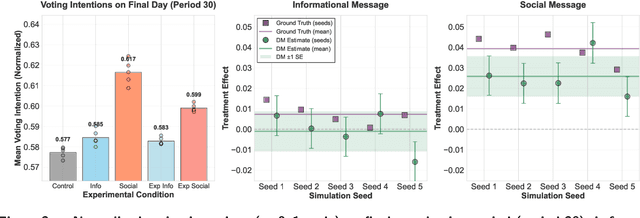
Online social networks have transformed the ways in which political mobilization messages are disseminated, raising new questions about how peer influence operates at scale. Building on the landmark 61-million-person Facebook experiment \citep{bond201261}, we develop an agent-based simulation framework that integrates real U.S. Census demographic distributions, authentic Twitter network topology, and heterogeneous large language model (LLM) agents to examine the effect of mobilization messages on voter turnout. Each simulated agent is assigned demographic attributes, a personal political stance, and an LLM variant (\texttt{GPT-4.1}, \texttt{GPT-4.1-Mini}, or \texttt{GPT-4.1-Nano}) reflecting its political sophistication. Agents interact over realistic social network structures, receiving personalized feeds and dynamically updating their engagement behaviors and voting intentions. Experimental conditions replicate the informational and social mobilization treatments of the original Facebook study. Across scenarios, the simulator reproduces qualitative patterns observed in field experiments, including stronger mobilization effects under social message treatments and measurable peer spillovers. Our framework provides a controlled, reproducible environment for testing counterfactual designs and sensitivity analyses in political mobilization research, offering a bridge between high-validity field experiments and flexible computational modeling.\footnote{Code and data available at https://github.com/CausalMP/LLM-SocioPol}
On Aligning Prediction Models with Clinical Experiential Learning: A Prostate Cancer Case Study
Sep 04, 2025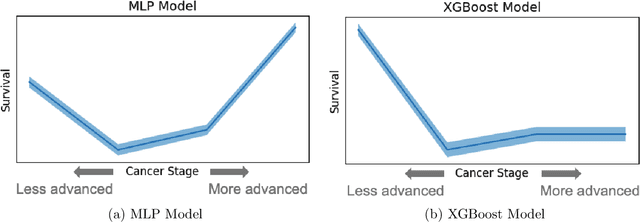
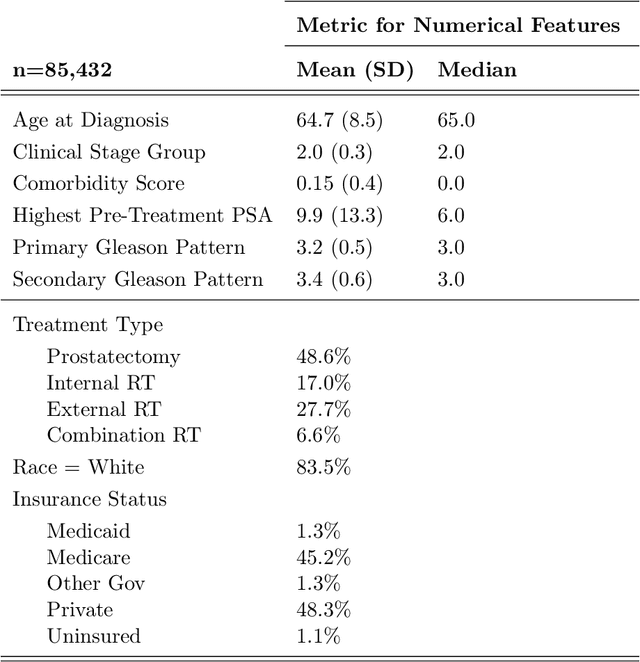
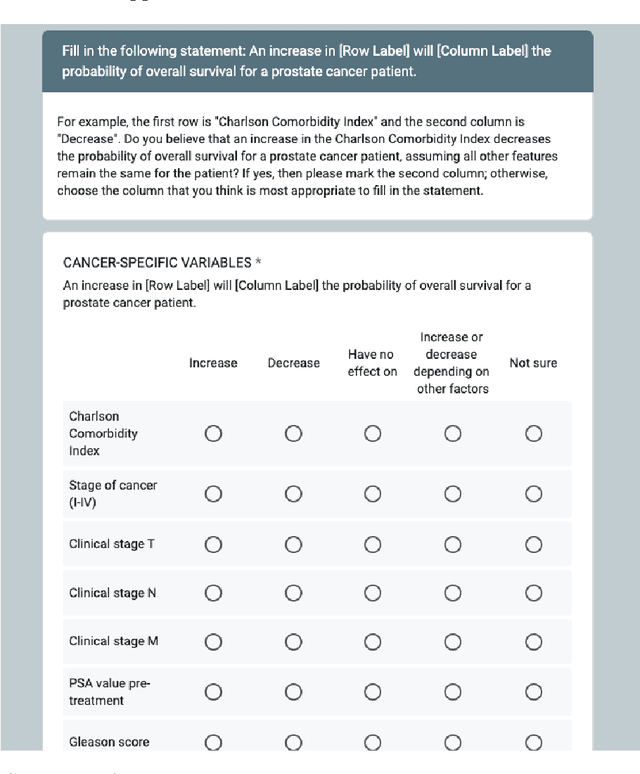
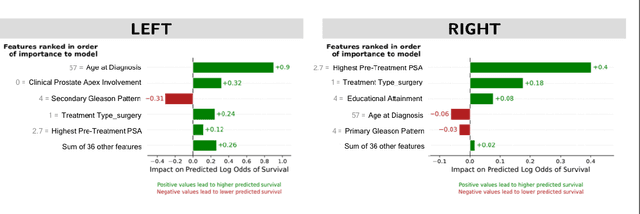
Over the past decade, the use of machine learning (ML) models in healthcare applications has rapidly increased. Despite high performance, modern ML models do not always capture patterns the end user requires. For example, a model may predict a non-monotonically decreasing relationship between cancer stage and survival, keeping all other features fixed. In this paper, we present a reproducible framework for investigating this misalignment between model behavior and clinical experiential learning, focusing on the effects of underspecification of modern ML pipelines. In a prostate cancer outcome prediction case study, we first identify and address these inconsistencies by incorporating clinical knowledge, collected by a survey, via constraints into the ML model, and subsequently analyze the impact on model performance and behavior across degrees of underspecification. The approach shows that aligning the ML model with clinical experiential learning is possible without compromising performance. Motivated by recent literature in generative AI, we further examine the feasibility of a feedback-driven alignment approach in non-generative AI clinical risk prediction models through a randomized experiment with clinicians. Our findings illustrate that, by eliciting clinicians' model preferences using our proposed methodology, the larger the difference in how the constrained and unconstrained models make predictions for a patient, the more apparent the difference is in clinical interpretation.