 Add to Chrome
 Add to Firefox
 Add to Edge
Training Beyond Convergence: Grokking nnU-Net for Glioma Segmentation in Sub-Saharan MRI
Jan 30, 2026
Gliomas are placing an increasingly clinical burden on Sub-Saharan Africa (SSA). In the region, the median survival for patients remains under two years, and access to diagnostic imaging is extremely limited. These constraints highlight an urgent need for automated tools that can extract the maximum possible information from each available scan, tools that are specifically trained on local data, rather than adapted from high-income settings where conditions are vastly different. We utilize the Brain Tumor Segmentation (BraTS) Africa 2025 Challenge dataset, an expert annotated collection of glioma MRIs. Our objectives are: (i) establish a strong baseline with nnUNet on this dataset, and (ii) explore whether the celebrated "grokking" phenomenon an abrupt, late training jump from memorization to superior generalization can be triggered to push performance without extra labels. We evaluate two training regimes. The first is a fast, budget-conscious approach that limits optimization to just a few epochs, reflecting the constrained GPU resources typically available in African institutions. Despite this limitation, nnUNet achieves strong Dice scores: 92.3% for whole tumor (WH), 86.6% for tumor core (TC), and 86.3% for enhancing tumor (ET). The second regime extends training well beyond the point of convergence, aiming to trigger a grokking-driven performance leap. With this approach, we were able to achieve grokking and enhanced our results to higher Dice scores: 92.2% for whole tumor (WH), 90.1% for tumor core (TC), and 90.2% for enhancing tumor (ET).

Towards SAMBA: Segment Anything Model for Brain Tumor Segmentation in Sub-Sharan African Populations
Dec 19, 2023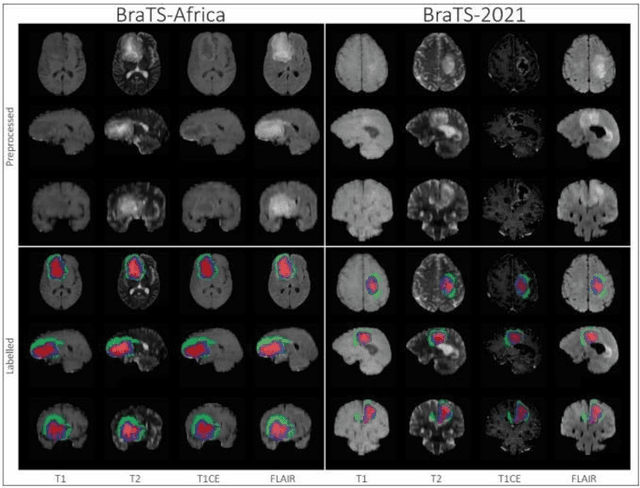
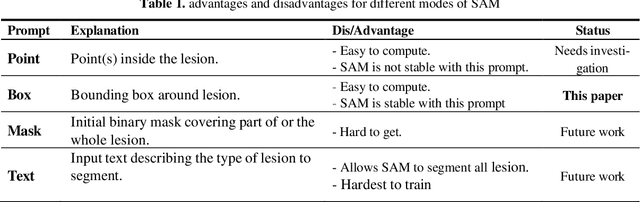

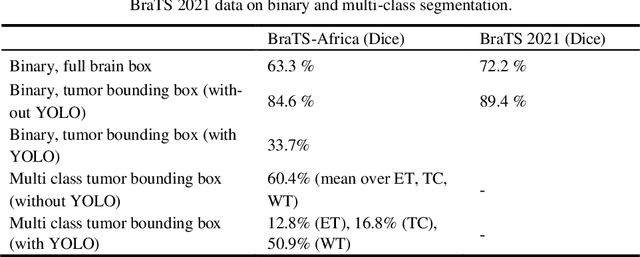
Gliomas, the most prevalent primary brain tumors, require precise segmentation for diagnosis and treatment planning. However, this task poses significant challenges, particularly in the African population, were limited access to high-quality imaging data hampers algorithm performance. In this study, we propose an innovative approach combining the Segment Anything Model (SAM) and a voting network for multi-modal glioma segmentation. By fine-tuning SAM with bounding box-guided prompts (SAMBA), we adapt the model to the complexities of African datasets. Our ensemble strategy, utilizing multiple modalities and views, produces a robust consensus segmentation, addressing intra-tumoral heterogeneity. Although the low quality of scans presents difficulties, our methodology has the potential to profoundly impact clinical practice in resource-limited settings such as Africa, improving treatment decisions and advancing neuro-oncology research. Furthermore, successful application to other brain tumor types and lesions in the future holds promise for a broader transformation in neurological imaging, improving healthcare outcomes across all settings. This study was conducted on the Brain Tumor Segmentation (BraTS) Challenge Africa (BraTS-Africa) dataset, which provides a valuable resource for addressing challenges specific to resource-limited settings, particularly the African population, and facilitating the development of effective and more generalizable segmentation algorithms. To illustrate our approach's potential, our experiments on the BraTS-Africa dataset yielded compelling results, with SAM attaining a Dice coefficient of 86.6 for binary segmentation and 60.4 for multi-class segmentation.