 Add to Chrome
 Add to Firefox
 Add to Edge
B-cos GNNs: Faithful Explanations through Dynamic Linearity
May 19, 2026
We introduce B-cos GNNs, an inherently explainable class of graph neural networks whose predictions decompose exactly into per-node, per-feature contributions via a single input-dependent linear map. B-cos GNNs use linear (sum-based) aggregation and replace non-linear message and update functions with B-cos transforms. This induces meaningful, task-specific weight-input alignment that is directly accessible through the model's dynamic linearity. Instance-level explanations follow from a single forward and backward pass, requiring no auxiliary explainer, modified learning objective, or perturbation procedure. Instantiated as a GIN, our approach trades small losses in predictive accuracy for state-of-the-art explainability across diverse synthetic and real-world benchmarks, producing explanations orders of magnitude faster than post-hoc baselines.

Vocal Breath Sound Based Gender Classification
Nov 11, 2022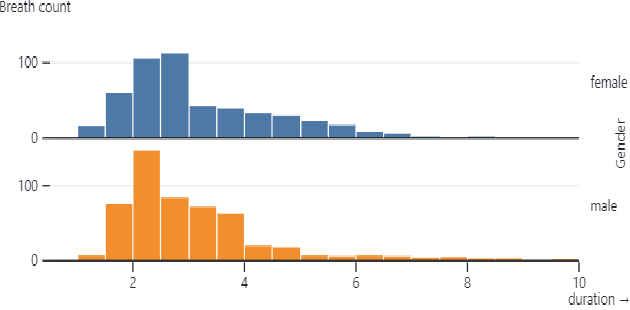
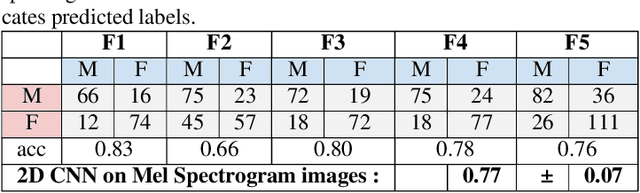
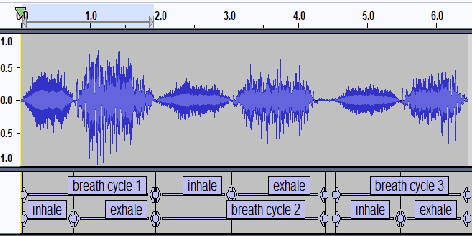
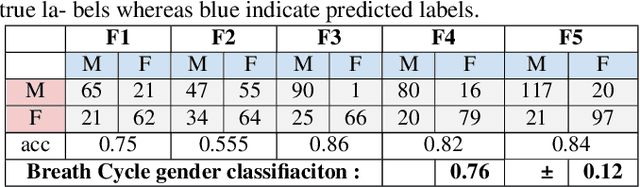
Voiced speech signals such as continuous speech are known to have acoustic features such as pitch(F0), and formant frequencies(F1, F2, F3) which can be used for gender classification. However, gender classification studies using non-speech signals such as vocal breath sounds have not been explored as they lack typical gender-specific acoustic features. In this work, we explore whether vocal breath sounds encode gender information and if so, to what extent it can be used for automatic gender classification. In this study, we explore the use of data-driven and knowledge-based features from vocal breath sounds as well as the classifier complexity for gender classification. We also explore the importance of the location and duration of breath signal segments to be used for automatic classification. Experiments with 54.23 minutes of male and 51.83 minutes of female breath sounds reveal that knowledge-based features, namely MFCC statistics, with low-complexity classifier perform comparably to the data-driven features with classifiers of higher complexity. Breath segments with an average duration of 3 seconds are found to be the best choice irrespective of the location which avoids the need for breath cycle boundary annotation.