 Add to Chrome
 Add to Firefox
 Add to Edge
Verifying rich robustness properties for neural networks
Nov 10, 2025
Robustness is a important problem in AI alignment and safety, with models such as neural networks being increasingly used in safety-critical systems. In the last decade, a large body of work has emerged on local robustness, i.e., checking if the decision of a neural network remains unchanged when the input is slightly perturbed. However, many of these approaches require specialized encoding and often ignore the confidence of a neural network on its output. In this paper, our goal is to build a generalized framework to specify and verify variants of robustness in neural network verification. We propose a specification framework using a simple grammar, which is flexible enough to capture most existing variants. This allows us to introduce new variants of robustness that take into account the confidence of the neural network in its outputs. Next, we develop a novel and powerful unified technique to verify all such variants in a homogeneous way, viz., by adding a few additional layers to the neural network. This enables us to use any state-of-the-art neural network verification tool, without having to tinker with the encoding within, while incurring an approximation error that we show is bounded. We perform an extensive experimental evaluation over a large suite of 8870 benchmarks having 138M parameters in a largest network, and show that we are able to capture a wide set of robustness variants and outperform direct encoding approaches by a significant margin.

Efficiently Finding Adversarial Examples with DNN Preprocessing
Nov 16, 2022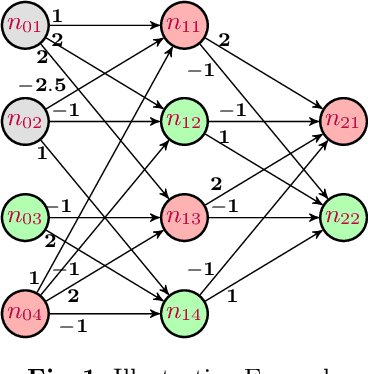
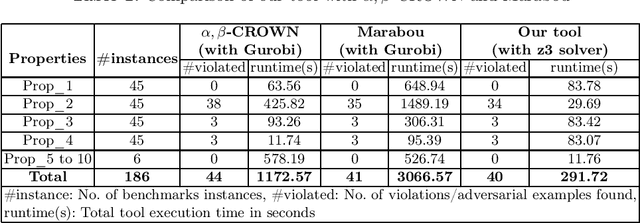
Deep Neural Networks (DNNs) are everywhere, frequently performing a fairly complex task that used to be unimaginable for machines to carry out. In doing so, they do a lot of decision making which, depending on the application, may be disastrous if gone wrong. This necessitates a formal argument that the underlying neural networks satisfy certain desirable properties. Robustness is one such key property for DNNs, particularly if they are being deployed in safety or business critical applications. Informally speaking, a DNN is not robust if very small changes to its input may affect the output in a considerable way (e.g. changes the classification for that input). The task of finding an adversarial example is to demonstrate this lack of robustness, whenever applicable. While this is doable with the help of constrained optimization techniques, scalability becomes a challenge due to large-sized networks. This paper proposes the use of information gathered by preprocessing the DNN to heavily simplify the optimization problem. Our experiments substantiate that this is effective, and does significantly better than the state-of-the-art.