 Add to Chrome
 Add to Firefox
 Add to Edge
Continuous Edit Distance, Geodesics and Barycenters of Time-varying Persistence Diagrams
Dec 15, 2025
We introduce the Continuous Edit Distance (CED), a geodesic and elastic distance for time-varying persistence diagrams (TVPDs). The CED extends edit-distance ideas to TVPDs by combining local substitution costs with penalized deletions/insertions, controlled by two parameters: \(α\) (trade-off between temporal misalignment and diagram discrepancy) and \(β\) (gap penalty). We also provide an explicit construction of CED-geodesics. Building on these ingredients, we present two practical barycenter solvers, one stochastic and one greedy, that monotonically decrease the CED Frechet energy. Empirically, the CED is robust to additive perturbations (both temporal and spatial), recovers temporal shifts, and supports temporal pattern search. On real-life datasets, the CED achieves clustering performance comparable or better than standard elastic dissimilarities, while our clustering based on CED-barycenters yields superior classification results. Overall, the CED equips TVPD analysis with a principled distance, interpretable geodesics, and practical barycenters, enabling alignment, comparison, averaging, and clustering directly in the space of TVPDs. A C++ implementation is provided for reproducibility at the following address https://github.com/sebastien-tchitchek/ContinuousEditDistance.

Topology Aware Neural Interpolation of Scalar Fields
Aug 25, 2025This paper presents a neural scheme for the topology-aware interpolation of time-varying scalar fields. Given a time-varying sequence of persistence diagrams, along with a sparse temporal sampling of the corresponding scalar fields, denoted as keyframes, our interpolation approach aims at "inverting" the non-keyframe diagrams to produce plausible estimations of the corresponding, missing data. For this, we rely on a neural architecture which learns the relation from a time value to the corresponding scalar field, based on the keyframe examples, and reliably extends this relation to the non-keyframe time steps. We show how augmenting this architecture with specific topological losses exploiting the input diagrams both improves the geometrical and topological reconstruction of the non-keyframe time steps. At query time, given an input time value for which an interpolation is desired, our approach instantaneously produces an output, via a single propagation of the time input through the network. Experiments interpolating 2D and 3D time-varying datasets show our approach superiority, both in terms of data and topological fitting, with regard to reference interpolation schemes.
A Practical Solver for Scalar Data Topological Simplification
Jul 17, 2024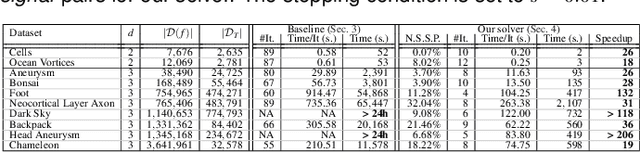
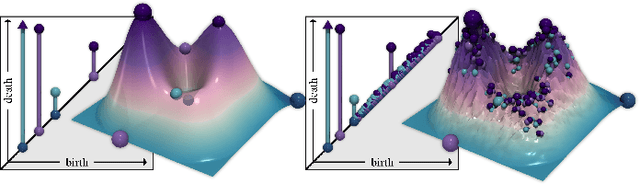
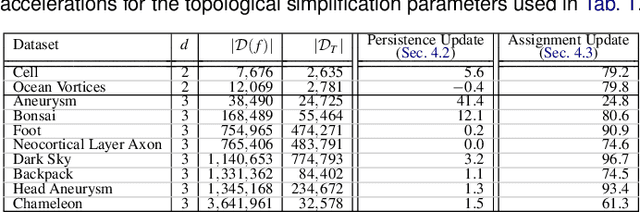
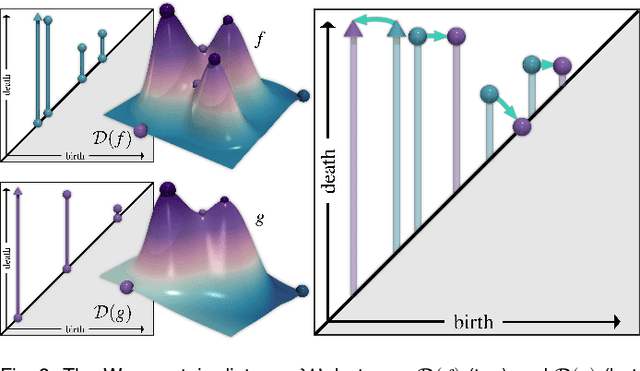
This paper presents a practical approach for the optimization of topological simplification, a central pre-processing step for the analysis and visualization of scalar data. Given an input scalar field f and a set of "signal" persistence pairs to maintain, our approach produces an output field g that is close to f and which optimizes (i) the cancellation of "non-signal" pairs, while (ii) preserving the "signal" pairs. In contrast to pre-existing simplification algorithms, our approach is not restricted to persistence pairs involving extrema and can thus address a larger class of topological features, in particular saddle pairs in three-dimensional scalar data. Our approach leverages recent generic persistence optimization frameworks and extends them with tailored accelerations specific to the problem of topological simplification. Extensive experiments report substantial accelerations over these frameworks, thereby making topological simplification optimization practical for real-life datasets. Our approach enables a direct visualization and analysis of the topologically simplified data, e.g., via isosurfaces of simplified topology (fewer components and handles). We apply our approach to the extraction of prominent filament structures in three-dimensional data. Specifically, we show that our pre-simplification of the data leads to practical improvements over standard topological techniques for removing filament loops. We also show how our approach can be used to repair genus defects in surface processing. Finally, we provide a C++ implementation for reproducibility purposes.