 Add to Chrome
 Add to Firefox
 Add to Edge
Trust-Aware Multi-Agent Traceability: Confidence-Calibrated Knowledge Graphs for Consistent Software Artifact Management
Jun 15, 2026
Multi-agent AI systems are increasingly used to automate software engineering tasks including requirements analysis, architecture design, test generation, and traceability linking. When these agents operate as a sequential pipeline over shared software artifacts, errors and low-confidence decisions made by upstream agents propagate to downstream stages, producing orphaned requirements, contradictory links, and compliance gaps that pose significant risks in safety-critical domains. We propose a trust-aware coordination framework where a shared knowledge graph serves as both centralized semantic memory and a coordination surface through which agents assess and build upon each other's contributions using calibrated confidence scores. Our approach introduces a two-stage traceability link prediction pipeline combining embedding-based retrieval with LLM-based multi-criteria analysis, a traceability seeding mechanism that enables comparison between derivation-time and validation-time confidence, and a consistency protocol governing pipeline interactions through confidence threshold gating, confidence divergence detection, and conflict resolution. We evaluate on an automotive software engineering case study measuring link prediction calibration, protocol effectiveness, threshold sensitivity, and the impact of traceability seeding. Ablation studies confirm that confidence calibration is essential for effective pipeline coordination.

Detection of road traffic crashes based on collision estimation
Jul 26, 2022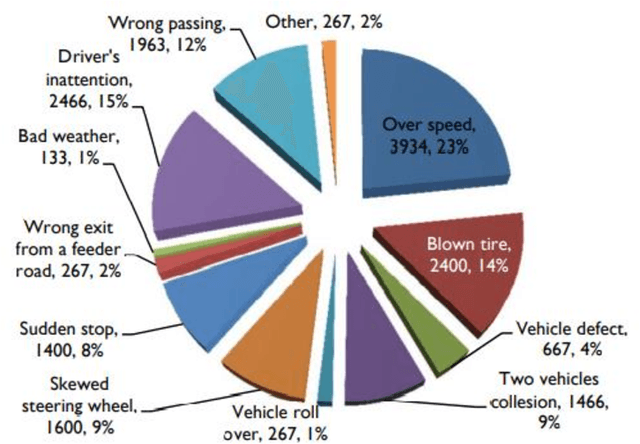



This paper introduces a framework based on computer vision that can detect road traffic crashes (RCTs) by using the installed surveillance/CCTV camera and report them to the emergency in real-time with the exact location and time of occurrence of the accident. The framework is built of five modules. We start with the detection of vehicles by using YOLO architecture; The second module is the tracking of vehicles using MOSSE tracker, Then the third module is a new approach to detect accidents based on collision estimation. Then the fourth module for each vehicle, we detect if there is a car accident or not based on the violent flow descriptor (ViF) followed by an SVM classifier for crash prediction. Finally, in the last stage, if there is a car accident, the system will send a notification to the emergency by using a GPS module that provides us with the location, time, and date of the accident to be sent to the emergency with the help of the GSM module. The main objective is to achieve higher accuracy with fewer false alarms and to implement a simple system based on pipelining technique.
* 11 pages , 9 figures