 Add to Chrome
 Add to Firefox
 Add to Edge
Trust-Aware Multi-Agent Traceability: Confidence-Calibrated Knowledge Graphs for Consistent Software Artifact Management
Jun 15, 2026
Multi-agent AI systems are increasingly used to automate software engineering tasks including requirements analysis, architecture design, test generation, and traceability linking. When these agents operate as a sequential pipeline over shared software artifacts, errors and low-confidence decisions made by upstream agents propagate to downstream stages, producing orphaned requirements, contradictory links, and compliance gaps that pose significant risks in safety-critical domains. We propose a trust-aware coordination framework where a shared knowledge graph serves as both centralized semantic memory and a coordination surface through which agents assess and build upon each other's contributions using calibrated confidence scores. Our approach introduces a two-stage traceability link prediction pipeline combining embedding-based retrieval with LLM-based multi-criteria analysis, a traceability seeding mechanism that enables comparison between derivation-time and validation-time confidence, and a consistency protocol governing pipeline interactions through confidence threshold gating, confidence divergence detection, and conflict resolution. We evaluate on an automotive software engineering case study measuring link prediction calibration, protocol effectiveness, threshold sensitivity, and the impact of traceability seeding. Ablation studies confirm that confidence calibration is essential for effective pipeline coordination.

Cluster-Aware Dual-Level Test Specification Generation for Large-Scale Automotive Software Requirements
Jun 15, 2026Generating test specifications that satisfy Automotive SPICE SWE.6 requirements becomes increasingly challenging and time-consuming as projects scale to thousands of requirements. Because this manual process often consumes weeks of engineering effort, automation becomes a critical necessity. However, standard Large Language Model (LLM) approaches struggle at scale: processing requirements individually discards vital inter-requirement dependencies, while feeding entire corpora at once exceeds context-window limits, leading to incomplete integration coverage and redundant test cases. This paper presents a novel "Cluster-then-Summarize" pipeline that addresses these limitations through three-stages. Requirements are embedded using sentence transformers and grouped using UMAP dimensionality reduction followed by HDBSCAN density-based clustering. This grouping utilizes an automatic minimum cluster size selection driven by a quality criterion combining normalized Silhouette and Calinski-Harabasz scores. A multi-level map-reduce summarization algorithm then distills each cluster into concise, domain-conformant descriptions while preserving quantitative thresholds and safety integrity levels. The pipeline exploits the derived cluster topology to generate test specifications at two levels: individual requirement verification and cluster-level integration tests that verify cross-requirement feature behavior. A nearby-cluster context mechanism provides bounded cross-feature awareness during each LLM call, and Retrieval-Augmented Generation grounds all outputs in ISO 26262 and ASPICE standards. Evaluation on automotive requirement datasets of varying scale demonstrates that the cluster-aware approach improves integration test coverage and maintains summarization fidelity compared to baseline methods while scaling efficiently to thousands of requirements.
MedDChest: A Content-Aware Multimodal Foundational Vision Model for Thoracic Imaging
Nov 06, 2025The performance of vision models in medical imaging is often hindered by the prevailing paradigm of fine-tuning backbones pre-trained on out-of-domain natural images. To address this fundamental domain gap, we propose MedDChest, a new foundational Vision Transformer (ViT) model optimized specifically for thoracic imaging. We pre-trained MedDChest from scratch on a massive, curated, multimodal dataset of over 1.2 million images, encompassing different modalities including Chest X-ray and Computed Tomography (CT) compiled from 10 public sources. A core technical contribution of our work is Guided Random Resized Crops, a novel content-aware data augmentation strategy that biases sampling towards anatomically relevant regions, overcoming the inefficiency of standard cropping techniques on medical scans. We validate our model's effectiveness by fine-tuning it on a diverse set of downstream diagnostic tasks. Comprehensive experiments empirically demonstrate that MedDChest significantly outperforms strong, publicly available ImageNet-pretrained models. By establishing the superiority of large-scale, in-domain pre-training combined with domain-specific data augmentation, MedDChest provides a powerful and robust feature extractor that serves as a significantly better starting point for a wide array of thoracic diagnostic tasks. The model weights will be made publicly available to foster future research and applications.
GNN-MoE: Context-Aware Patch Routing using GNNs for Parameter-Efficient Domain Generalization
Nov 06, 2025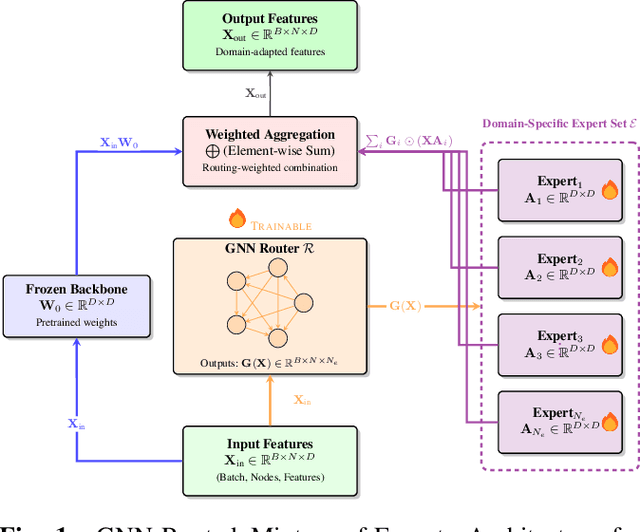
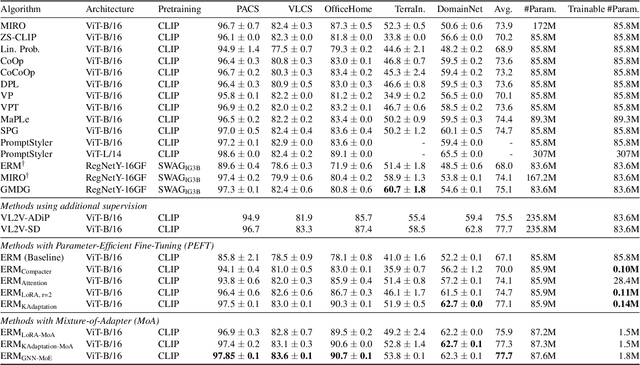
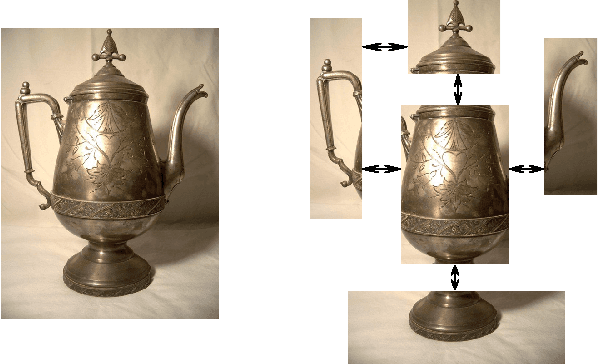
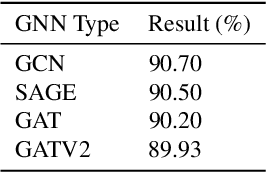
Domain generalization (DG) seeks robust Vision Transformer (ViT) performance on unseen domains. Efficiently adapting pretrained ViTs for DG is challenging; standard fine-tuning is costly and can impair generalization. We propose GNN-MoE, enhancing Parameter-Efficient Fine-Tuning (PEFT) for DG with a Mixture-of-Experts (MoE) framework using efficient Kronecker adapters. Instead of token-based routing, a novel Graph Neural Network (GNN) router (GCN, GAT, SAGE) operates on inter-patch graphs to dynamically assign patches to specialized experts. This context-aware GNN routing leverages inter-patch relationships for better adaptation to domain shifts. GNN-MoE achieves state-of-the-art or competitive DG benchmark performance with high parameter efficiency, highlighting the utility of graph-based contextual routing for robust, lightweight DG.