 Add to Chrome
 Add to Firefox
 Add to Edge
HAJJv2-CrowdCount: Zero-Shot Benchmark for Dense Crowd Counting
Jul 08, 2026
Automated crowd counting in Hajj video is difficult not because current models lack capacity, but because the footage violates the assumptions those models were built on: cameras observe the crowd from steep, near-vertical angles, individuals occlude one another extensively, and a single frame can contain well over a thousand people. Benchmarks that test crowd counting in such an environment are either private or not detailed per second. We revisit the HAJJv2 dataset and contribute HAJJv2-CrowdCount: per-second human-annotated crowd counts for its testing videos. Using these annotations, we benchmark three recent zero-shot counting paradigms: an open-vocabulary detector (YOLO-World), a point-based counter (APGCC), and a promptable segmentation-based counter (SAM3Count). SAM3Count attains the lowest overall mean absolute error (MAE 70.4, 95% CI 56.0-86.1), ahead of YOLO-World (92.0) and APGCC (152.9). This ordering reverses, however, in the regime most relevant to deployment: on the densest frames, the detection- and segmentation-based counters both degrade sharply (MAE exceeding 300), while the point-based counter degrades far more gracefully (MAE 114.9). This inversion is decision-relevant for Hajj crowd management, where reliable counts are needed most precisely in the densest and most occluded scenes. The annotations are released to support reproduction and extension of these results.

When Does Small Data Work? Accuracy and Efficiency Trade-offs Between Tabular Foundation Models and Conventional Methods for Crowd-State Classification at Hajj and Umrah
Jul 04, 2026Learning from few labeled examples is a central challenge in tabular machine learning, and it becomes the binding constraint in domains where labeling is costly, such as crowd monitoring during Hajj and Umrah. Tabular foundation models, which predict from only a handful of examples without task-specific training, were recently introduced to address this very-few-label regime. In this study we test them on crowd-state classification to assess how much they help when labels are scarce, and we compare them against standard machine learning methods to characterize the accuracy and efficiency trade-offs between the two approaches. Using three real datasets we evaluate different machine learning models, in untuned and tuned forms, against three foundation models. Results show that no single family is best everywhere. The right choice depends on the label budget. When labels are very few, foundation models lead. As labels grow, tuned conventional models catch up and significantly surpass the foundation models on the more structural geometry target. Efficiency separates them further where tuned machine learning models incur a large tuning cost that foundation models avoid, although foundation models reprocess their context at every prediction. We summarize these results as a practical map of which approach to prefer under a given label budget and computational budget.
GridProbe: Posterior-Probing for Adaptive Test-Time Compute in Long-Video VLMs
May 11, 2026Long-video understanding in VLMs is bottlenecked by a single monolithic forward pass over thousands of frames at quadratic attention cost. A common mitigation is to first select a small subset of informative frames before the forward pass; common for training-free selectors via auxiliary encoder-space similarities. Such signals are capped by contrastive pretraining, which usually fails on reasoning-heavy queries (negation, cross-frame counting, holistic summarization). We propose GridProbe, an efficient training-free posterior-probing inference paradigm that scores evidence in answer space using a frozen VLM's own reasoning and then selects question-relevant frames adaptively, resulting in sub-quadratic attention cost with little to no accuracy loss. We arrange frames on a $K{\times}K$ grid and run lightweight row R and column C probes, where each probe reads its peak posterior as a query-conditioned confidence. The outer product of R and C yields an interpretable importance map whose skewness and kurtosis drive Shape-Adaptive Selection, a closed-form rule that reliably replaces the fixed frame budget $M$ with a per-question $M_{\mathrm{eff}}$. We show empirically that $M_{\mathrm{eff}}$ tracks intrinsic question difficulty without ever seeing the answer, a sign of test-time adaptive compute. On Video-MME-v2, GridProbe matches the monolithic baseline within $1.6$ pp Avg Acc at $3.36\times$ TFLOPs reduction, while on LongVideoBench it Pareto-dominates the baseline ($+0.9$ pp at $0.35\times$ compute). Because the selector and QA models can be decoupled, pairing a small 2B selector with a stronger 4B or 8B QA is strictly Pareto-dominant over the 2B monolithic baseline (up to $+4.0$ pp at $0.52\times$ compute, on average), with no retraining. Finally, the interpretability of the importance maps opens future avenues for behavioral diagnostics, grounding, and frame-selection distillation.
GridVAD: Open-Set Video Anomaly Detection via Spatial Reasoning over Stratified Frame Grids
Mar 26, 2026Vision-Language Models (VLMs) are powerful open-set reasoners, yet their direct use as anomaly detectors in video surveillance is fragile: without calibrated anomaly priors, they alternate between missed detections and hallucinated false alarms. We argue the problem is not the VLM itself but how it is used. VLMs should function as anomaly proposers, generating open-set candidate descriptions that are then grounded and tracked by purpose-built spatial and temporal modules. We instantiate this propose-ground-propagate principle in GridVAD, a training-free pipeline that produces pixel-level anomaly masks without any domain-specific training. A VLM reasons over stratified grid representations of video clips to generate natural-language anomaly proposals. Self-Consistency Consolidation (SCC) filters hallucinations by retaining only proposals that recur across multiple independent samplings. Grounding DINO anchors each surviving proposal to a bounding box, and SAM2 propagates it as a dense mask through the anomaly interval. The per-clip VLM budget is fixed at M+1 calls regardless of video length, where M can be set according to the proposals needed. On UCSD Ped2, GridVAD achieves the highest Pixel-AUROC (77.59) among all compared methods, surpassing even the partially fine-tuned TAO (75.11) and outperforms other zero-shot approaches on object-level RBDC by over 5x. Ablations reveal that SCC provides a controllable precision-recall tradeoff: filtering improves all pixel level metrics at a modest cost in object-level recall. Efficiency experiments show GridVAD is 2.7x more call-efficient than uniform per-frame VLM querying while additionally producing dense segmentation masks.Code and qualitative video results are available at https://gridvad.github.io.
VideoAtlas: Navigating Long-Form Video in Logarithmic Compute
Mar 18, 2026Extending language models to video introduces two challenges: representation, where existing methods rely on lossy approximations, and long-context, where caption- or agent-based pipelines collapse video into text and lose visual fidelity. To overcome this, we introduce \textbf{VideoAtlas}, a task-agnostic environment to represent video as a hierarchical grid that is simultaneously lossless, navigable, scalable, caption- and preprocessing-free. An overview of the video is available at a glance, and any region can be recursively zoomed into, with the same visual representation used uniformly for the video, intermediate investigations, and the agent's memory, eliminating lossy text conversion end-to-end. This hierarchical structure ensures access depth grows only logarithmically with video length. For long-context, Recursive Language Models (RLMs) recently offered a powerful solution for long text, but extending them to visual domain requires a structured environment to recurse into, which \textbf{VideoAtlas} provides. \textbf{VideoAtlas} as a Markov Decision Process unlocks Video-RLM: a parallel Master-Worker architecture where a Master coordinates global exploration while Workers concurrently drill into assigned regions to accumulate lossless visual evidence. We demonstrate three key findings: (1)~logarithmic compute growth with video duration, further amplified by a 30-60\% multimodal cache hit rate arising from the grid's structural reuse. (2)~environment budgeting, where bounding the maximum exploration depth provides a principled compute-accuracy hyperparameter. (3)~emergent adaptive compute allocation that scales with question granularity. When scaling from 1-hour to 10-hour benchmarks, Video-RLM remains the most duration-robust method with minimal accuracy degradation, demonstrating that structured environment navigation is a viable and scalable paradigm for video understanding.
Multimodal Lengthy Videos Retrieval Framework and Evaluation Metric
Apr 06, 2025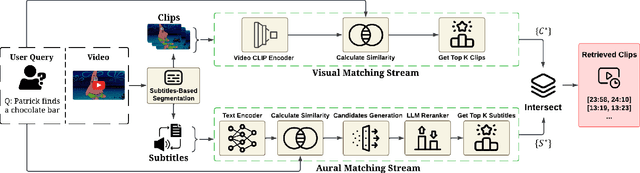
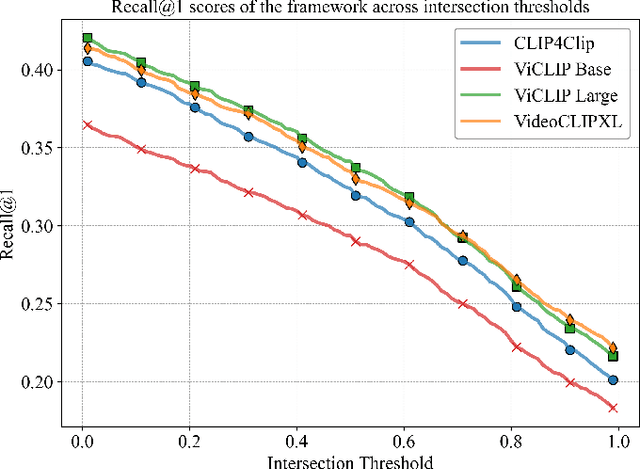
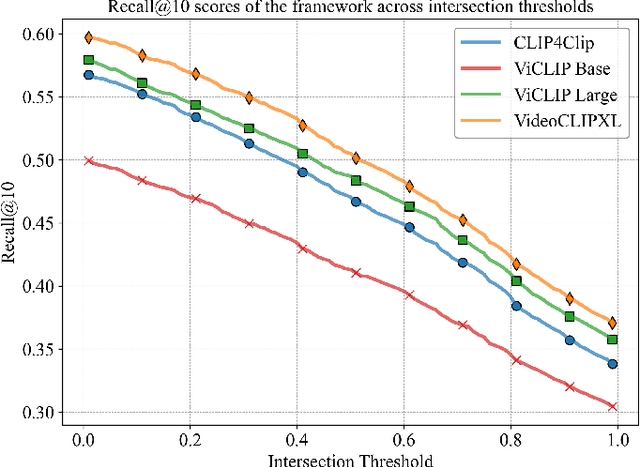
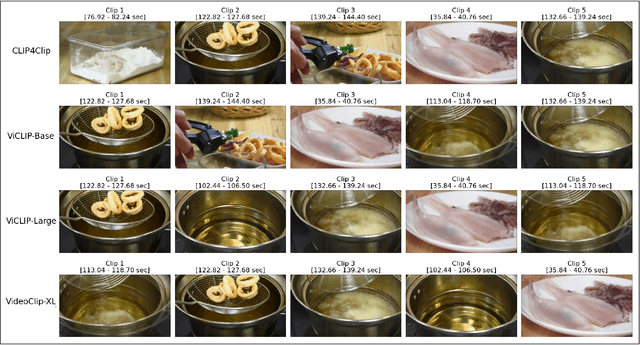
Precise video retrieval requires multi-modal correlations to handle unseen vocabulary and scenes, becoming more complex for lengthy videos where models must perform effectively without prior training on a specific dataset. We introduce a unified framework that combines a visual matching stream and an aural matching stream with a unique subtitles-based video segmentation approach. Additionally, the aural stream includes a complementary audio-based two-stage retrieval mechanism that enhances performance on long-duration videos. Considering the complex nature of retrieval from lengthy videos and its corresponding evaluation, we introduce a new retrieval evaluation method specifically designed for long-video retrieval to support further research. We conducted experiments on the YouCook2 benchmark, showing promising retrieval performance.