 Add to Chrome
 Add to Firefox
 Add to Edge
Builder, Defender, Breaker: The Case Against Removing the Human from the AI-Driven Security Lifecycle
Jul 03, 2026
Artificial intelligence has spread across the whole of the security lifecycle. The same family of models now writes application code, hardens it, and probes it for weaknesses, so that a single generative substrate increasingly performs all three roles at once. Enthusiasm for this convergence tends to treat full autonomy as the natural end point of partial assistance. This article argues that it is not. When the system that builds an artifact is drawn from the same distribution as the systems that defend and test it, the three roles inherit a common set of blind spots, and the independence that makes verification meaningful is quietly lost. Removing the human does more than raise the automation level: it collapses the external oracle against which machine output is judged, outruns the point at which a person could intervene, hands adversaries a predictable and poisonable target, and dissolves the locus of accountability when something fails. Drawing on evidence from autonomous code generation, adversarial machine learning, software fault tolerance, and the first all-machine hacking tournaments, we argue that the human belongs in the loop not as a temporary scaffold but as a permanent structural requirement, and set out what a defensible division of labour between people and machines should preserve.

Agentic and Generative AI for Open-Source Intelligence and Cyber Investigations: Taxonomy, Evaluation, Challenges, and Future Directions
Jul 03, 2026The rapid growth of publicly available digital information has rendered manual open-source intelligence (OSINT) analysis insufficient for modern intelligence, cybersecurity, and cyber investigation. Large language models (LLMs) and agentic AI systems, capable of tool use, multi-step reasoning, and iterative intelligence generation, have emerged as promising solutions, yet evaluation frameworks have not kept pace with reported capabilities. This survey systematically reviews 74 studies and makes four contributions. First, it establishes agentic AI as a distinct analytical category rather than an extension of LLM prompting, organising the literature through an 11-category taxonomy covering LLM foundations, agentic architectures, retrieval-augmented generation (RAG), knowledge graphs, prompt engineering, domain adaptation, evaluation benchmarks, and risk. Second, it identifies the hallucination-validation gap as a corpus-level finding: although hallucination is recognised as a major reliability concern in over twenty studies, end-to-end hallucination is empirically measured in only one OSINT-specific RAG-based system, non-reproducible conditions, while related reasoning and factual-correction studies evaluate general-domain question answering rather than OSINT. Third, it maps existing research to the OSINT lifecycle, showing strong support for collection and analysis but limited coverage of verification, reporting, dissemination, and decision support. Fourth, it derives a ten-point research agenda addressing evaluation, benchmarking, hallucination measurement, adversarial robustness, dark-web coverage, multimodal intelligence, and governance. It concludes that a human-AI co-pilot model, where LLMs assist collection and triage while analysts retain responsibility for verification and decision-making, represents the most defensible near-term deployment architecture.
A Robust Cross-Domain IDS using BiGRU-LSTM-Attention for Medical and Industrial IoT Security
Aug 17, 2025The increased Internet of Medical Things IoMT and the Industrial Internet of Things IIoT interconnectivity has introduced complex cybersecurity challenges, exposing sensitive data, patient safety, and industrial operations to advanced cyber threats. To mitigate these risks, this paper introduces a novel transformer-based intrusion detection system IDS, termed BiGAT-ID a hybrid model that combines bidirectional gated recurrent units BiGRU, long short-term memory LSTM networks, and multi-head attention MHA. The proposed architecture is designed to effectively capture bidirectional temporal dependencies, model sequential patterns, and enhance contextual feature representation. Extensive experiments on two benchmark datasets, CICIoMT2024 medical IoT and EdgeIIoTset industrial IoT demonstrate the model's cross-domain robustness, achieving detection accuracies of 99.13 percent and 99.34 percent, respectively. Additionally, the model exhibits exceptional runtime efficiency, with inference times as low as 0.0002 seconds per instance in IoMT and 0.0001 seconds in IIoT scenarios. Coupled with a low false positive rate, BiGAT-ID proves to be a reliable and efficient IDS for deployment in real-world heterogeneous IoT environments
A Novel Reinforcement Learning Model for Post-Incident Malware Investigations
Oct 19, 2024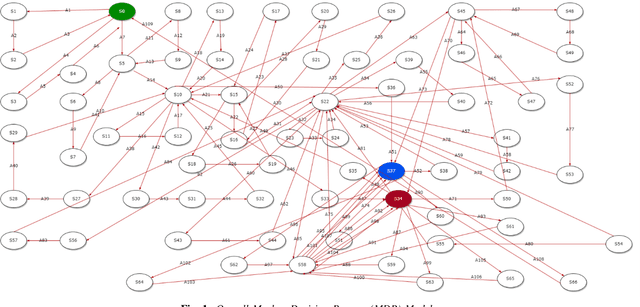
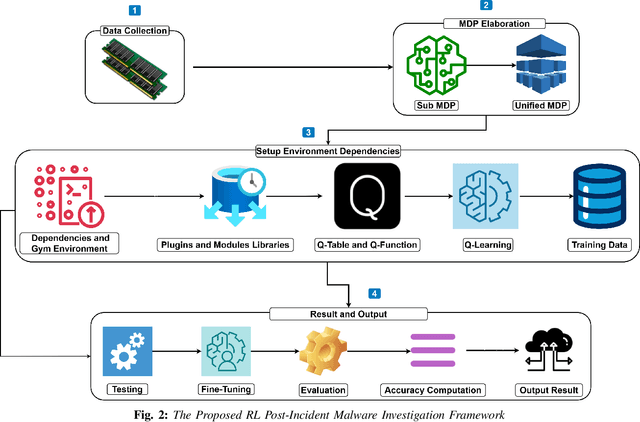
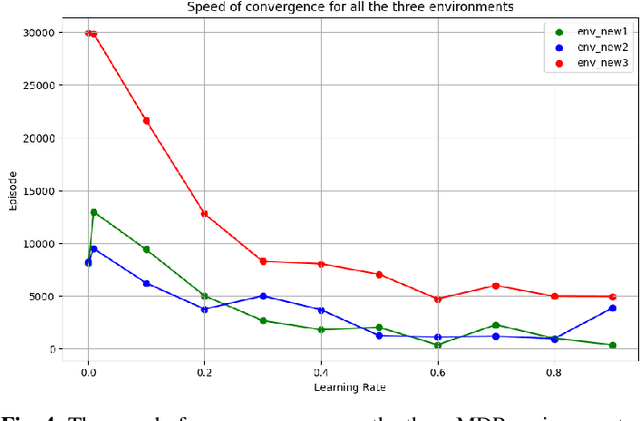
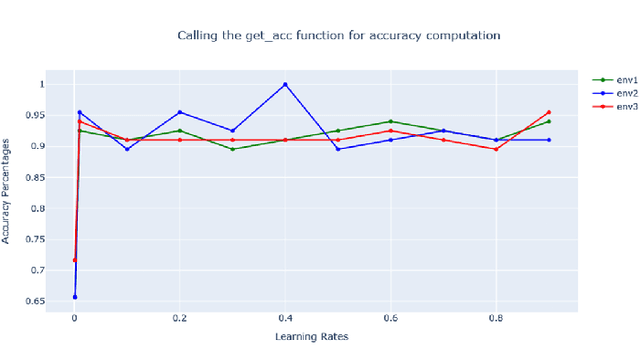
This Research proposes a Novel Reinforcement Learning (RL) model to optimise malware forensics investigation during cyber incident response. It aims to improve forensic investigation efficiency by reducing false negatives and adapting current practices to evolving malware signatures. The proposed RL framework leverages techniques such as Q-learning and the Markov Decision Process (MDP) to train the system to identify malware patterns in live memory dumps, thereby automating forensic tasks. The RL model is based on a detailed malware workflow diagram that guides the analysis of malware artefacts using static and behavioural techniques as well as machine learning algorithms. Furthermore, it seeks to address challenges in the UK justice system by ensuring the accuracy of forensic evidence. We conduct testing and evaluation in controlled environments, using datasets created with Windows operating systems to simulate malware infections. The experimental results demonstrate that RL improves malware detection rates compared to conventional methods, with the RL model's performance varying depending on the complexity and learning rate of the environment. The study concludes that while RL offers promising potential for automating malware forensics, its efficacy across diverse malware types requires ongoing refinement of reward systems and feature extraction methods.
* 8 pages. arXiv admin note: substantial text overlap with arXiv:2408.01999
Advanced Persistent Threats (APT) Attribution Using Deep Reinforcement Learning
Oct 15, 2024This paper investigates the application of Deep Reinforcement Learning (DRL) for attributing malware to specific Advanced Persistent Threat (APT) groups through detailed behavioural analysis. By analysing over 3500 malware samples from 12 distinct APT groups, the study utilises sophisticated tools like Cuckoo Sandbox to extract behavioural data, providing a deep insight into the operational patterns of malware. The research demonstrates that the DRL model significantly outperforms traditional machine learning approaches such as SGD, SVC, KNN, MLP, and Decision Tree Classifiers, achieving an impressive test accuracy of 89.27 %. It highlights the model capability to adeptly manage complex, variable, and elusive malware attributes. Furthermore, the paper discusses the considerable computational resources and extensive data dependencies required for deploying these advanced AI models in cybersecurity frameworks. Future research is directed towards enhancing the efficiency of DRL models, expanding the diversity of the datasets, addressing ethical concerns, and leveraging Large Language Models (LLMs) to refine reward mechanisms and optimise the DRL framework. By showcasing the transformative potential of DRL in malware attribution, this research advocates for a responsible and balanced approach to AI integration, with the goal of advancing cybersecurity through more adaptable, accurate, and robust systems.
Advancing Cyber Incident Timeline Analysis Through Rule Based AI and Large Language Models
Sep 04, 2024Timeline Analysis (TA) is a key part of Timeline Forensics (TF) in Digital Forensics (DF), focusing primarily on examining and analysing temporal digital artefacts such as timestamps, derived from event logs, file metadata, and other related data to correlate events resulting from cyber incidents and reconstruct their chronological timeline. Traditional tools often struggle to efficiently process the vast volume and variety of data acquired during DF investigations and Incident Response (IR) processes. This paper presents a novel framework, GenDFIR, that combines Rule-Based Artificial Intelligence (R-BAI) algorithms with Large Language Models (LLMs) to advance and automate the TA process. Our approach consists of two main stages (1) We use R-BAI to identify and select anomalous digital artefacts based on predefined rules. (2) The selected artefacts are then converted into embeddings for processing by an LLM with the help of a Retrieval-Augmented Generation (RAG) agent. The LLM consequently leverages its capabilities to perform automated TA on the artefacts and predict potential incident scenarios. To validate our framework, we evaluate GenDFIR performance, efficiency, and reliability using various metrics across synthetic cyber incident simulation scenarios. This paper presents a proof of concept, where the findings demonstrate the significant potential of integrating R-BAI and LLMs for TA. This novel approach highlights the power of Generative AI (GenAI), specifically LLMs, and opens new avenues for advanced threat detection and incident reconstruction, representing a significant step forward in the field.
Reinforcement Learning for an Efficient and Effective Malware Investigation during Cyber Incident Response
Aug 04, 2024This research focused on enhancing post-incident malware forensic investigation using reinforcement learning RL. We proposed an advanced MDP post incident malware forensics investigation model and framework to expedite post incident forensics. We then implement our RL Malware Investigation Model based on structured MDP within the proposed framework. To identify malware artefacts, the RL agent acquires and examines forensics evidence files, iteratively improving its capabilities using Q Table and temporal difference learning. The Q learning algorithm significantly improved the agent ability to identify malware. An epsilon greedy exploration strategy and Q learning updates enabled efficient learning and decision making. Our experimental testing revealed that optimal learning rates depend on the MDP environment complexity, with simpler environments benefiting from higher rates for quicker convergence and complex ones requiring lower rates for stability. Our model performance in identifying and classifying malware reduced malware analysis time compared to human experts, demonstrating robustness and adaptability. The study highlighted the significance of hyper parameter tuning and suggested adaptive strategies for complex environments. Our RL based approach produced promising results and is validated as an alternative to traditional methods notably by offering continuous learning and adaptation to new and evolving malware threats which ultimately enhance the post incident forensics investigations.
D2WFP: A Novel Protocol for Forensically Identifying, Extracting, and Analysing Deep and Dark Web Browsing Activities
Sep 11, 2023The use of the un-indexed web, commonly known as the deep web and dark web, to commit or facilitate criminal activity has drastically increased over the past decade. The dark web is an in-famously dangerous place where all kinds of criminal activities take place [1-2], despite advances in web forensics techniques, tools, and methodologies, few studies have formally tackled the dark and deep web forensics and the technical differences in terms of investigative techniques and artefacts identification and extraction. This research proposes a novel and comprehensive protocol to guide and assist digital forensics professionals in investigating crimes committed on or via the deep and dark web, The protocol named D2WFP establishes a new sequential approach for performing investigative activities by observing the order of volatility and implementing a systemic approach covering all browsing related hives and artefacts which ultimately resulted into improv-ing the accuracy and effectiveness. Rigorous quantitative and qualitative research has been conducted by assessing D2WFP following a scientifically-sound and comprehensive process in different scenarios and the obtained results show an apparent increase in the number of artefacts re-covered when adopting D2WFP which outperform any current industry or opensource browsing forensics tools. The second contribution of D2WFP is the robust formulation of artefact correlation and cross-validation within D2WFP which enables digital forensics professionals to better document and structure their analysis of host-based deep and dark web browsing artefacts.