 Add to Chrome
 Add to Firefox
 Add to Edge
NeST: Neuron Selective Tuning for LLM Safety
Feb 18, 2026
Safety alignment is essential for the responsible deployment of large language models (LLMs). Yet, existing approaches often rely on heavyweight fine-tuning that is costly to update, audit, and maintain across model families. Full fine-tuning incurs substantial computational and storage overhead, while parameter-efficient methods such as LoRA trade efficiency for inconsistent safety gains and sensitivity to design choices. Safety intervention mechanisms such as circuit breakers reduce unsafe outputs without modifying model weights, but do not directly shape or preserve the internal representations that govern safety behavior. These limitations hinder rapid and reliable safety updates, particularly in settings where models evolve frequently or must adapt to new policies and domains. We present NeST, a lightweight, structure-aware safety alignment framework that strengthens refusal behavior by selectively adapting a small subset of safety-relevant neurons while freezing the remainder of the model. NeST aligns parameter updates with the internal organization of safety behavior by clustering functionally coherent safety neurons and enforcing shared updates within each cluster, enabling targeted and stable safety adaptation without broad model modification or inference-time overhead. We benchmark NeST against three dominant baselines: full fine-tuning, LoRA-based fine-tuning, and circuit breakers across 10 open-weight LLMs spanning multiple model families and sizes. Across all evaluated models, NeST reduces the attack success rate from an average of 44.5% to 4.36%, corresponding to a 90.2% reduction in unsafe generations, while requiring only 0.44 million trainable parameters on average. This amounts to a 17,310x decrease in updated parameters compared to full fine-tuning and a 9.25x reduction relative to LoRA, while consistently achieving stronger safety performance for alignment.

Beyond Random Inputs: A Novel ML-Based Hardware Fuzzing
Apr 10, 2024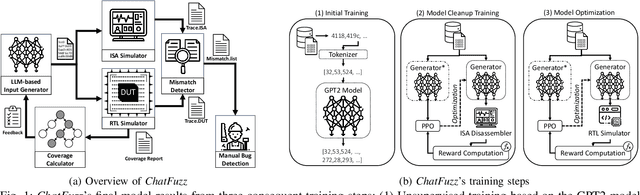

Modern computing systems heavily rely on hardware as the root of trust. However, their increasing complexity has given rise to security-critical vulnerabilities that cross-layer at-tacks can exploit. Traditional hardware vulnerability detection methods, such as random regression and formal verification, have limitations. Random regression, while scalable, is slow in exploring hardware, and formal verification techniques are often concerned with manual effort and state explosions. Hardware fuzzing has emerged as an effective approach to exploring and detecting security vulnerabilities in large-scale designs like modern processors. They outperform traditional methods regarding coverage, scalability, and efficiency. However, state-of-the-art fuzzers struggle to achieve comprehensive coverage of intricate hardware designs within a practical timeframe, often falling short of a 70% coverage threshold. We propose a novel ML-based hardware fuzzer, ChatFuzz, to address this challenge. Ourapproach leverages LLMs like ChatGPT to understand processor language, focusing on machine codes and generating assembly code sequences. RL is integrated to guide the input generation process by rewarding the inputs using code coverage metrics. We use the open-source RISCV-based RocketCore processor as our testbed. ChatFuzz achieves condition coverage rate of 75% in just 52 minutes compared to a state-of-the-art fuzzer, which requires a lengthy 30-hour window to reach a similar condition coverage. Furthermore, our fuzzer can attain 80% coverage when provided with a limited pool of 10 simulation instances/licenses within a 130-hour window. During this time, it conducted a total of 199K test cases, of which 6K produced discrepancies with the processor's golden model. Our analysis identified more than 10 unique mismatches, including two new bugs in the RocketCore and discrepancies from the RISC-V ISA Simulator.