 Add to Chrome
 Add to Firefox
 Add to Edge
A Single-Fiber Optical Frequency Domain Reflectometry (OFDR)-Based Shape Sensing of Concentric Tube Steerable Drilling Robots
Mar 18, 2026
This paper introduces a novel shape-sensing approach for Concentric Tube Steerable Drilling Robots (CT-SDRs) based on Optical Frequency Domain Reflectometry (OFDR). Unlike traditional FBG-based methods, OFDR enables continuous strain measurement along the entire fiber length with enhanced spatial resolution. In the proposed method, a Shape Sensing Assembly (SSA) is first fabricated by integrating a single OFDR fiber with a flat NiTi wire. The calibrated SSA is then routed through and housed within the internal channel of a flexible drilling instrument, which is guided by the pre-shaped NiTi tube of the CT-SDR. In this configuration, the drilling instrument serves as a protective sheath for the SSA during drilling, eliminating the need for integration or adhesion to the instrument surface that is typical of conventional optical sensor approaches. The performance of the proposed SSA, integrated within the cannulated CT-SDR, was thoroughly evaluated under free-bending conditions and during drilling along multiple J-shaped trajectories in synthetic Sawbones phantoms. Results demonstrate accurate and reliable shape-sensing capability, confirming the feasibility and robustness of this integration strategy.

A Learning-Based Approach for Contact Detection, Localization, and Force Estimation of Continuum Manipulators With Integrated OFDR Optical Fiber
Mar 12, 2026Continuum manipulators (CMs) are widely used in minimally invasive procedures due to their compliant structure and ability to navigate deep and confined anatomical environments. However, their distributed deformation makes force sensing, contact detection, localization, and force estimation challenging, particularly when interactions occur at unknown arc-length locations along the robot. To address this problem, we propose a cascade learning-based framework (CLF) for CMs instrumented with a single distributed Optical Frequency Domain Reflectometry (OFDR) fiber embedded along one side of the robot. The OFDR sensor provides dense strain measurements along the manipulator backbone, capturing strain perturbations caused by external interactions. The proposed CLF first detects contact using a Gradient Boosting classifier and then estimates contact location and interaction force magnitude using a CNN--FiLM model that predicts a spatial force distribution along the manipulator. Experimental validation on a sensorized tendon-driven CM in an obstructed environment demonstrates that a single distributed OFDR fiber provides sufficient information to jointly infer contact occurrence, location, and force in continuum manipulators.
Single-Fiber Optical Frequency Domain Reflectometry Shape Sensing of Continuum Manipulators with Planar Bending
May 27, 2024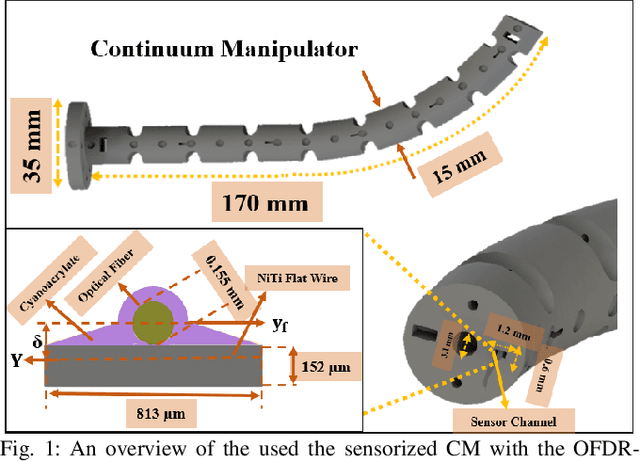
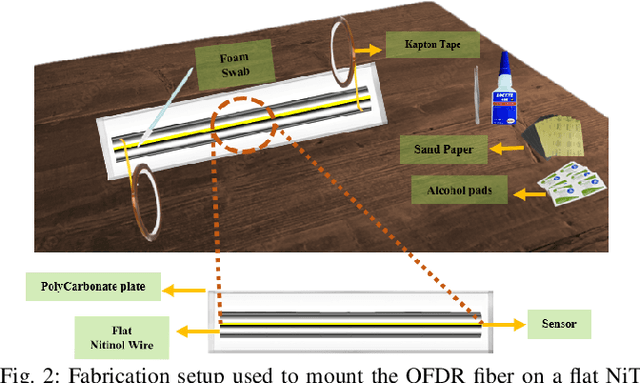
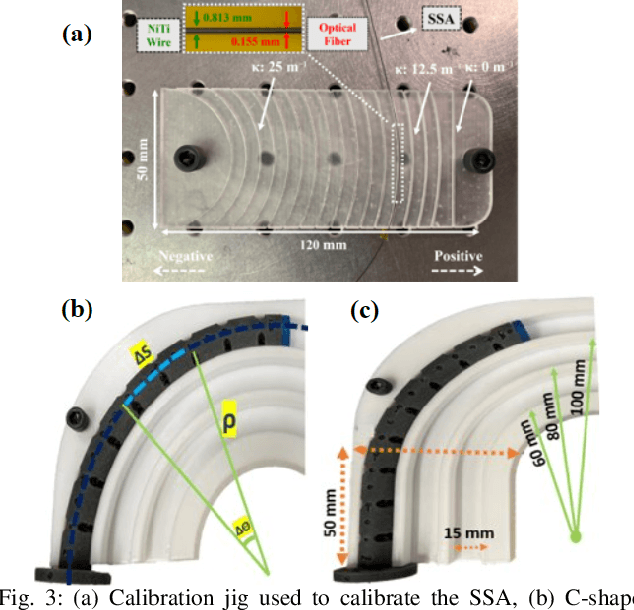
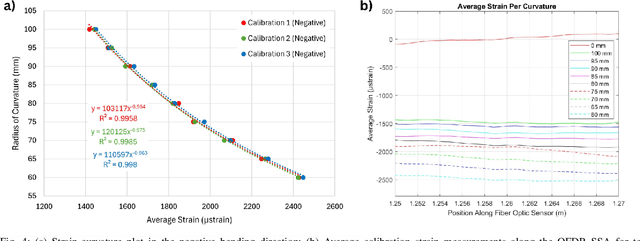
To address the challenges associated with shape sensing of continuum manipulators (CMs) using Fiber Bragg Grating (FBG) optical fibers, we feature a unique shape sensing assembly utilizing solely a single Optical Frequency Domain Reflectometry (OFDR) fiber attached to a flat nitinol wire (NiTi). Integrating this easy-to-manufacture unique sensor with a long and soft CM with 170 mm length, we performed different experiments to evaluate its shape reconstruction ability. Results demonstrate phenomenal shape reconstruction accuracy for both C-shape (< 2 mm tip error, < 1.2 mm shape error) and J-shape (< 3.4 mm tip error, < 2.3 mm shape error) experiments.