 Add to Chrome
 Add to Firefox
 Add to Edge
SE3Kit: A Lightweight Python Library for Specialized Geometric Primitives in Robotics
May 21, 2026
The Python robotics ecosystem faces a challenge: while many libraries exist for rigid body transformations, few are both lightweight and mathematically strict. This paper introduces SE3Kit, a lightweight Python library efficient operations on the Special Euclidean Group SE(3) and the Special Orthogonal Group SO(3). Unlike established frameworks that require heavy dependencies (e.g., SpatialMath, PyPose) or general tools that lack robotics-specific features (e.g., SciPy), SE3Kit targets the gap between these extremes. It is designed for embedded deployment, rapid prototyping, and education while providing rigorous mathematical implementation. It provides a pure-Python, NumPy-only implementation of Lie Group operations, without the overhead of deep learning or other visualization software.

A Single-Fiber Optical Frequency Domain Reflectometry (OFDR)-Based Shape Sensing of Concentric Tube Steerable Drilling Robots
Mar 18, 2026This paper introduces a novel shape-sensing approach for Concentric Tube Steerable Drilling Robots (CT-SDRs) based on Optical Frequency Domain Reflectometry (OFDR). Unlike traditional FBG-based methods, OFDR enables continuous strain measurement along the entire fiber length with enhanced spatial resolution. In the proposed method, a Shape Sensing Assembly (SSA) is first fabricated by integrating a single OFDR fiber with a flat NiTi wire. The calibrated SSA is then routed through and housed within the internal channel of a flexible drilling instrument, which is guided by the pre-shaped NiTi tube of the CT-SDR. In this configuration, the drilling instrument serves as a protective sheath for the SSA during drilling, eliminating the need for integration or adhesion to the instrument surface that is typical of conventional optical sensor approaches. The performance of the proposed SSA, integrated within the cannulated CT-SDR, was thoroughly evaluated under free-bending conditions and during drilling along multiple J-shaped trajectories in synthetic Sawbones phantoms. Results demonstrate accurate and reliable shape-sensing capability, confirming the feasibility and robustness of this integration strategy.
Comparative Analysis of Autonomous Robotic and Manual Techniques for Ultrasonic Sacral Osteotomy: A Preliminary Study
Feb 03, 2026In this paper, we introduce an autonomous Ultrasonic Sacral Osteotomy (USO) robotic system that integrates an ultrasonic osteotome with a seven-degree-of-freedom (DoF) robotic manipulator guided by an optical tracking system. To assess multi-directional control along both the surface trajectory and cutting depth of this system, we conducted quantitative comparisons between manual USO (MUSO) and robotic USO (RUSO) in Sawbones phantoms under identical osteotomy conditions. The RUSO system achieved sub-millimeter trajectory accuracy (0.11 mm RMSE), an order of magnitude improvement over MUSO (1.10 mm RMSE). Moreover, MUSO trials showed substantial over-penetration (16.0 mm achieved vs. 8.0 mm target), whereas the RUSO system maintained precise depth control (8.1 mm). These results demonstrate that robotic procedures can effectively overcome the critical limitations of manual osteotomy, establishing a foundation for safer and more precise sacral resections.
S3D: A Spatial Steerable Surgical Drilling Framework for Robotic Spinal Fixation Procedures
Jul 02, 2025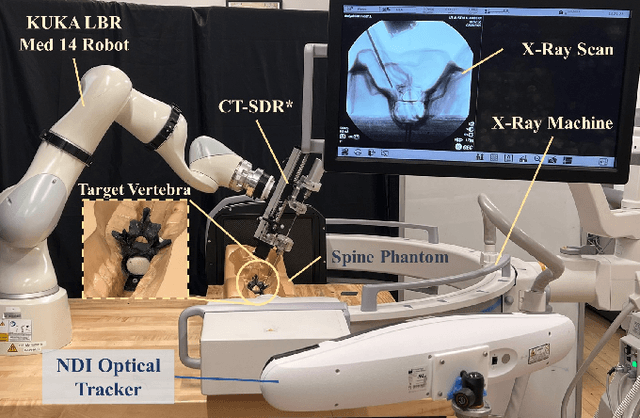
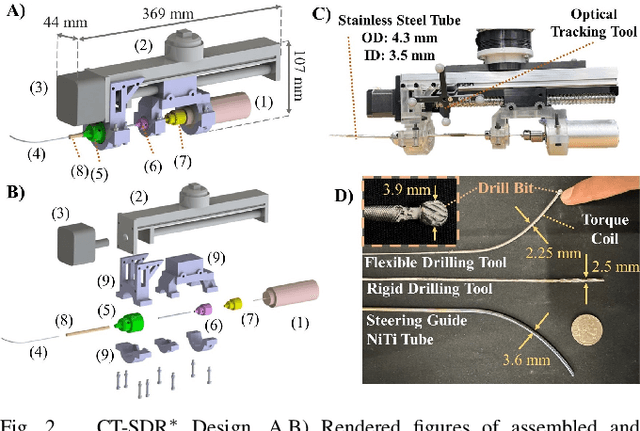
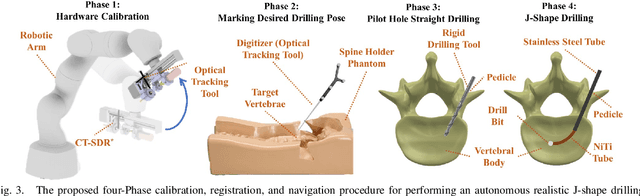
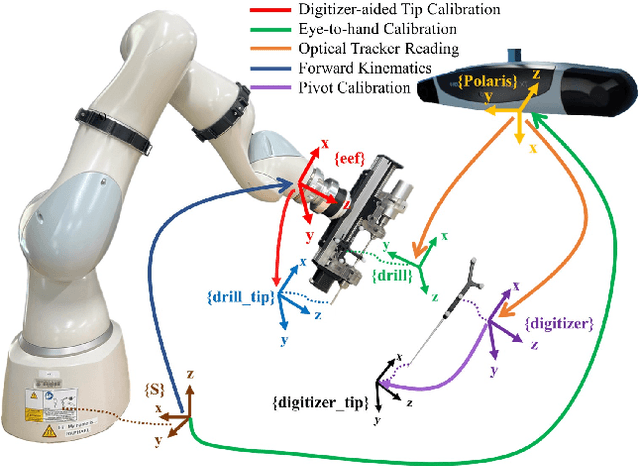
In this paper, we introduce S3D: A Spatial Steerable Surgical Drilling Framework for Robotic Spinal Fixation Procedures. S3D is designed to enable realistic steerable drilling while accounting for the anatomical constraints associated with vertebral access in spinal fixation (SF) procedures. To achieve this, we first enhanced our previously designed concentric tube Steerable Drilling Robot (CT-SDR) to facilitate steerable drilling across all vertebral levels of the spinal column. Additionally, we propose a four-Phase calibration, registration, and navigation procedure to perform realistic SF procedures on a spine holder phantom by integrating the CT-SDR with a seven-degree-of-freedom robotic manipulator. The functionality of this framework is validated through planar and out-of-plane steerable drilling experiments in vertebral phantoms.
An Intelligent Approach to Detecting Novel Fault Classes for Centrifugal Pumps Based on Deep CNNs and Unsupervised Methods
Sep 22, 2023Despite the recent success in data-driven fault diagnosis of rotating machines, there are still remaining challenges in this field. Among the issues to be addressed, is the lack of information about variety of faults the system may encounter in the field. In this paper, we assume a partial knowledge of the system faults and use the corresponding data to train a convolutional neural network. A combination of t-SNE method and clustering techniques is then employed to detect novel faults. Upon detection, the network is augmented using the new data. Finally, a test setup is used to validate this two-stage methodology on a centrifugal pump and experimental results show high accuracy in detecting novel faults.