 Add to Chrome
 Add to Firefox
 Add to Edge
Blind Symmetry Matching in Quantum States with Application to Shot-Count Reduction
Jun 17, 2026
Measuring a quantum computation in a basis adapted to a symmetry it carries reduces the repeated measurements, commonly referred to as ``shots'', needed to read a statistical answer. Detecting the symmetry a quantum state carries has many uses: certifying a claimed symmetry, identifying a conserved-charge sector, flagging symmetry-breaking as an error signature, and selecting a compression or readout basis; shot-count reduction is developed here as one exemplary case. Existing methods assume the symmetry is known in advance; we remove that assumption. When it is unknown, the carried symmetry is discovered from the data by a symmetry test that scores candidate groups, and the largest passing group is exploited as the measurement basis. We state the pipeline precisely, prove the selection rule is unbiased, and charge discovery in full. Two conditions are treated, both detected by the same score with a different projection: a weak condition, commutation with the representation, and a strong condition, confinement to a single charge sector, the distinction drawn in the quantum-reference-frame literature. A single circuit, a controlled twirl followed by a SWAP test, discovers both: discarding the group register tests the weak condition, post-selecting it the strong one. The framework is general over finite groups, with cyclic (Fourier), dihedral, and symmetric-group (Schur-Weyl) examples; strong confinement to the symmetric, or Dicke, subspace is an exponential reduction. Seeded demonstrations show the loop wins net of discovery: weak matching on momentum readout reduces shots by a factor widening from ten to several thousand, and strong matching on a two-system target by a further factor of the subsystem size. Blind symmetry matching is a practical primitive for the common case where the matched basis cannot be written down in advance.

Kernel Density Estimation by Spectral Decomposition: Data-Driven Tapering and Superposition
Jun 13, 2026Kernel density estimation depends largely on one choice, the smoothing bandwidth. We treat bandwidth selection and density estimation in the characteristic-function domain, where the cyclic group-averaged covariance of the binned data has the squared empirical characteristic function as its spectrum: the true characteristic function sits over a sampling-noise floor of $1/n$, and the bandwidth is the spectral cutoff where the two meet. Several methods follow. An automatic selector strips the floor and minimizes a frequency-domain error criterion, matching the rule of thumb on smooth densities and approaching the best fixed bandwidth on multimodal ones. An adaptive estimator generalizes the fixed kernel to the per-frequency optimal Wiener taper, matching or surpassing the best fixed bandwidth on most standard densities, including sharply peaked and comb-like cases where fixed bandwidths fail; deconvolution under known measurement error follows in the same domain. Because the Wiener estimator resolves sharp structure but does not fit smooth bases as economically as a mixture, a Gaussian mixture is combined with it two ways, a piecewise partition and a superposition of a smooth base and a band-limited residual, the default. A data-driven floor read from the spectrum replaces the assumed $1/n$ floor and stays robust on heaped and rounded data. On the Marron-Wand benchmark scored by exact integrated squared error, the advantage emerges with sample size, a bias-variance tradeoff: the spectral estimators carry low bias but pay in variance, so cross-validation leads at $n=100$ while the Wiener filter and superposition take the top two ranks at $n=5000$. The methods are validated on six real datasets (CRSP returns, NHANES self-reports, CMS dimuon and SDSS spectra, a random-beacon stream, and UNSW-NB15 traffic) and on a synthetic-data quality check. All experiments are reproducible.
Unification of Signal Transform Theory
May 12, 2026We unify the discrete Fourier transform (DFT), discrete cosine transform (DCT), Walsh-Hadamard, Haar wavelet, Karhunen-Loève transform, and several others along with their continuous counterparts (Fourier transform, Fourier series, spherical harmonics, fractional Fourier transform) under one representation-theoretic principle: each is the eigenbasis of every covariance invariant under a specific finite or compact group, with columns constructed from the irreducible matrix elements of the group via the Peter-Weyl theorem. The unification rests on the Algebraic Diversity (AD) framework, which identifies the matched group of a covariance as the foundational object of second-order signal processing. The data-dependent KLT emerges as the trivial-matched-group limit; classical transforms emerge as the cyclic, dihedral, elementary abelian, iterated wreath, and hybrid wreath cases. Composition rules cover direct, wreath, and semidirect products. The Reed-Muller and arithmetic transforms appear as related change-of-basis transforms on the matched group of Walsh-Hadamard. A polynomial-time algorithm for matched-group discovery, the DAD-CAD relaxation cast as a generalized eigenvalue problem in double-commutator form, closes the operational loop: the matched group of any empirical covariance is discovered without expert judgment, with noise-aware variants via the commutativity residual $δ$ and algebraic coloring index $α$ for finite-SNR settings. The fractional Fourier transform is treated as the metaplectic $SO(2)$ case with Hermite-Gauss matched basis, and a structural principle relates matched group size inversely to transform resolution. Modern applications (massive-MIMO, graph neural networks, transformer attention, point cloud and 3D vision, brain connectivity, single-cell genomics, quantum informatics) are sketched with their matched groups.
Algebraic Diversity: Principles of a Group-Theoretic Approach to Signal Processing
Apr 21, 2026We present principles of algebraic diversity (AD), a group-theoretic approach to signal processing exploiting signal symmetry to extract more information per observation, complementing classical methods that use temporal and spatial diversity. The transformations under which a signal's statistics are invariant form a matched group; this group determines the natural transform for analysis, and averaging an estimator over the group action reduces variance without requiring additional snapshots. The viewpoint is broadened in five directions beyond the single-observation measurement of a companion paper. Rank promotion admits AD on scalar data streams and identifies the law of large numbers as the trivial-group case of a $(G, L)$ continuum combining sample-count with group-orbit averaging. An eigentensor hierarchy handles signals with nested symmetry. A blind group-matching methodology identifies the matched group from data via a polynomial-time generalized eigenvalue problem on the unitary Lie algebra, placing the DFT, DCT, and Karhunen--Loève transforms as distinguished points on a transform manifold. A cost-symmetry matching principle then extends AD from measurement to blind and adaptive signal processing generally; blind equalization is the lead detailed example, with the Constant Modulus Algorithm's residual phase ambiguity predicted analytically and matched within $1.6^\circ$ on 3GPP TDL multipath channels, and other blind problems in signal processing are mapped into the framework. Four theorems formalize a structural capacity $κ$, the Rényi-2 analog of Shannon and von Neumann's Rényi-1 entropies, quantifying how a signal's information is organized rather than how much information it contains. AD complements prior algebraic approaches including invariant estimation, minimax robust estimation, algebraic signal processing, and compressed sensing.
Quantum Algebraic Diversity: Single-Copy Density Matrix Estimation via Group-Structured Measurements
Apr 04, 2026We extend the algebraic diversity (AD) framework from classical signal processing to quantum measurement theory. The central result -- the Quantum Algebraic Diversity (QAD) Theorem -- establishes that a group-structured positive operator-valued measure (POVM) applied to a single copy of a quantum state produces a group-averaged density matrix estimator that recovers the spectral structure of the true density matrix, analogous to the classical result that a group-averaged outer product recovers covariance eigenstructure from a single observation. We establish a formal Classical-Quantum Duality Map connecting classical covariance estimation to quantum state tomography, and prove an Optimality Inheritance Theorem showing that classical group optimality transfers to quantum settings via the Born map. SIC-POVMs are identified as algebraic diversity with the Heisenberg-Weyl group, and mutually unbiased bases (MUBs) as algebraic diversity with the Clifford group, revealing the hierarchy $\mathrm{HW}(d) \subseteq \mathcal{C}(d) \subseteq S_d$ that mirrors the classical hierarchy $\mathbb{Z}_M \subseteq G_{\min} \subseteq S_M$. The double-commutator eigenvalue theorem provides polynomial-time adaptive POVM selection. A worked qubit example demonstrates that the group-averaged estimator from a single Pauli measurement recovers a full-rank approximation to a mixed qubit state, achieving fidelity 0.91 where standard single-basis tomography produces a rank-1 estimate with fidelity 0.71. Monte Carlo simulations on qudits of dimension $d = 2$ through $d = 13$ (200 random states per dimension) confirm that the Heisenberg-Weyl QAD estimator maintains fidelity above 0.90 across all dimensions from a single measurement outcome, while standard tomography fidelity degrades as $\sim 1/d$, with the improvement ratio scaling linearly with $d$ as predicted by the $O(d)$ copy reduction theorem.
Algebraic Diversity: Group-Theoretic Spectral Estimation from Single Observations
Apr 04, 2026We prove that temporal averaging over multiple observations can be replaced by algebraic group action on a single observation for second-order statistical estimation. A General Replacement Theorem establishes conditions under which a group-averaged estimator from one snapshot achieves equivalent subspace decomposition to multi-snapshot covariance estimation, and an Optimality Theorem proves that the symmetric group is universally optimal (yielding the KL transform). The framework unifies the DFT, DCT, and KLT as special cases of group-matched spectral transforms, with a closed-form double-commutator eigenvalue problem for polynomial-time optimal group selection. Five applications are demonstrated: MUSIC DOA estimation from a single snapshot, massive MIMO channel estimation with 64% throughput gain, single-pulse waveform classification at 90% accuracy, graph signal processing with non-Abelian groups, and a new algebraic analysis of transformer LLMs revealing that RoPE uses the wrong algebraic group for 70-80% of attention heads across five models (22,480 head observations), that the optimal group is content-dependent, and that spectral-concentration-based pruning improves perplexity at the 13B scale. All diagnostics require a single forward pass with no gradients or training.
A Photonic Physically Unclonable Function's Resilience to Multiple-Valued Machine Learning Attacks
Mar 02, 2024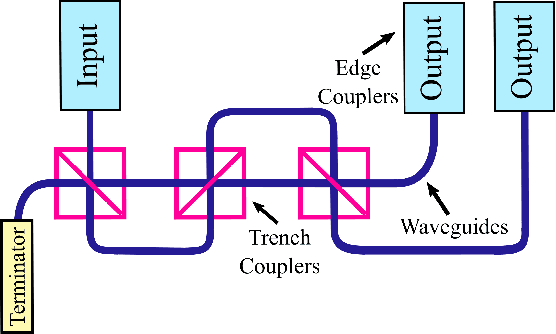
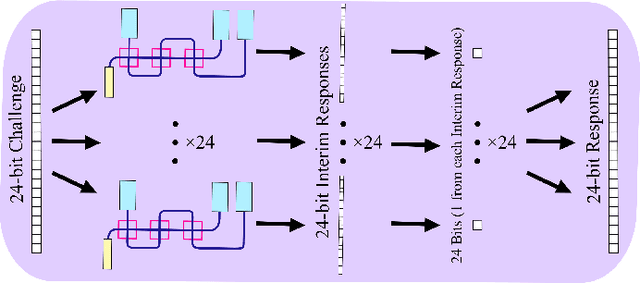
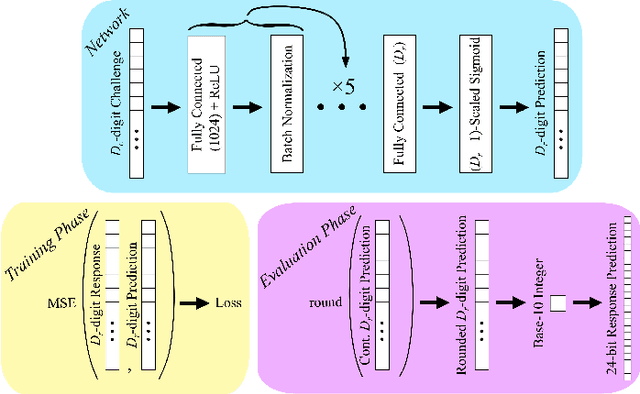
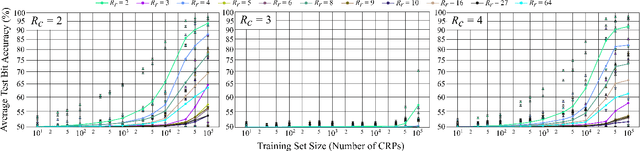
Physically unclonable functions (PUFs) identify integrated circuits using nonlinearly-related challenge-response pairs (CRPs). Ideally, the relationship between challenges and corresponding responses is unpredictable, even if a subset of CRPs is known. Previous work developed a photonic PUF offering improved security compared to non-optical counterparts. Here, we investigate this PUF's susceptibility to Multiple-Valued-Logic-based machine learning attacks. We find that approximately 1,000 CRPs are necessary to train models that predict response bits better than random chance. Given the significant challenge of acquiring a vast number of CRPs from a photonic PUF, our results demonstrate photonic PUF resilience against such attacks.
CNN-Assisted Steganography -- Integrating Machine Learning with Established Steganographic Techniques
Apr 25, 2023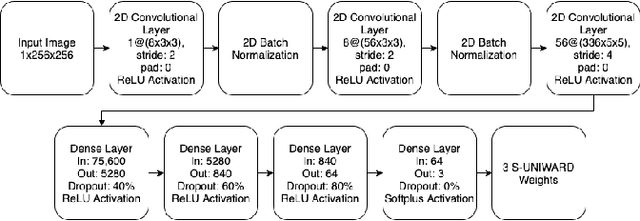
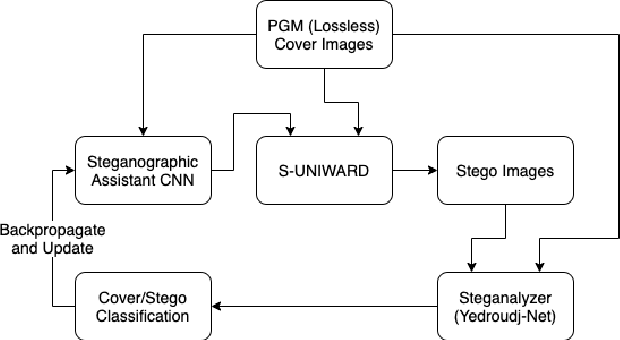

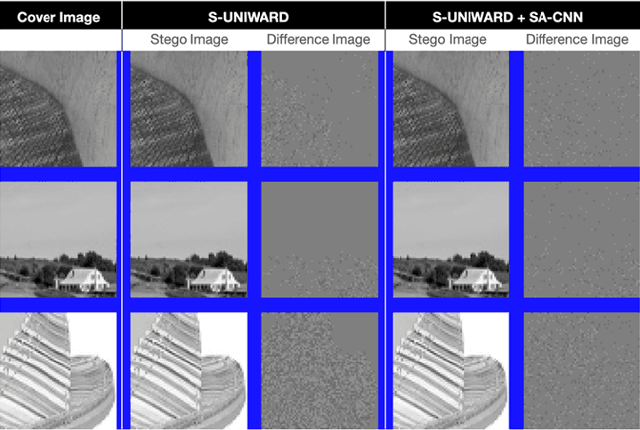
We propose a method to improve steganography by increasing the resilience of stego-media to discovery through steganalysis. Our approach enhances a class of steganographic approaches through the inclusion of a steganographic assistant convolutional neural network (SA-CNN). Previous research showed success in discovering the presence of hidden information within stego-images using trained neural networks as steganalyzers that are applied to stego-images. Our results show that such steganalyzers are less effective when SA-CNN is employed during the generation of a stego-image. We also explore the advantages and disadvantages of representing all the possible outputs of our SA-CNN within a smaller, discrete space, rather than a continuous space. Our SA-CNN enables certain classes of parametric steganographic algorithms to be customized based on characteristics of the cover media in which information is to be embedded. Thus, SA-CNN is adaptive in the sense that it enables the core steganographic algorithm to be especially configured for each particular instance of cover media. Experimental results are provided that employ a recent steganographic technique, S-UNIWARD, both with and without the use of SA-CNN. We then apply both sets of stego-images, those produced with and without SA-CNN, to an exmaple steganalyzer, Yedroudj-Net, and we compare the results. We believe that this approach for the integration of neural networks with hand-crafted algorithms increases the reliability and adaptability of steganographic algorithms.