 Add to Chrome
 Add to Firefox
 Add to Edge
Modeling Matches as Language: A Generative Transformer Approach for Counterfactual Player Valuation in Football
Mar 16, 2026
Evaluating football player transfers is challenging because player actions depend strongly on tactical systems, teammates, and match context. Despite this complexity, recruitment decisions often rely on static statistics and subjective expert judgment, which do not fully account for these contextual factors. This limitation stems largely from the absence of counterfactual simulation mechanisms capable of predicting outcomes in hypothetical scenarios. To address these challenges, we propose ScoutGPT, a generative model that treats football match events as sequential tokens within a language modeling framework. Utilizing a NanoGPT-based Transformer architecture trained on next-token prediction, ScoutGPT learns the dynamics of match event sequences to simulate event sequences under hypothetical lineups, demonstrating superior predictive performance compared to existing baseline models. Leveraging this capability, the model employs Monte Carlo sampling to enable counterfactual simulation, allowing for the assessment of unobserved scenarios. Experiments on K League data show that simulated player transfers lead to measurable changes in offensive progression and goal probabilities, indicating that ScoutGPT captures player-specific impact beyond traditional static metrics.

ScoutGPT: Capturing Player Impact from Team Action Sequences Using GPT-Based Framework
Dec 23, 2025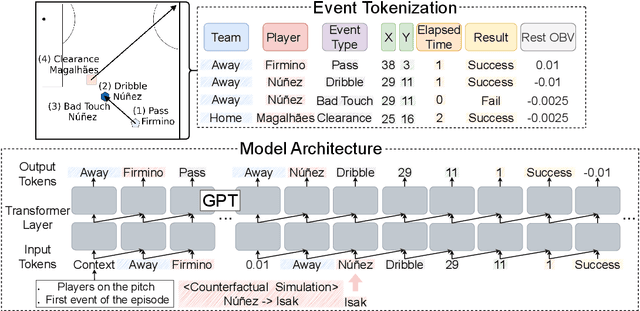
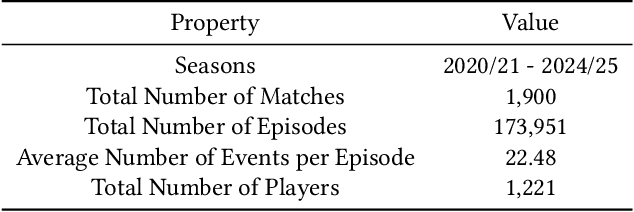

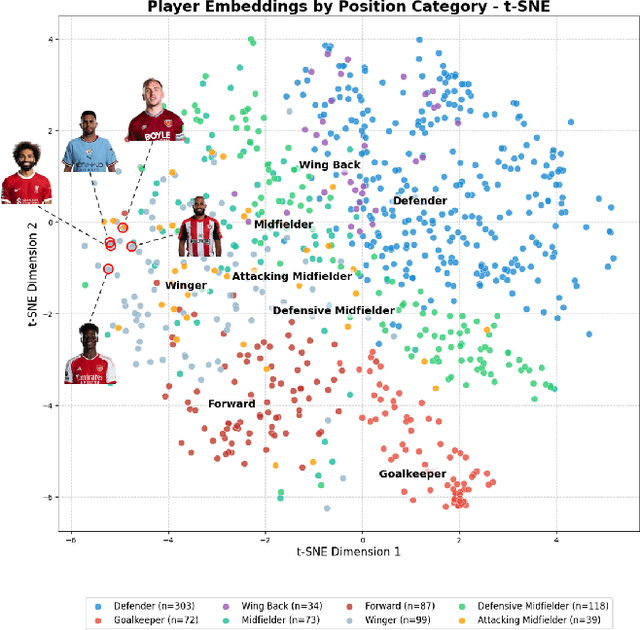
Transfers play a pivotal role in shaping a football club's success, yet forecasting whether a transfer will succeed remains difficult due to the strong context-dependence of on-field performance. Existing evaluation practices often rely on static summary statistics or post-hoc value models, which fail to capture how a player's contribution adapts to a new tactical environment or different teammates. To address this gap, we introduce EventGPT, a player-conditioned, value-aware next-event prediction model built on a GPT-style autoregressive transformer. Our model treats match play as a sequence of discrete tokens, jointly learning to predict the next on-ball action's type, location, timing, and its estimated residual On-Ball Value (rOBV) based on the preceding context and player identity. A key contribution of this framework is the ability to perform counterfactual simulations. By substituting learned player embeddings into new event sequences, we can simulate how a player's behavioral distribution and value profile would change when placed in a different team or tactical structure. Evaluated on five seasons of Premier League event data, EventGPT outperforms existing sequence-based baselines in next-event prediction accuracy and spatial precision. Furthermore, we demonstrate the model's practical utility for transfer analysis through case studies-such as comparing striker performance across different systems and identifying stylistic replacements for specific roles-showing that our approach provides a principled method for evaluating transfer fit.