 Add to Chrome
 Add to Firefox
 Add to Edge
Unleashing the Potential of Differential Evolution through Individual-Level Strategy Diversity
Feb 01, 2026
Since Differential Evolution (DE) is sensitive to strategy choice, most existing variants pursue performance through adaptive mechanisms or intricate designs. While these approaches focus on adjusting strategies over time, the structural benefits that static strategy diversity may bring remain largely unexplored. To bridge this gap, we study the impact of individual-level strategy diversity on DE's search dynamics and performance, and introduce iStratDE (DE with individual-level strategies), a minimalist variant that assigns mutation and crossover strategies independently to each individual at initialization and keeps them fixed throughout the evolutionary process. By injecting diversity at the individual level without adaptation or feedback, iStratDE cultivates persistent behavioral heterogeneity that is especially effective with large populations. Moreover, its communication-free construction possesses intrinsic concurrency, thereby enabling efficient parallel execution and straightforward scaling for GPU computing. We further provide a convergence analysis of iStratDE under standard reachability assumptions, which establishes the almost-sure convergence of the best-so-far fitness. Extensive experiments on the CEC2022 benchmark suite and robotic control tasks demonstrate that iStratDE matches or surpasses established adaptive DE variants. These results highlight individual-level strategy assignment as a straightforward yet effective mechanism for enhancing DE's performance. The source code of iStratDE is publicly accessible at: https://github.com/EMI-Group/istratde.

A Composite Decomposition Method for Large-Scale Global Optimization
Mar 08, 2024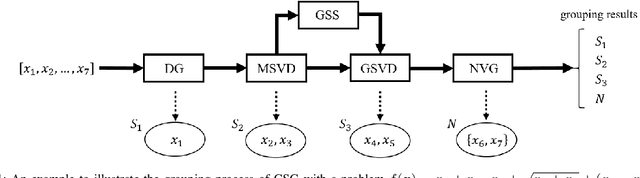
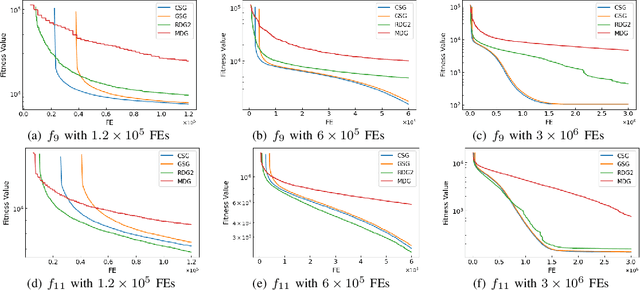
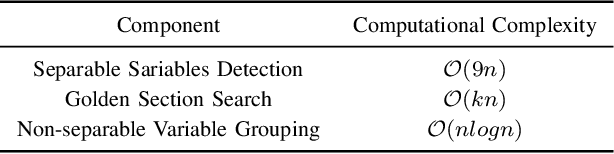

Cooperative co-evolution (CC) algorithms, based on the divide-and-conquer strategy, have emerged as the predominant approach to solving large-scale global optimization (LSGO) problems. The efficiency and accuracy of the grouping stage significantly impact the performance of the optimization process. While the general separability grouping (GSG) method has overcome the limitation of previous differential grouping (DG) methods by enabling the decomposition of non-additively separable functions, it suffers from high computational complexity. To address this challenge, this article proposes a composite separability grouping (CSG) method, seamlessly integrating DG and GSG into a problem decomposition framework to utilize the strengths of both approaches. CSG introduces a step-by-step decomposition framework that accurately decomposes various problem types using fewer computational resources. By sequentially identifying additively, multiplicatively and generally separable variables, CSG progressively groups non-separable variables by recursively considering the interactions between each non-separable variable and the formed non-separable groups. Furthermore, to enhance the efficiency and accuracy of CSG, we introduce two innovative methods: a multiplicatively separable variable detection method and a non-separable variable grouping method. These two methods are designed to effectively detect multiplicatively separable variables and efficiently group non-separable variables, respectively. Extensive experimental results demonstrate that CSG achieves more accurate variable grouping with lower computational complexity compared to GSG and state-of-the-art DG series designs.