 Add to Chrome
 Add to Firefox
 Add to Edge
Kinodynamic Task and Motion Planning using VLM-guided and Interleaved Sampling
Oct 30, 2025
Task and Motion Planning (TAMP) integrates high-level task planning with low-level motion feasibility, but existing methods are costly in long-horizon problems due to excessive motion sampling. While LLMs provide commonsense priors, they lack 3D spatial reasoning and cannot ensure geometric or dynamic feasibility. We propose a kinodynamic TAMP framework based on a hybrid state tree that uniformly represents symbolic and numeric states during planning, enabling task and motion decisions to be jointly decided. Kinodynamic constraints embedded in the TAMP problem are verified by an off-the-shelf motion planner and physics simulator, and a VLM guides exploring a TAMP solution and backtracks the search based on visual rendering of the states. Experiments on the simulated domains and in the real world show 32.14% - 1166.67% increased average success rates compared to traditional and LLM-based TAMP planners and reduced planning time on complex problems, with ablations further highlighting the benefits of VLM guidance.

Fast and Accurate Task Planning using Neuro-Symbolic Language Models and Multi-level Goal Decomposition
Sep 28, 2024

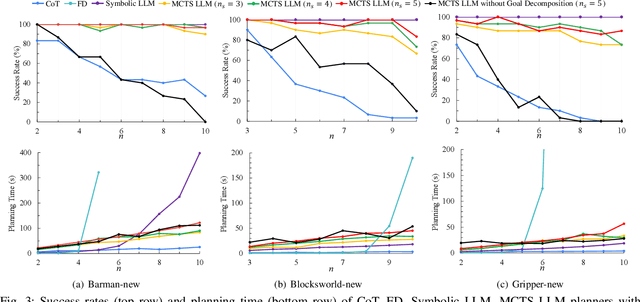

In robotic task planning, symbolic planners using rule-based representations like PDDL are effective but struggle with long-sequential tasks in complicated planning environments due to exponentially increasing search space. Recently, Large Language Models (LLMs) based on artificial neural networks have emerged as promising alternatives for autonomous robot task planning, offering faster inference and leveraging commonsense knowledge. However, they typically suffer from lower success rates. In this paper, to address the limitations of the current symbolic (slow speed) or LLM-based approaches (low accuracy), we propose a novel neuro-symbolic task planner that decomposes complex tasks into subgoals using LLM and carries out task planning for each subgoal using either symbolic or MCTS-based LLM planners, depending on the subgoal complexity. Generating subgoals helps reduce planning time and improve success rates by narrowing the overall search space and enabling LLMs to focus on smaller, more manageable tasks. Our method significantly reduces planning time while maintaining a competitive success rate, as demonstrated through experiments in different public task planning domains, as well as real-world and simulated robotics environments.