 Add to Chrome
 Add to Firefox
 Add to Edge
Strategic Buying Agents
Jul 06, 2026
Agentic AI is shifting online shopping from search toward delegated purchasing, where autonomous buying agents monitor markets and decide when to buy on a consumer's behalf. We study the design of such strategic buying agents, which must decide when to purchase within a finite shopping window, translating price observations, the remaining time horizon, and beliefs about future price changes into a purchase policy. We formulate this problem across three information regimes: stationary, Bayesian, and robust, and treat the resulting optimal policies as a policy menu for implementation. In the stationary regime, price adjustments follow a Poisson arrival process with a known post-adjustment price distribution; the optimal policy is a dynamic purchase-threshold rule, with the threshold governed by an ordinary differential equation. In the Bayesian regime, the adjustment intensity is known, but the price-adjustment distribution is uncertain; the optimal rule remains threshold-based, now depending on posterior beliefs, and we bound the value of knowing the true distribution. In the robust regime, the agent has only price bounds and seeks worst-case protection; randomized threshold policies achieve optimal competitive-ratio and minimax-regret guarantees. We evaluate the proposed policies on Amazon price histories from Keepa (367 items, 48,933 timestamped observations) and examine their integration into language-model buying agents. The stationary and Bayesian policies perform competitively on mean normalized consumer surplus despite their stylized assumptions, while the robust policy performs best at the distribution's 10th percentile. Results suggest language models are better suited to selecting among regimes and calibration samples than to making buy-or-wait decisions directly.

Optimizing Length Compression in Large Reasoning Models
Jun 17, 2025

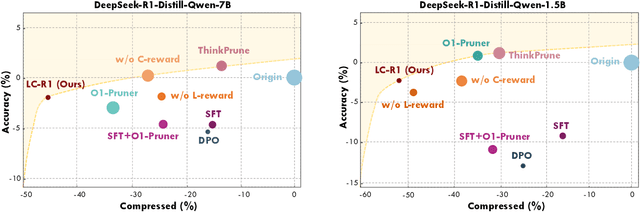
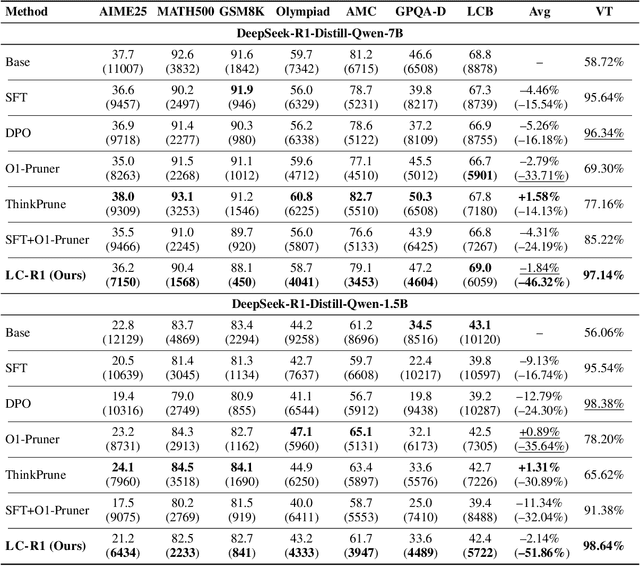
Large Reasoning Models (LRMs) have achieved remarkable success, yet they often suffer from producing unnecessary and verbose reasoning chains. We identify a core aspect of this issue as "invalid thinking" -- models tend to repeatedly double-check their work after having derived the correct answer. To address this specific inefficiency, we move beyond the general principles of Efficacy and Efficiency to propose two new, fine-grained principles: Brevity, which advocates for eliminating redundancy, and Sufficiency, which ensures critical reasoning steps are preserved. Guided by these principles, we introduce LC-R1, a post-training method based on Group Relative Policy Optimization (GRPO). LC-R1 employs a novel combination of a Length Reward for overall conciseness and a Compress Reward that is specifically designed to remove the invalid portion of the thinking process. Extensive experiments on multiple reasoning benchmarks demonstrate that LC-R1 achieves a significant reduction in sequence length (~50%) with only a marginal (~2%) drop in accuracy, achieving a favorable trade-off point on the Pareto frontier that prioritizes high compression. Our analysis further validates the robustness of LC-R1 and provides valuable insights for developing more powerful yet computationally efficient LRMs. Our code is released at https://github.com/zxiangx/LC-R1.
LiveVQA: Live Visual Knowledge Seeking
Apr 07, 2025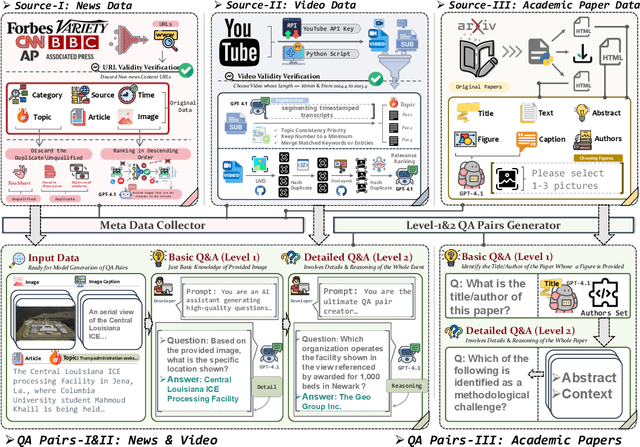
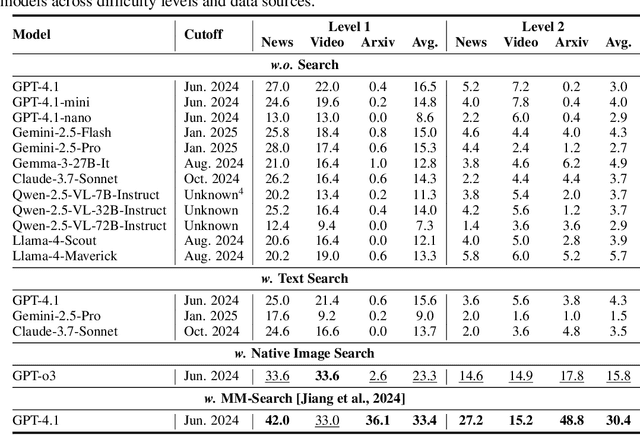
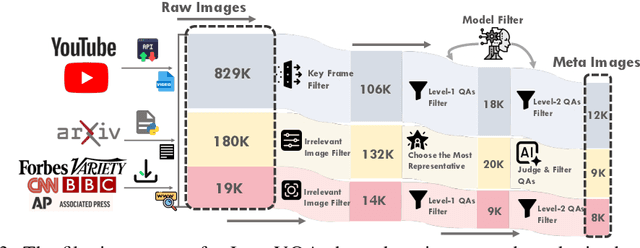
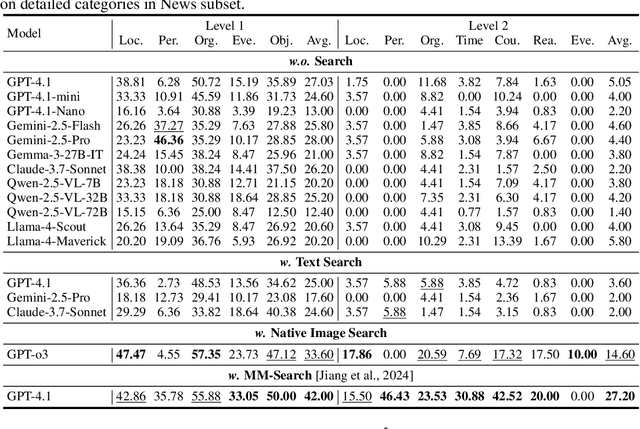
We introduce LiveVQA, an automatically collected dataset of latest visual knowledge from the Internet with synthesized VQA problems. LiveVQA consists of 3,602 single- and multi-hop visual questions from 6 news websites across 14 news categories, featuring high-quality image-text coherence and authentic information. Our evaluation across 15 MLLMs (e.g., GPT-4o, Gemma-3, and Qwen-2.5-VL family) demonstrates that stronger models perform better overall, with advanced visual reasoning capabilities proving crucial for complex multi-hop questions. Despite excellent performance on textual problems, models with tools like search engines still show significant gaps when addressing visual questions requiring latest visual knowledge, highlighting important areas for future research.