 Add to Chrome
 Add to Firefox
 Add to Edge
Towards Robust Driving Perception: A Flexible Scale-Driven Family for Self-Supervised Monocular Depth Estimation
Jul 01, 2026
Self-Supervised Monocular Depth Estimation (MDE) has garnered attention in recent years due to its independence from ground truth. However, most existing models are limited to a single scale and exhibit considerable performance degradation in complex driving environments. Networks specifically designed to handle dynamic traffic participants tend to be overly complex, hindering their deployment on resource-constrained automotive edge devices. To address these limitations and move towards robust driving perception, we propose FlexDepth, a scale-driven and flexible family of self-supervised MDE models tailored for challenging road scenarios. FlexDepth employs a two-stage static-dynamic decoupled training strategy, enabling the independent assessment of confidence for both static backgrounds and dynamic road objects. Furthermore, it introduces a meticulously designed Scale-Driven Decoder (SDD) to dynamically select components based on scale size, facilitating efficient feature fusion and the output of high-precision depth maps. Extensive experiments on standard driving benchmarks demonstrate that without any auxiliary information, our model achieves state-of-the-art performance across arbitrary scales with minimal computational overhead. Our smallest model, Flex-Nano, requires only 0.7 GFLOPs and achieves 37.6 FPS on mobile platforms, ensuring reliable real-time perception while maintaining excellent zero-shot generalization.Our source code is avalible: https://github.com/startnew/flexdepth

VistaDepth: Frequency Modulation With Bias Reweighting For Enhanced Long-Range Depth Estimation
Apr 22, 2025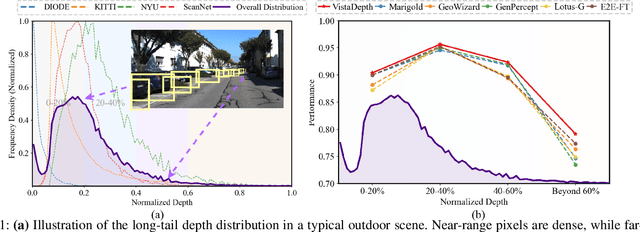
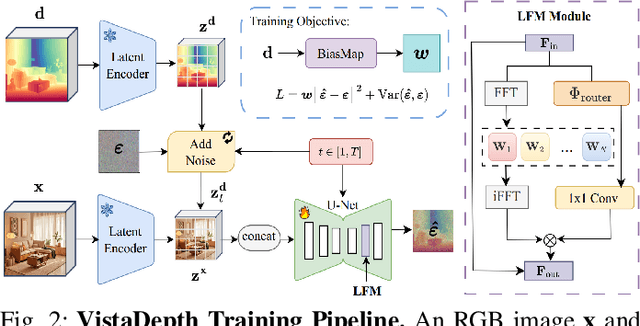
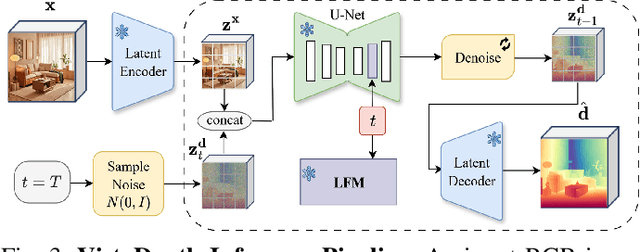
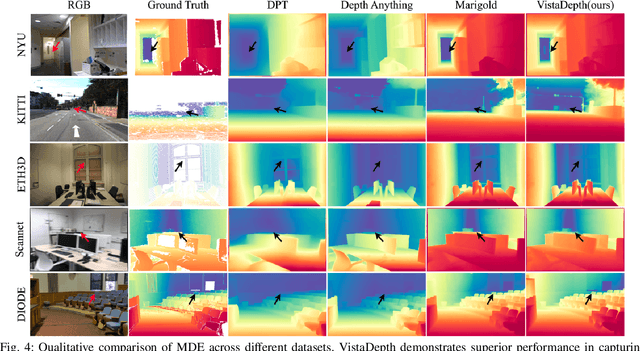
Monocular depth estimation (MDE) aims to predict per-pixel depth values from a single RGB image. Recent advancements have positioned diffusion models as effective MDE tools by framing the challenge as a conditional image generation task. Despite their progress, these methods often struggle with accurately reconstructing distant depths, due largely to the imbalanced distribution of depth values and an over-reliance on spatial-domain features. To overcome these limitations, we introduce VistaDepth, a novel framework that integrates adaptive frequency-domain feature enhancements with an adaptive weight-balancing mechanism into the diffusion process. Central to our approach is the Latent Frequency Modulation (LFM) module, which dynamically refines spectral responses in the latent feature space, thereby improving the preservation of structural details and reducing noisy artifacts. Furthermore, we implement an adaptive weighting strategy that modulates the diffusion loss in real-time, enhancing the model's sensitivity towards distant depth reconstruction. These innovations collectively result in superior depth perception performance across both distance and detail. Experimental evaluations confirm that VistaDepth achieves state-of-the-art performance among diffusion-based MDE techniques, particularly excelling in the accurate reconstruction of distant regions.