 Add to Chrome
 Add to Firefox
 Add to Edge
Optically Writable Atomic Vapor Memory as a Substrate for Optical Reservoir Computing
Aug 18, 2026
We present an optical random access memory (ORAM) based on warm cesium (Cs) atomic vapor and demonstrate its operation as the physical substrate of a reservoir computer. Information is stored in the hyperfine population distribution of a Cs ensemble via optical pumping and retrieved through differential probe absorption. Spatial multiplexing via acousto-optic deflection provides eight addressable memory rails able to store up to 3.8 bits of information per rail. Employing this platform as a temporally multiplexed reservoir, we achieve a kernel rank ($\mathrm{KR}= 8.8 \pm 0.4$), and a minimum bit error rate of $0.02 \pm 0.01$ on the Exclusive-or (XOR) benchmark. We find the limited memory lifetime constrains the achievable temporal depth, encouraging further research into fast addressable memories. This constitutes the first demonstration of a free-space, optically writable atomic RAM as a substrate in an optical reservoir computing system.

On the Re-Solving Heuristic for Contextual Bandits with Knapsacks
Nov 25, 2022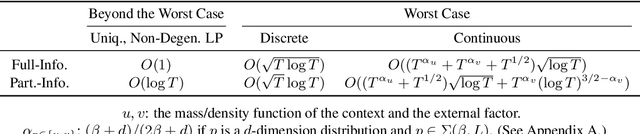

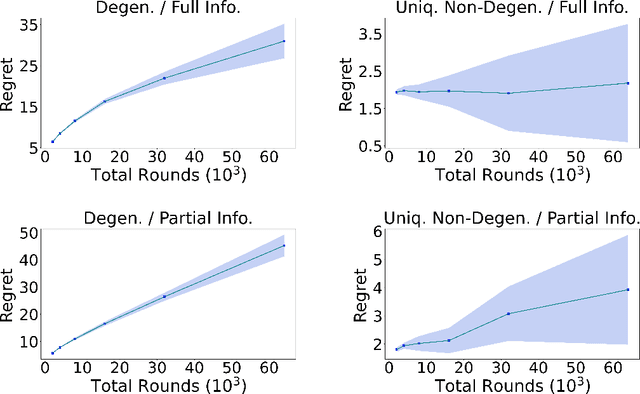
In the problem of (binary) contextual bandits with knapsacks (CBwK), the agent receives an i.i.d. context in each of the $T$ rounds and chooses an action, resulting in a random reward and a random consumption of resources that are related to an i.i.d. external factor. The agent's goal is to maximize the accumulated reward under the initial resource constraints. In this work, we combine the re-solving heuristic, which proved successful in revenue management, with distribution estimation techniques to solve this problem. We consider two different information feedback models, with full and partial information, which vary in the difficulty of getting a sample of the external factor. Under both information feedback settings, we achieve two-way results: (1) For general problems, we show that our algorithm gets an $\widetilde O(T^{\alpha_u} + T^{\alpha_v} + T^{1/2})$ regret against the fluid benchmark. Here, $\alpha_u$ and $\alpha_v$ reflect the complexity of the context and external factor distributions, respectively. This result is comparable to existing results. (2) When the fluid problem is linear programming with a unique and non-degenerate optimal solution, our algorithm leads to an $\widetilde O(1)$ regret. To the best of our knowledge, this is the first $\widetilde O(1)$ regret result in the CBwK problem regardless of information feedback models. We further use numerical experiments to verify our results.