 Add to Chrome
 Add to Firefox
 Add to Edge
Feature importance analysis for patient management decisions
May 06, 2026
The objective of this paper is to understand what characteristics and features of clinical data influence physician's decision about ordering laboratory tests or prescribing medications the most. We conduct our analysis on data and decisions extracted from electronic health records of 4486 post-surgical cardiac patients. The summary statistics for 335 different lab order decisions and 407 medication decisions are reported. We show that in many cases, physician's lab-order and medication decisions can be well predicted from a small subset of all features.

Evidence-based anomaly detection in clinical domains
May 06, 2026Anomaly detection methods can be very useful in identifying interesting or concerning events. In this work, we develop and examine new probabilistic anomaly detection methods that let us evaluate management decisions for a specific patient and identify those decisions that are highly unusual with respect to patients with the same or similar condition. The statistics used in this detection are derived from probabilistic models such as Bayesian networks that are learned from a database of past patient cases. We apply our methods to the problem of identifying unusual patient-management decisions in post-surgical cardiac patients.
Conditional outlier detection for clinical alerting
May 06, 2026We develop and evaluate a data-driven approach for detecting unusual (anomalous) patient-management actions using past patient cases stored in an electronic health record (EHR) system. Our hypothesis is that patient-management actions that are unusual with respect to past patients may be due to a potential error and that it is worthwhile to raise an alert if such a condition is encountered. We evaluate this hypothesis using data obtained from the electronic health records of 4,486 post-cardiac surgical patients. We base the evaluation on the opinions of a panel of experts. The results support that anomaly-based alerting can have reasonably low false alert rates and that stronger anomalies are correlated with higher alert rates.
Conditional anomaly detection with soft harmonic functions
Apr 23, 2026In this paper, we consider the problem of conditional anomaly detection that aims to identify data instances with an unusual response or a class label. We develop a new non-parametric approach for conditional anomaly detection based on the soft harmonic solution, with which we estimate the confidence of the label to detect anomalous mislabeling. We further regularize the solution to avoid the detection of isolated examples and examples on the boundary of the distribution support. We demonstrate the efficacy of the proposed method on several synthetic and UCI ML datasets in detecting unusual labels when compared to several baseline approaches. We also evaluate the performance of our method on a real-world electronic health record dataset where we seek to identify unusual patient-management decisions.
* Published at IEEE International Conference on Data Mining (ICDM 2011). 10.1109/ICDM.2011.40
Personalized Event Prediction for Electronic Health Records
Aug 21, 2023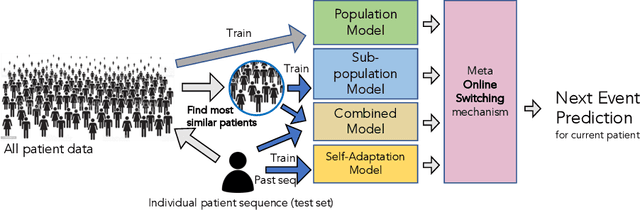
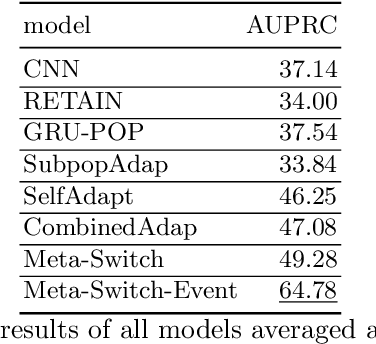
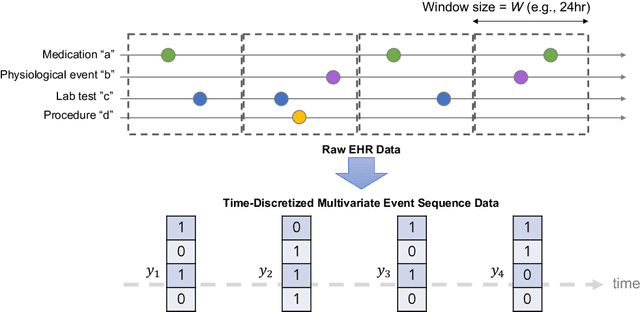
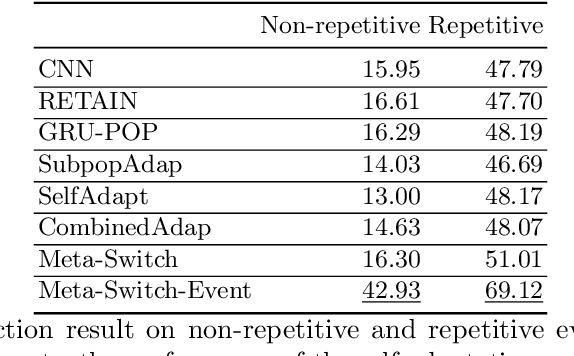
Clinical event sequences consist of hundreds of clinical events that represent records of patient care in time. Developing accurate predictive models of such sequences is of a great importance for supporting a variety of models for interpreting/classifying the current patient condition, or predicting adverse clinical events and outcomes, all aimed to improve patient care. One important challenge of learning predictive models of clinical sequences is their patient-specific variability. Based on underlying clinical conditions, each patient's sequence may consist of different sets of clinical events (observations, lab results, medications, procedures). Hence, simple population-wide models learned from event sequences for many different patients may not accurately predict patient-specific dynamics of event sequences and their differences. To address the problem, we propose and investigate multiple new event sequence prediction models and methods that let us better adjust the prediction for individual patients and their specific conditions. The methods developed in this work pursue refinement of population-wide models to subpopulations, self-adaptation, and a meta-level model switching that is able to adaptively select the model with the best chance to support the immediate prediction. We analyze and test the performance of these models on clinical event sequences of patients in MIMIC-III database.
* arXiv admin note: text overlap with arXiv:2104.01787
Learning to Adapt Clinical Sequences with Residual Mixture of Experts
Apr 06, 2022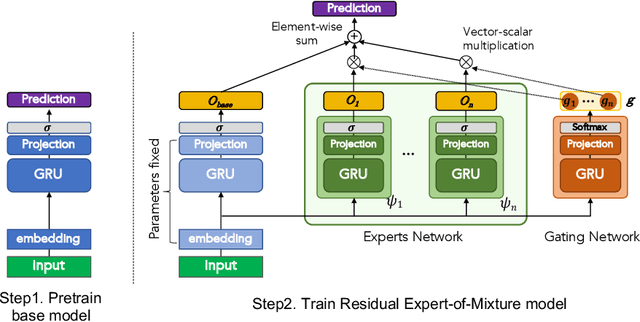

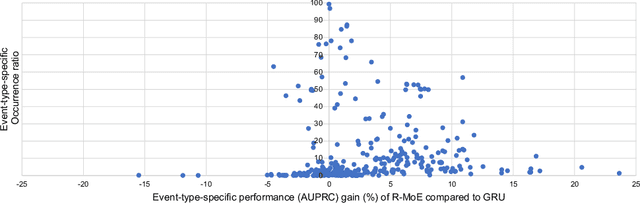
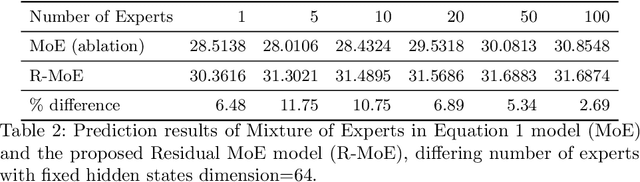
Clinical event sequences in Electronic Health Records (EHRs) record detailed information about the patient condition and patient care as they occur in time. Recent years have witnessed increased interest of machine learning community in developing machine learning models solving different types of problems defined upon information in EHRs. More recently, neural sequential models, such as RNN and LSTM, became popular and widely applied models for representing patient sequence data and for predicting future events or outcomes based on such data. However, a single neural sequential model may not properly represent complex dynamics of all patients and the differences in their behaviors. In this work, we aim to alleviate this limitation by refining a one-fits-all model using a Mixture-of-Experts (MoE) architecture. The architecture consists of multiple (expert) RNN models covering patient sub-populations and refining the predictions of the base model. That is, instead of training expert RNN models from scratch we define them on the residual signal that attempts to model the differences from the population-wide model. The heterogeneity of various patient sequences is modeled through multiple experts that consist of RNN. Particularly, instead of directly training MoE from scratch, we augment MoE based on the prediction signal from pretrained base GRU model. With this way, the mixture of experts can provide flexible adaptation to the (limited) predictive power of the single base RNN model. We experiment with the newly proposed model on real-world EHRs data and the multivariate clinical event prediction task. We implement RNN using Gated Recurrent Units (GRU). We show 4.1% gain on AUPRC statistics compared to a single RNN prediction.
Improving Prediction of Low-Prior Clinical Events with Simultaneous General Patient-State Representation Learning
Jun 28, 2021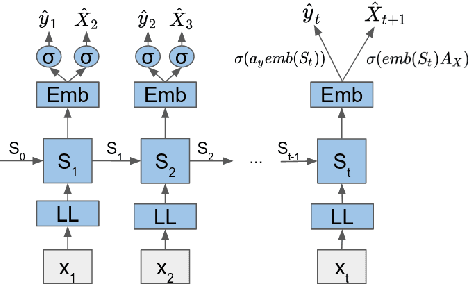
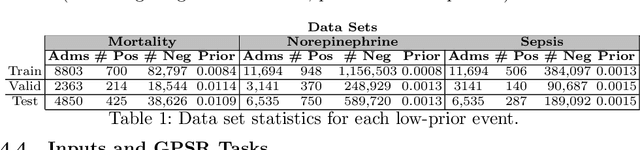
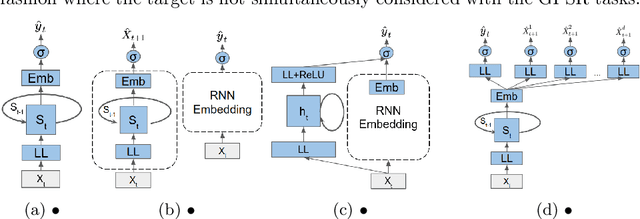
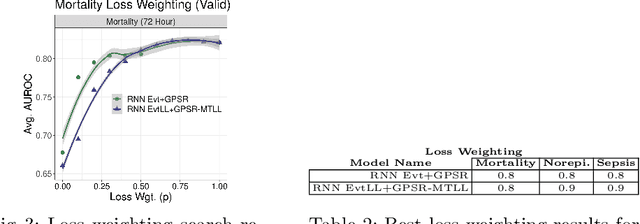
Low-prior targets are common among many important clinical events, which introduces the challenge of having enough data to support learning of their predictive models. Many prior works have addressed this problem by first building a general patient-state representation model, and then adapting it to a new low-prior prediction target. In this schema, there is potential for the predictive performance to be hindered by the misalignment between the general patient-state model and the target task. To overcome this challenge, we propose a new method that simultaneously optimizes a shared model through multi-task learning of both the low-prior supervised target and general purpose patient-state representation (GPSR). More specifically, our method improves prediction performance of a low-prior task by jointly optimizing a shared model that combines the loss of the target event and a broad range of generic clinical events. We study the approach in the context of Recurrent Neural Networks (RNNs). Through extensive experiments on multiple clinical event targets using MIMIC-III data, we show that the inclusion of general patient-state representation tasks during model training improves the prediction of individual low-prior targets.
Neural Clinical Event Sequence Prediction through Personalized Online Adaptive Learning
Apr 06, 2021
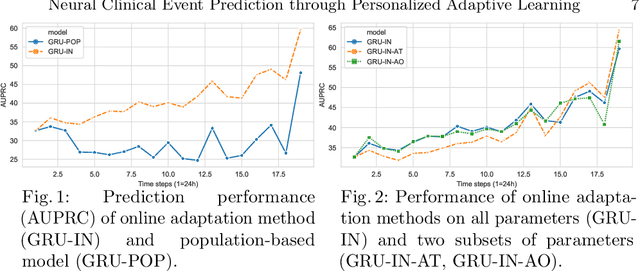
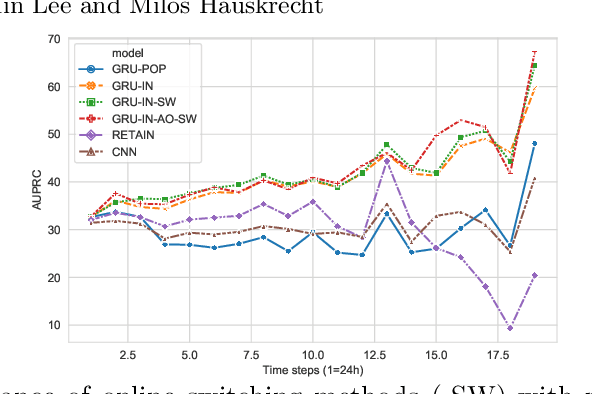
Clinical event sequences consist of thousands of clinical events that represent records of patient care in time. Developing accurate prediction models for such sequences is of a great importance for defining representations of a patient state and for improving patient care. One important challenge of learning a good predictive model of clinical sequences is patient-specific variability. Based on underlying clinical complications, each patient's sequence may consist of different sets of clinical events. However, population-based models learned from such sequences may not accurately predict patient-specific dynamics of event sequences. To address the problem, we develop a new adaptive event sequence prediction framework that learns to adjust its prediction for individual patients through an online model update.
Contextual Outlier Detection in Continuous-Time Event Sequences
Dec 19, 2019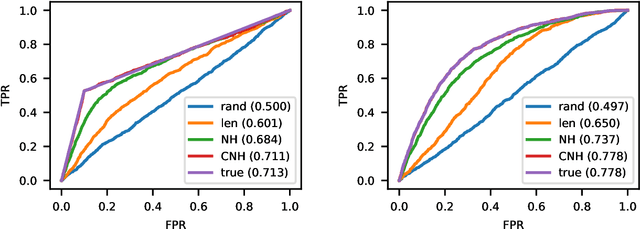
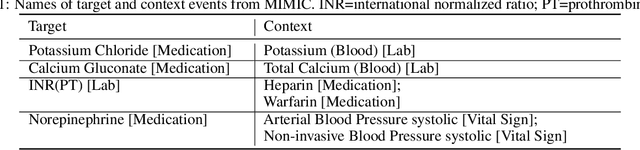
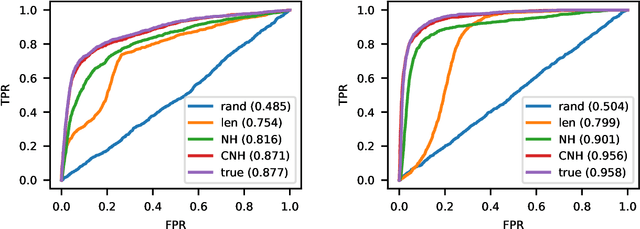
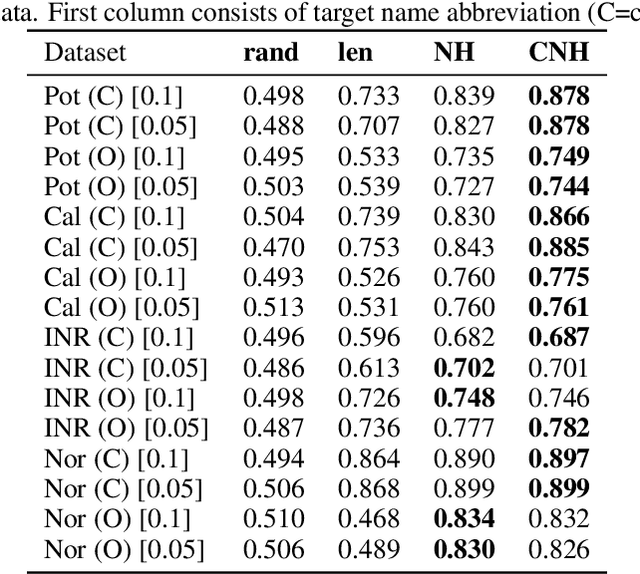
Continuous-time event sequences represent discrete events occurring in continuous time. Such sequences arise frequently in real-life and cover a wide variety of natural events, such as earthquakes, or events corresponding to human actions, such as medical administrations. Usually we expect the event sequences to follow some regular pattern over time. However, sometimes these regular patterns may be interrupted by unexpected absence or unexpected occurrences of events. Identification of these unexpected cases can be very important as they may point to abnormal situations that need human attention. In this work, we study and develop methods for detecting outliers in continuous-time event sequences, including unexpected absence and unexpected occurrences of events. Since the patterns that event sequences tend to follow may change in different contexts, we develop outlier detection methods based on point processes that take into account different contexts. Our outlier scoring methods are based on Bayesian decision theory and hypothesis testing with theoretical guarantees. To test the performance of the methods, we conduct experiments on both synthetic data and real-world clinical data and show the effectiveness of the proposed methods.
Detection of Abnormal Input-Output Associations
Aug 03, 2017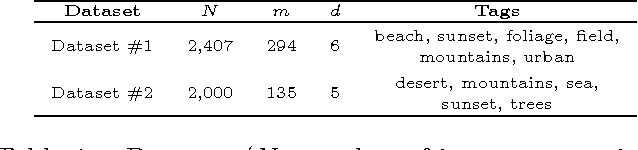
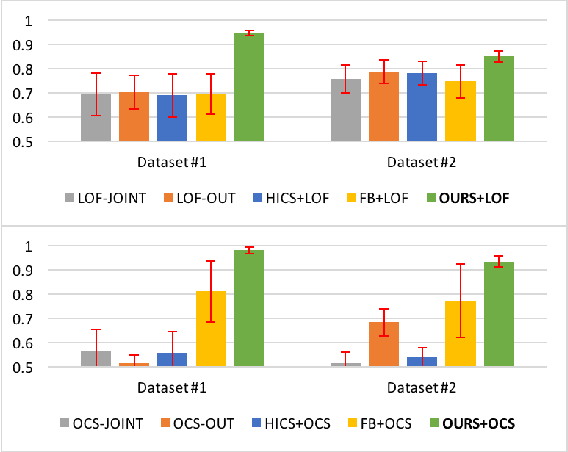
We study a novel outlier detection problem that aims to identify abnormal input-output associations in data, whose instances consist of multi-dimensional input (context) and output (responses) pairs. We present our approach that works by analyzing data in the conditional (input--output) relation space, captured by a decomposable probabilistic model. Experimental results demonstrate the ability of our approach in identifying multivariate conditional outliers.