 Add to Chrome
 Add to Firefox
 Add to Edge
Empirical Study of Observable Sets in Multiclass Quantum Classification
Feb 09, 2026
Variational quantum algorithms have gained attention as early applications of quantum computers for learning tasks. In the context of supervised learning, most of the works that tackle classification problems with parameterized quantum circuits constrain their scope to the setting of binary classification or perform multiclass classification via ensembles of binary classifiers (strategies such as one versus rest). Those few works that propose native multiclass models, however, do not justify the choice of observables that perform the classification. This work studies two main classification criteria in multiclass quantum machine learning: maximizing the expected value of an observable representing a class or maximizing the fidelity of the encoded quantum state with a reference state representing a class. To compare both approaches, sets of Pauli strings and sets of projectors into the computational basis are chosen as observables in the quantum machine learning models. Observing the empirical behavior of each model type, the effect of different observable set choices on the performance of quantum machine learning models is analyzed in the context of Barren Plateaus and Neural Collapse. The results provide insights that may guide the design of future multiclass quantum machine learning models.

Image Classification with Rotation-Invariant Variational Quantum Circuits
Mar 22, 2024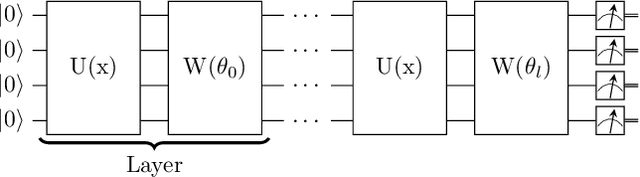
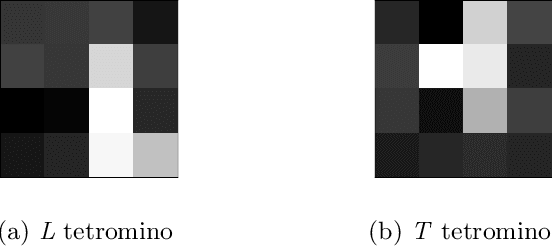
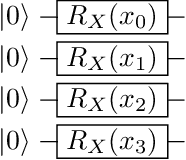
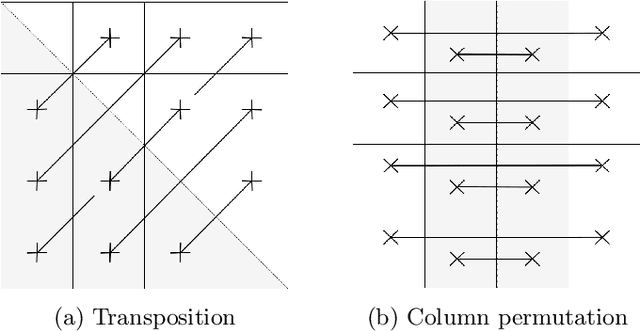
Variational quantum algorithms are gaining attention as an early application of Noisy Intermediate-Scale Quantum (NISQ) devices. One of the main problems of variational methods lies in the phenomenon of Barren Plateaus, present in the optimization of variational parameters. Adding geometric inductive bias to the quantum models has been proposed as a potential solution to mitigate this problem, leading to a new field called Geometric Quantum Machine Learning. In this work, an equivariant architecture for variational quantum classifiers is introduced to create a label-invariant model for image classification with $C_4$ rotational label symmetry. The equivariant circuit is benchmarked against two different architectures, and it is experimentally observed that the geometric approach boosts the model's performance. Finally, a classical equivariant convolution operation is proposed to extend the quantum model for the processing of larger images, employing the resources available in NISQ devices.