 Add to Chrome
 Add to Firefox
 Add to Edge
What Works for 'Lost-in-the-Middle' in LLMs? A Study on GM-Extract and Mitigations
Nov 17, 2025
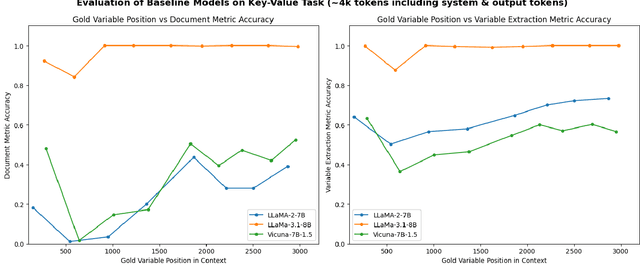
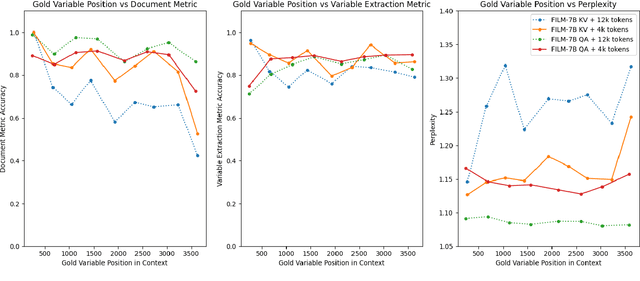
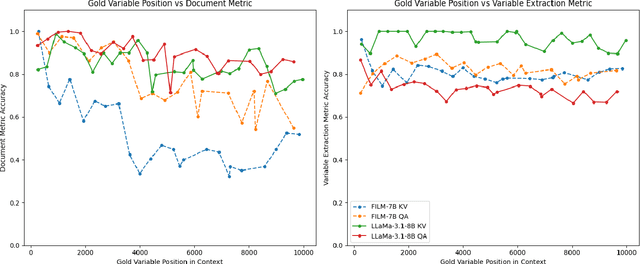
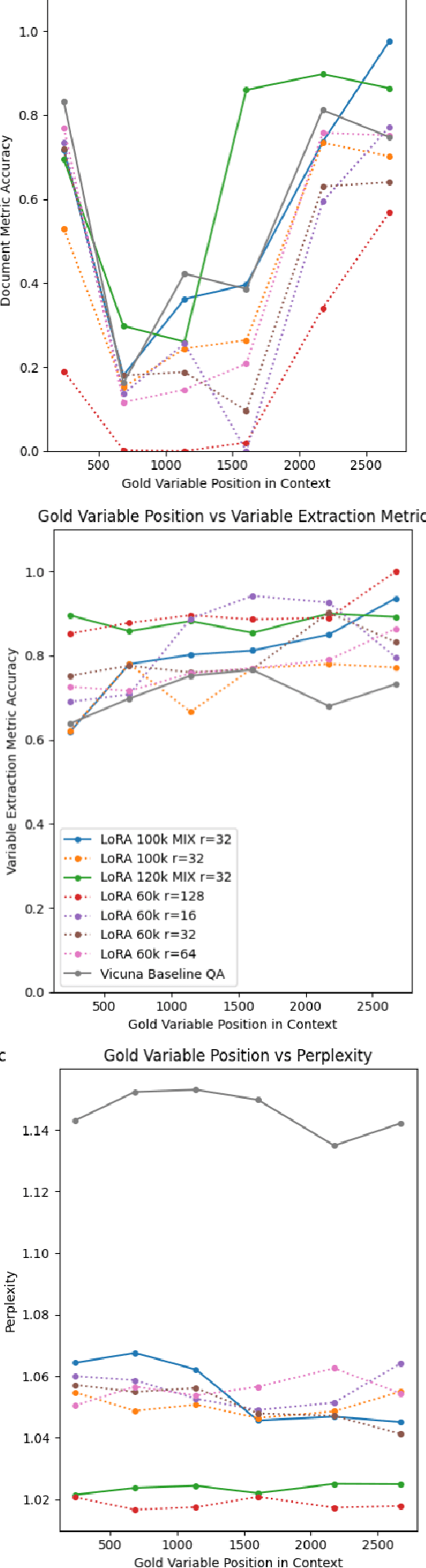
The diminishing ability of large language models (LLMs) to effectively utilize long-range context-the "lost-in-the-middle" phenomenon-poses a significant challenge in retrieval-based LLM applications. To study the impact of this phenomenon in a real-world application setting, we introduce GM-Extract, a novel benchmark dataset meticulously designed to evaluate LLM performance on retrieval of control variables. To accurately diagnose failure modes, we propose a simple yet elegant evaluation system using two distinct metrics: one for spatial retrieval capability (Document Metric) and the other for semantic retrieval capability (Variable Extraction Metric). We conduct a systematic evaluation of 7-8B parameter models on two multi-document tasks (key-value extraction and question-answering), demonstrating a significant change in retrieval performance simply by altering how the data is represented in the context window. While a distinct U-shaped curve was not consistently observed, our analysis reveals a clear pattern of performance across models, which we further correlate with perplexity scores. Furthermore, we perform a literature survey of mitigation methods, which we categorize into two distinct approaches: black-box and white-box methods. We then apply these techniques to our benchmark, finding that their efficacy is highly nuanced. Our evaluation highlights scenarios where these strategies successfully improve performance, as well as surprising cases where they lead to a negative impact, providing a comprehensive understanding of their utility in a practical context.

Towards Autoformalization of LLM-generated Outputs for Requirement Verification
Nov 14, 2025Autoformalization, the process of translating informal statements into formal logic, has gained renewed interest with the emergence of powerful Large Language Models (LLMs). While LLMs show promise in generating structured outputs from natural language (NL), such as Gherkin Scenarios from NL feature requirements, there's currently no formal method to verify if these outputs are accurate. This paper takes a preliminary step toward addressing this gap by exploring the use of a simple LLM-based autoformalizer to verify LLM-generated outputs against a small set of natural language requirements. We conducted two distinct experiments. In the first one, the autoformalizer successfully identified that two differently-worded NL requirements were logically equivalent, demonstrating the pipeline's potential for consistency checks. In the second, the autoformalizer was used to identify a logical inconsistency between a given NL requirement and an LLM-generated output, highlighting its utility as a formal verification tool. Our findings, while limited, suggest that autoformalization holds significant potential for ensuring the fidelity and logical consistency of LLM-generated outputs, laying a crucial foundation for future, more extensive studies into this novel application.