 Add to Chrome
 Add to Firefox
 Add to Edge
Automating the Detection of Requirement Dependencies Using Large Language Models
Feb 25, 2026
Requirements are inherently interconnected through various types of dependencies. Identifying these dependencies is essential, as they underpin critical decisions and influence a range of activities throughout software development. However, this task is challenging, particularly in modern software systems, given the high volume of complex, coupled requirements. These challenges are further exacerbated by the ambiguity of Natural Language (NL) requirements and their constant change. Consequently, requirement dependency detection is often overlooked or performed manually. Large Language Models (LLMs) exhibit strong capabilities in NL processing, presenting a promising avenue for requirement-related tasks. While they have shown to enhance various requirements engineering tasks, their effectiveness in identifying requirement dependencies remains unexplored. In this paper, we introduce LEREDD, an LLM-based approach for automated detection of requirement dependencies that leverages Retrieval-Augmented Generation (RAG) and In-Context Learning (ICL). It is designed to identify diverse dependency types directly from NL requirements. We empirically evaluate LEREDD against two state-of-the-art baselines. The results show that LEREDD provides highly accurate classification of dependent and non-dependent requirements, achieving an accuracy of 0.93, and an F1 score of 0.84, with the latter averaging 0.96 for non-dependent cases. LEREDD outperforms zero-shot LLMs and baselines, particularly in detecting fine-grained dependency types, where it yields average relative gains of 94.87% and 105.41% in F1 scores for the Requires dependency over the baselines. We also provide an annotated dataset of requirement dependencies encompassing 813 requirement pairs across three distinct systems to support reproducibility and future research.

What Works for 'Lost-in-the-Middle' in LLMs? A Study on GM-Extract and Mitigations
Nov 17, 2025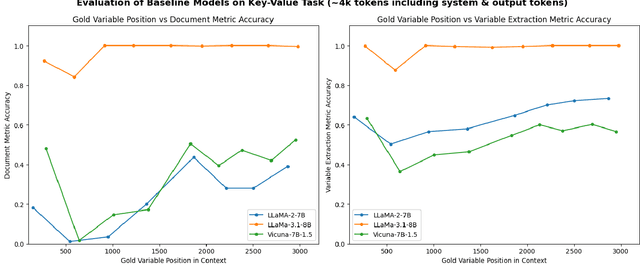
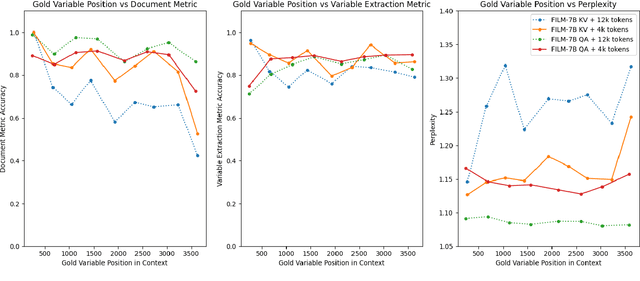
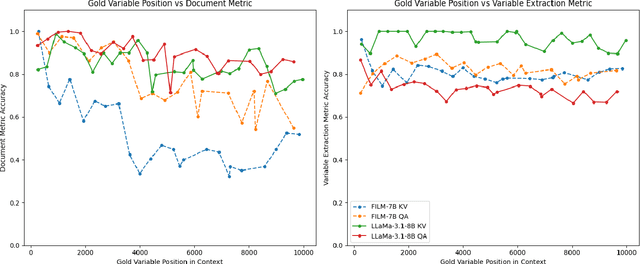
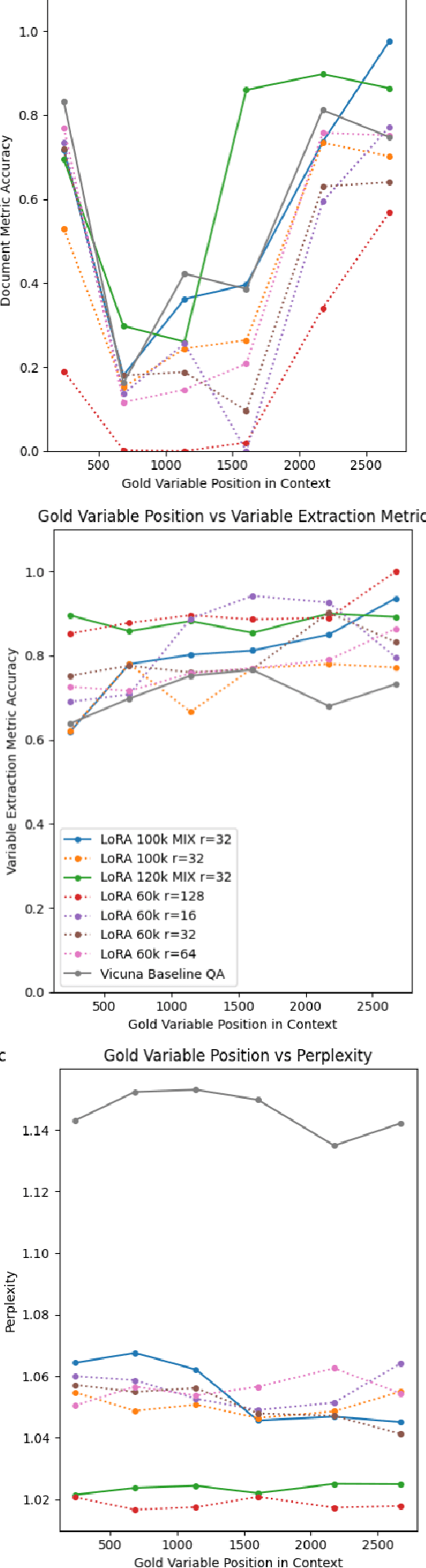
The diminishing ability of large language models (LLMs) to effectively utilize long-range context-the "lost-in-the-middle" phenomenon-poses a significant challenge in retrieval-based LLM applications. To study the impact of this phenomenon in a real-world application setting, we introduce GM-Extract, a novel benchmark dataset meticulously designed to evaluate LLM performance on retrieval of control variables. To accurately diagnose failure modes, we propose a simple yet elegant evaluation system using two distinct metrics: one for spatial retrieval capability (Document Metric) and the other for semantic retrieval capability (Variable Extraction Metric). We conduct a systematic evaluation of 7-8B parameter models on two multi-document tasks (key-value extraction and question-answering), demonstrating a significant change in retrieval performance simply by altering how the data is represented in the context window. While a distinct U-shaped curve was not consistently observed, our analysis reveals a clear pattern of performance across models, which we further correlate with perplexity scores. Furthermore, we perform a literature survey of mitigation methods, which we categorize into two distinct approaches: black-box and white-box methods. We then apply these techniques to our benchmark, finding that their efficacy is highly nuanced. Our evaluation highlights scenarios where these strategies successfully improve performance, as well as surprising cases where they lead to a negative impact, providing a comprehensive understanding of their utility in a practical context.