 Add to Chrome
 Add to Firefox
 Add to Edge
Tight Convergence Rates for Online Distributed Linear Estimation with Adversarial Measurements
Apr 07, 2026
We study mean estimation of a random vector $X$ in a distributed parameter-server-worker setup. Worker $i$ observes samples of $a_i^\top X$, where $a_i^\top$ is the $i$th row of a known sensing matrix $A$. The key challenges are adversarial measurements and asynchrony: a fixed subset of workers may transmit corrupted measurements, and workers are activated asynchronously--only one is active at any time. In our previous work, we proposed a two-timescale $\ell_1$-minimization algorithm and established asymptotic recovery under a null-space-property-like condition on $A$. In this work, we establish tight non-asymptotic convergence rates under the same null-space-property-like condition. We also identify relaxed conditions on $A$ under which exact recovery may fail but recovery of a projected component of $\mathbb{E}[X]$ remains possible. Overall, our results provide a unified finite-time characterization of robustness, identifiability, and statistical efficiency in distributed linear estimation with adversarial workers, with implications for network tomography and related distributed sensing problems.

A continuous Structural Intervention Distance to compare Causal Graphs
Jul 31, 2023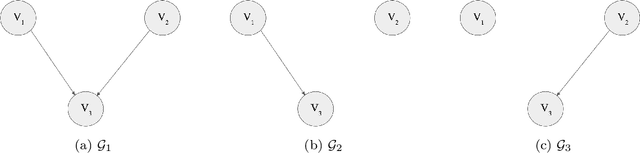
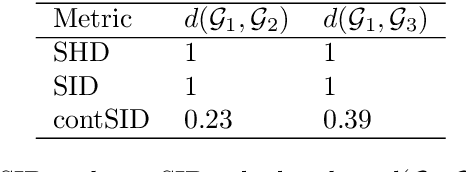

Understanding and adequately assessing the difference between a true and a learnt causal graphs is crucial for causal inference under interventions. As an extension to the graph-based structural Hamming distance and structural intervention distance, we propose a novel continuous-measured metric that considers the underlying data in addition to the graph structure for its calculation of the difference between a true and a learnt causal graph. The distance is based on embedding intervention distributions over each pair of nodes as conditional mean embeddings into reproducing kernel Hilbert spaces and estimating their difference by the maximum (conditional) mean discrepancy. We show theoretical results which we validate with numerical experiments on synthetic data.