 Add to Chrome
 Add to Firefox
 Add to Edge
Towards Safe Learning-Based Non-Linear Model Predictive Control through Recurrent Neural Network Modeling
Mar 25, 2026
The practical deployment of nonlinear model predictive control (NMPC) is often limited by online computation: solving a nonlinear program at high control rates can be expensive on embedded hardware, especially when models are complex or horizons are long. Learning-based NMPC approximations shift this computation offline but typically demand large expert datasets and costly training. We propose Sequential-AMPC, a sequential neural policy that generates MPC candidate control sequences by sharing parameters across the prediction horizon. For deployment, we wrap the policy in a safety-augmented online evaluation and fallback mechanism, yielding Safe Sequential-AMPC. Compared to a naive feedforward policy baseline across several benchmarks, Sequential-AMPC requires substantially fewer expert MPC rollouts and yields candidate sequences with higher feasibility rates and improved closed-loop safety. On high-dimensional systems, it also exhibits better learning dynamics and performance in fewer epochs while maintaining stable validation improvement where the feedforward baseline can stagnate.

Depth Matters: Multimodal RGB-D Perception for Robust Autonomous Agents
Mar 20, 2025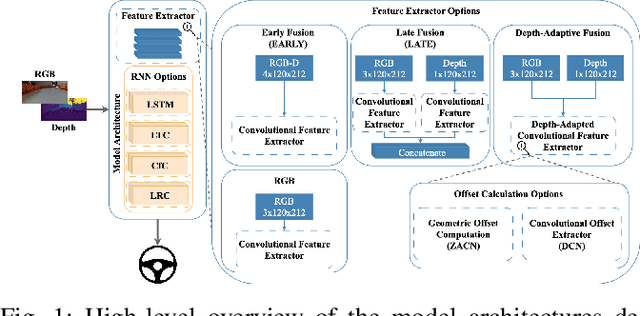
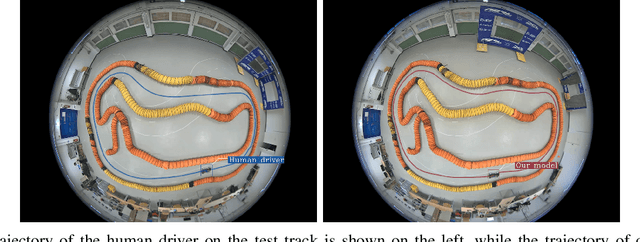
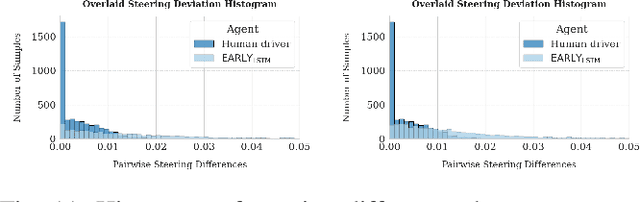
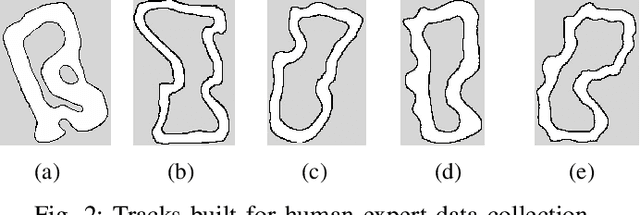
Autonomous agents that rely purely on perception to make real-time control decisions require efficient and robust architectures. In this work, we demonstrate that augmenting RGB input with depth information significantly enhances our agents' ability to predict steering commands compared to using RGB alone. We benchmark lightweight recurrent controllers that leverage the fused RGB-D features for sequential decision-making. To train our models, we collect high-quality data using a small-scale autonomous car controlled by an expert driver via a physical steering wheel, capturing varying levels of steering difficulty. Our models, trained under diverse configurations, were successfully deployed on real hardware. Specifically, our findings reveal that the early fusion of depth data results in a highly robust controller, which remains effective even with frame drops and increased noise levels, without compromising the network's focus on the task.