 Add to Chrome
 Add to Firefox
 Add to Edge
The Climate Change Knowledge Graph: Supporting Climate Services
Feb 23, 2026
Climate change impacts a broad spectrum of human resources and activities, necessitating the use of climate models to project long-term effects and inform mitigation and adaptation strategies. These models generate multiple datasets by running simulations across various scenarios and configurations, thereby covering a range of potential future outcomes. Currently, researchers rely on traditional search interfaces and APIs to retrieve such datasets, often piecing together information from metadata and community vocabularies. The Climate Change Knowledge Graph is designed to address these challenges by integrating diverse data sources related to climate simulations into a coherent and interoperable knowledge graph. This innovative resource allows for executing complex queries involving climate models, simulations, variables, spatio-temporal domains, and granularities. Developed with input from domain experts, the knowledge graph and its underlying ontology are published with open access license and provide a comprehensive framework that enhances the exploration of climate data, facilitating more informed decision-making in addressing climate change issues.

Ontology Generation using Large Language Models
Mar 07, 2025The ontology engineering process is complex, time-consuming, and error-prone, even for experienced ontology engineers. In this work, we investigate the potential of Large Language Models (LLMs) to provide effective OWL ontology drafts directly from ontological requirements described using user stories and competency questions. Our main contribution is the presentation and evaluation of two new prompting techniques for automated ontology development: Memoryless CQbyCQ and Ontogenia. We also emphasize the importance of three structural criteria for ontology assessment, alongside expert qualitative evaluation, highlighting the need for a multi-dimensional evaluation in order to capture the quality and usability of the generated ontologies. Our experiments, conducted on a benchmark dataset of ten ontologies with 100 distinct CQs and 29 different user stories, compare the performance of three LLMs using the two prompting techniques. The results demonstrate improvements over the current state-of-the-art in LLM-supported ontology engineering. More specifically, the model OpenAI o1-preview with Ontogenia produces ontologies of sufficient quality to meet the requirements of ontology engineers, significantly outperforming novice ontology engineers in modelling ability. However, we still note some common mistakes and variability of result quality, which is important to take into account when using LLMs for ontology authoring support. We discuss these limitations and propose directions for future research.
The World Literature Knowledge Graph
Jul 31, 2023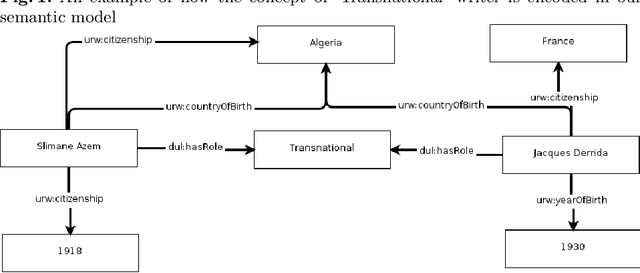

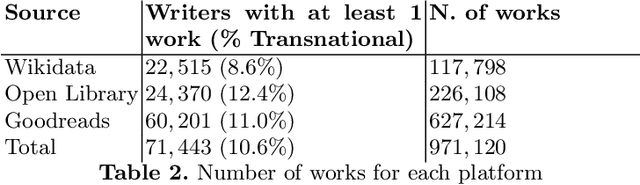

Digital media have enabled the access to unprecedented literary knowledge. Authors, readers, and scholars are now able to discover and share an increasing amount of information about books and their authors. However, these sources of knowledge are fragmented and do not adequately represent non-Western writers and their works. In this paper we present The World Literature Knowledge Graph, a semantic resource containing 194,346 writers and 965,210 works, specifically designed for exploring facts about literary works and authors from different parts of the world. The knowledge graph integrates information about the reception of literary works gathered from 3 different communities of readers, aligned according to a single semantic model. The resource is accessible through an online visualization platform, which can be found at the following URL: https://literaturegraph.di.unito.it/. This platform has been rigorously tested and validated by $3$ distinct categories of experts who have found it to be highly beneficial for their respective work domains. These categories include teachers, researchers in the humanities, and professionals in the publishing industry. The feedback received from these experts confirms that they can effectively utilize the platform to enhance their work processes and achieve valuable outcomes.