 Add to Chrome
 Add to Firefox
 Add to Edge
Alternating Levenberg-Marquardt Training of Physics-Informed Neural Networks with Fourier-Enhanced Features
Aug 06, 2026
Physics-informed neural networks (PINNs) often fail to accurately resolve partial differential equations (PDEs) with high-frequency or multi-scale solutions, as well as strongly nonlinear problems. Two factors underlie this difficulty: spectral bias, the tendency of neural networks to underfit high-frequency features; and representation-coefficient coupling, the entanglement of representation learning and coefficient fitting within a single nonconvex optimization objective. In this work, we propose the Fourier-enhanced alternating Levenberg--Marquardt PINN (FALM-PINN), an optimization framework that decouples representation learning from coefficient fitting. The upper-level problem learns a Fourier-enhanced basis that enriches the latent space with high-frequency components, while the lower-level problem resolves the coupling by fitting the projection coefficients on this basis, solving a nonlinear least-squares problem with the Levenberg--Marquardt algorithm. The framework applies to general nonlinear and coupled PDE systems, and reduces to a single-step convex optimization problem for linear PDEs. We prove global convergence of the alternating training scheme in both cases. Numerical examples on multiple challenging high-frequency and nonlinear PDEs show that FALM-PINN achieves relative $L^2$ errors up to two orders of magnitude lower than state-of-the-art baselines.

RHYME-XT: A Neural Operator for Spatiotemporal Control Systems
Mar 18, 2026We propose RHYME-XT, an operator-learning framework for surrogate modeling of spatiotemporal control systems governed by input-affine nonlinear partial integro-differential equations (PIDEs) with localized rhythmic behavior. RHYME-XT uses a Galerkin projection to approximate the infinite-dimensional PIDE on a learned finite-dimensional subspace with spatial basis functions parameterized by a neural network. This yields a projected system of ODEs driven by projected inputs. Instead of integrating this non-autonomous system, we directly learn its flow map using an architecture for learning flow functions, avoiding costly computations while obtaining a continuous-time and discretization-invariant representation. Experiments on a neural field PIDE show that RHYME-XT outperforms a state-of-the-art neural operator and is able to transfer knowledge effectively across models trained on different datasets, through a fine-tuning process.
Learning Flow Functions from Data with Applications to Nonlinear Oscillators
Apr 11, 2023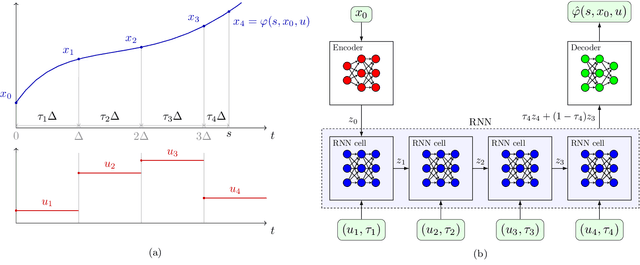
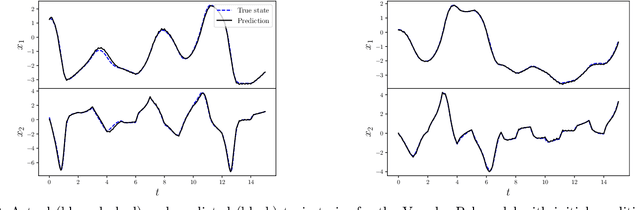
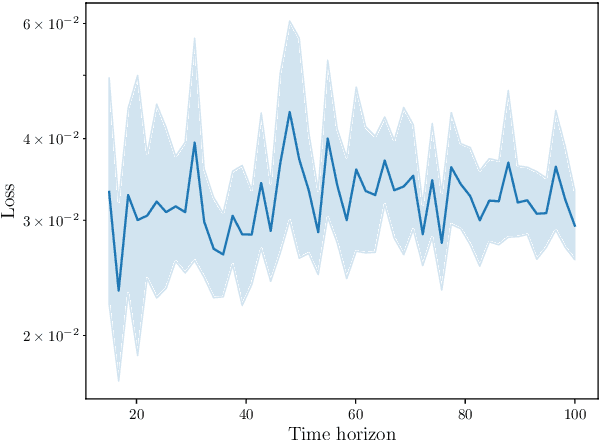
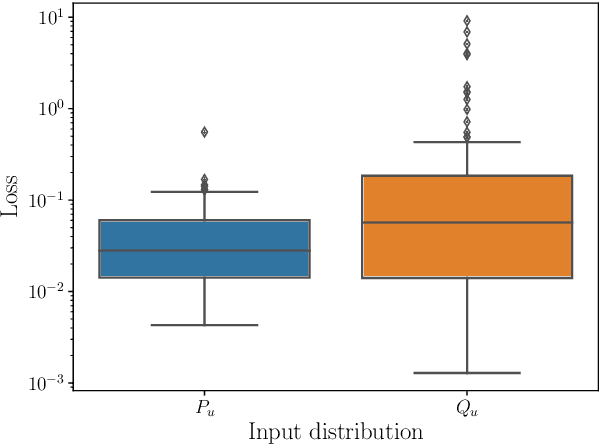
We describe a recurrent neural network (RNN) based architecture to learn the flow function of a causal, time-invariant and continuous-time control system from trajectory data. By restricting the class of control inputs to piecewise constant functions, we show that learning the flow function is equivalent to learning the input-to-state map of a discrete-time dynamical system. This motivates the use of an RNN together with encoder and decoder networks which map the state of the system to the hidden state of the RNN and back. We show that the proposed architecture is able to approximate the flow function by exploiting the system's causality and time-invariance. The output of the learned flow function model can be queried at any time instant. We experimentally validate the proposed method using models of the Van der Pol and FitzHugh Nagumo oscillators. In both cases, the results demonstrate that the architecture is able to closely reproduce the trajectories of these two systems. For the Van der Pol oscillator, we further show that the trained model generalises to the system's response with a prolonged prediction time horizon as well as control inputs outside the training distribution. For the FitzHugh-Nagumo oscillator, we show that the model accurately captures the input-dependent phenomena of excitability.