 Add to Chrome
 Add to Firefox
 Add to Edge
The generator is the tracker: Multi-object tracking by painting persistent identity colours
Jul 19, 2026
Multi-object tracking (MOT) is conventionally decomposed into detection followed by association, with object identity maintained as external state: track buffers, motion models, and appearance embeddings. We ask whether a video generator can maintain that state in pixels. We fine-tune a 22B text-to-video diffusion model (LTX-2.3) with a lightweight in-context LoRA to translate an RGB clip into an ID-map clip, a video in which every person is painted a flat, distinct color that persists over time: same color, same identity. Long videos are generated as chained windows, where each window is conditioned on the cleaned tail of the previous one. A brief continuation fine-tune teaches the model to extend a given coloring, after which identity flows through the chain with no tracker, no motion model, and no re-identification module. On the DanceTrack test server, our system, to our knowledge the first generative tracker evaluated there and the only entry with no detector and no tracking stack, reaches 40.3 HOTA. This is well below today's specialist state of the art (>=70 HOTA), but with a unique, inverted error profile: its association score (AssA 44.1) exceeds every tracker of the original benchmark suite while detection remains the sole deficit. Controlled comparisons show the mechanism matters: the same generated windows linked by classical post-hoc association score 2x worse (18.2 HOTA), and frame-to-frame IoU association fragments tracks that the generator's colors keep whole. On 383 mined occlusion events, the generator re-acquires identities after gaps at a 42% conditional rate where appearance-embedding baselines score zero, including gaps longer than its temporal context, evidence that the generator's color assignment functions as an emergent re-identification signal. We release code, checkpoints, and the full pre-registered experimental log.

Exploring parameter-efficient fine-tuning (PEFT) of billion-parameter vision models with QLoRA and DoRA: insights into generalization for limited-data image classification under a 98:1 test-to-train regime
Mar 18, 2026Automated behavior classification is essential for precision livestock farming but faces challenges of high computational costs and limited labeled data. This study systematically compared three approaches: training from scratch (ResNet-18, ViT-Small), frozen feature extraction, and parameter-efficient fine-tuning (PEFT) of the DINOv3 foundation model (6.7 billion parameters). We evaluated QLoRA and DoRA across multiple configurations varying rank (8, 16, 64) and target modules (q_proj versus all-linear layers). With 2,160 verified training images, we assessed generalization of our model on 211,800 test samples, which is essentially a 98:1 test-to-train ratio. Results demonstrated that PEFT substantially outperformed alternatives, where the best QLoRA configuration (all-linear layers and rank=64) achieved 83.16% test accuracy with only 2.72% parameters (183.0M) in 5.8 hours, compared to 72.87% for ResNet-18 (16.8 hours), 61.91% for ViT-Small (18.7 hours), and 76.56% for frozen DINOv3 (17.5 hours). DoRA achieved comparable accuracy (83.14%) but with longer training time (11.0 hours). Notably, increasing adapter capacity consistently improved generalization while simultaneously not causing overfitting: reducing rank from 16 to 8 decreased test accuracy from 78.38% to 77.17%, while expanding from q_proj-only to all-linear layers with rank=64 improved accuracy from 78.38% to 83.16%. This suggests underfitting, instead of overfitting, is the primary challenge when adapting foundation models to agricultural imagery. Our findings provide guidelines for deploying billion-parameter vision models with PEFT in agricultural livestock applications.
From Manual Observation to Automated Monitoring: Space Allowance Effects on Play Behaviour in Group-Housed Dairy Calves
Jan 26, 2026Play behaviour serves as a positive welfare indicator in dairy calves, yet the influence of space allowance under commercial conditions remains poorly characterized, particularly at intermediate-to-high allowances (6-20 m2 per calf). This study investigated the relationship between space allowance and play behaviour in 60 group-housed dairy calves across 14 commercial farms in the Netherlands (space range: 2.66-17.98 m2 per calf), and developed an automated computer vision pipeline for scalable monitoring. Video observations were analyzed using a detailed ethogram, with play expressed as percentage of observation period (%OP). Statistical analysis employed linear mixed models with farm as a random effect. A computer vision pipeline was trained on manual annotations from 108 hours on 6 farms and validated on held-out test data. The computer vision classifier achieved 97.6% accuracy with 99.4% recall for active play detection. Calves spent on average 1.0% of OP playing reflecting around 10 minutes per 17-hour period. The space-play relationship was non-linear, with highest play levels at 8-10 m2 per calf (1.6% OP) and lowest at 6-8 m2 and 12-14 m2 (<0.6% OP). Space remained significant after controlling for age, health, and group size. In summary, these findings suggest that 8-10 m2 per calf represents a practical target balancing welfare benefits with economic feasibility, and demonstrate that automated monitoring can scale small annotation projects to continuous welfare assessment systems.
Evaluating Small Language Models for Agentic On-Farm Decision Support Systems
Dec 16, 2025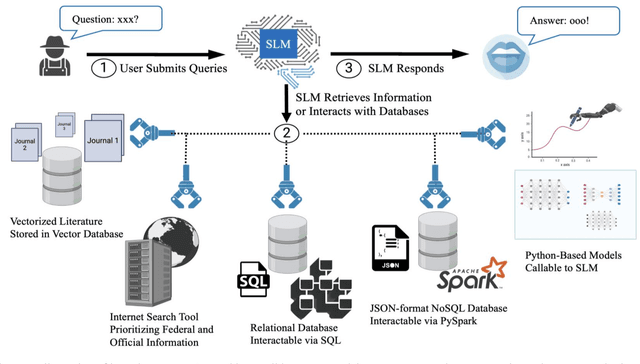
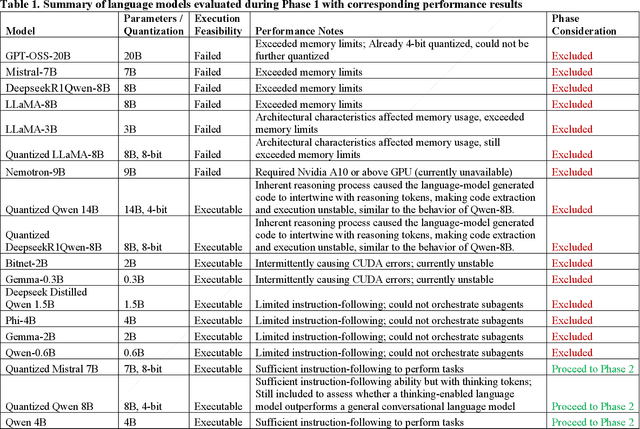
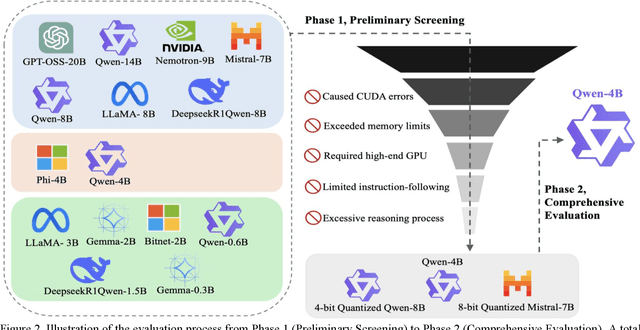

Large Language Models (LLM) hold potential to support dairy scholars and farmers by supporting decision-making and broadening access to knowledge for stakeholders with limited technical expertise. However, the substantial computational demand restricts access to LLM almost exclusively through cloud-based service, which makes LLM-based decision support tools impractical for dairy farming. To address this gap, lightweight alternatives capable of running locally on farm hardware are required. In this work, we benchmarked 20 open-source Small Language Models (SLM) available on HuggingFace under farm-realistic computing constraints. Building on our prior work, we developed an agentic AI system that integrates five task-specific agents: literature search, web search, SQL database interaction, NoSQL database interaction, and graph generation following predictive models. Evaluation was conducted in two phases. In the first phase, five test questions were used for the initial screening to identify models capable of following basic dairy-related instructions and performing reliably in a compute-constrained environment. Models that passed this preliminary stage were then evaluated using 30 questions (five per task category mentioned above, plus one category addressing integrity and misconduct) in phase two. In results, Qwen-4B achieved superior performance across most of task categories, although showed unstable effectiveness in NoSQL database interactions through PySpark. To our knowledge, this is the first work explicitly evaluating the feasibility of SLM as engines for dairy farming decision-making, with central emphases on privacy and computational efficiency. While results highlight the promise of SLM-assisted tools for practical deployment in dairy farming, challenges remain, and fine-tuning is still needed to refine SLM performance in dairy-specific questions.