 Add to Chrome
 Add to Firefox
 Add to Edge
Statistical Proof of Execution (SPEX)
Mar 24, 2025
Many real-world applications are increasingly incorporating automated decision-making, driven by the widespread adoption of ML/AI inference for planning and guidance. This study examines the growing need for verifiable computing in autonomous decision-making. We formalize the problem of verifiable computing and introduce a sampling-based protocol that is significantly faster, more cost-effective, and simpler than existing methods. Furthermore, we tackle the challenges posed by non-determinism, proposing a set of strategies to effectively manage common scenarios.

Node Classification in Uncertain Graphs
May 22, 2014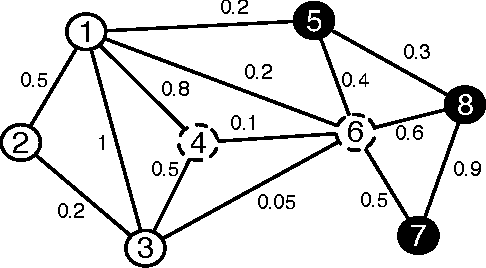
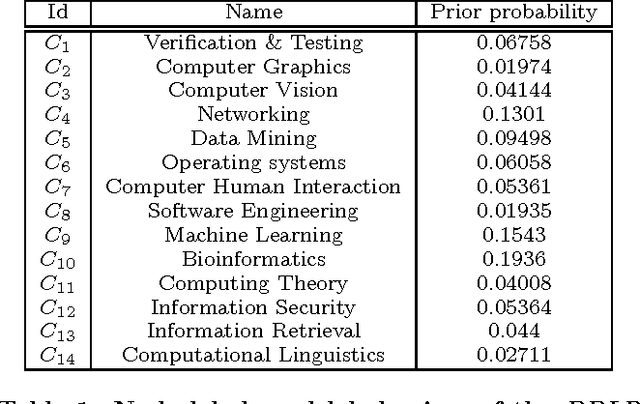
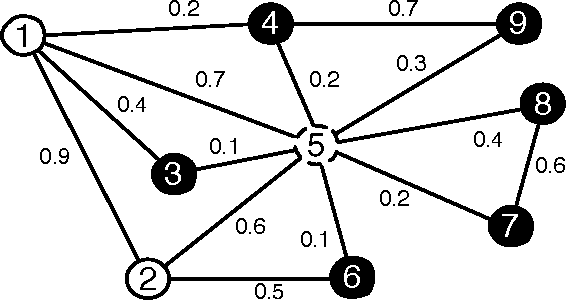
In many real applications that use and analyze networked data, the links in the network graph may be erroneous, or derived from probabilistic techniques. In such cases, the node classification problem can be challenging, since the unreliability of the links may affect the final results of the classification process. If the information about link reliability is not used explicitly, the classification accuracy in the underlying network may be affected adversely. In this paper, we focus on situations that require the analysis of the uncertainty that is present in the graph structure. We study the novel problem of node classification in uncertain graphs, by treating uncertainty as a first-class citizen. We propose two techniques based on a Bayes model and automatic parameter selection, and show that the incorporation of uncertainty in the classification process as a first-class citizen is beneficial. We experimentally evaluate the proposed approach using different real data sets, and study the behavior of the algorithms under different conditions. The results demonstrate the effectiveness and efficiency of our approach.