 Add to Chrome
 Add to Firefox
 Add to Edge
CIP-Net: Continual Interpretable Prototype-based Network
Dec 08, 2025
Continual learning constrains models to learn new tasks over time without forgetting what they have already learned. A key challenge in this setting is catastrophic forgetting, where learning new information causes the model to lose its performance on previous tasks. Recently, explainable AI has been proposed as a promising way to better understand and reduce forgetting. In particular, self-explainable models are useful because they generate explanations during prediction, which can help preserve knowledge. However, most existing explainable approaches use post-hoc explanations or require additional memory for each new task, resulting in limited scalability. In this work, we introduce CIP-Net, an exemplar-free self-explainable prototype-based model designed for continual learning. CIP-Net avoids storing past examples and maintains a simple architecture, while still providing useful explanations and strong performance. We demonstrate that CIPNet achieves state-of-the-art performances compared to previous exemplar-free and self-explainable methods in both task- and class-incremental settings, while bearing significantly lower memory-related overhead. This makes it a practical and interpretable solution for continual learning.

Fine-grained Analysis of Brain-LLM Alignment through Input Attribution
Oct 14, 2025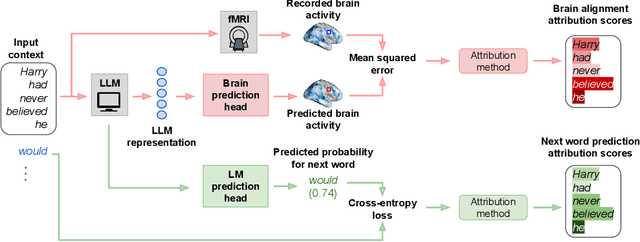

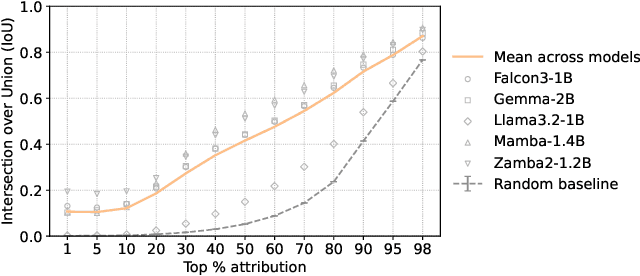
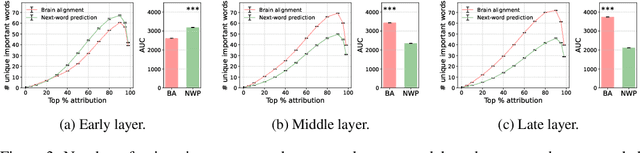
Understanding the alignment between large language models (LLMs) and human brain activity can reveal computational principles underlying language processing. We introduce a fine-grained input attribution method to identify the specific words most important for brain-LLM alignment, and leverage it to study a contentious research question about brain-LLM alignment: the relationship between brain alignment (BA) and next-word prediction (NWP). Our findings reveal that BA and NWP rely on largely distinct word subsets: NWP exhibits recency and primacy biases with a focus on syntax, while BA prioritizes semantic and discourse-level information with a more targeted recency effect. This work advances our understanding of how LLMs relate to human language processing and highlights differences in feature reliance between BA and NWP. Beyond this study, our attribution method can be broadly applied to explore the cognitive relevance of model predictions in diverse language processing tasks.