 Add to Chrome
 Add to Firefox
 Add to Edge
SommBench: Assessing Sommelier Expertise of Language Models
Mar 12, 2026
With the rapid advances of large language models, it becomes increasingly important to systematically evaluate their multilingual and multicultural capabilities. Previous cultural evaluation benchmarks focus mainly on basic cultural knowledge that can be encoded in linguistic form. Here, we propose SommBench, a multilingual benchmark to assess sommelier expertise, a domain deeply grounded in the senses of smell and taste. While language models learn about sensory properties exclusively through textual descriptions, SommBench tests whether this textual grounding is sufficient to emulate expert-level sensory judgment. SommBench comprises three main tasks: Wine Theory Question Answering (WTQA), Wine Feature Completion (WFC), and Food-Wine Pairing (FWP). SommBench is available in multiple languages: English, Slovak, Swedish, Finnish, German, Danish, Italian, and Spanish. This helps separate a language model's wine expertise from its language skills. The benchmark datasets were developed in close collaboration with a professional sommelier and native speakers of the respective languages, resulting in 1,024 wine theory question-answering questions, 1,000 wine feature-completion examples, and 1,000 food-wine pairing examples. We provide results for the most popular language models, including closed-weights models such as Gemini 2.5, and open-weights models, such as GPT-OSS and Qwen 3. Our results show that the most capable models perform well on wine theory question answering (up to 97% correct with a closed-weights model), yet feature completion (peaking at 65%) and food-wine pairing show (MCC ranging between 0 and 0.39) turn out to be more challenging. These results position SommBench as an interesting and challenging benchmark for evaluating the sommelier expertise of language models. The benchmark is publicly available at https://github.com/sommify/sommbench.

The Effectiveness of Large Language Models in Transforming Unstructured Text to Standardized Formats
Mar 04, 2025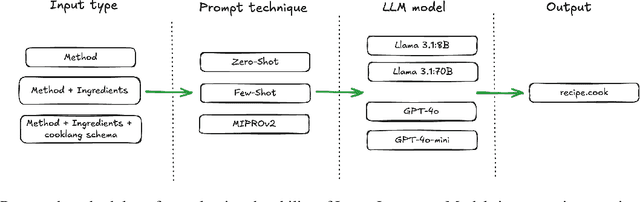
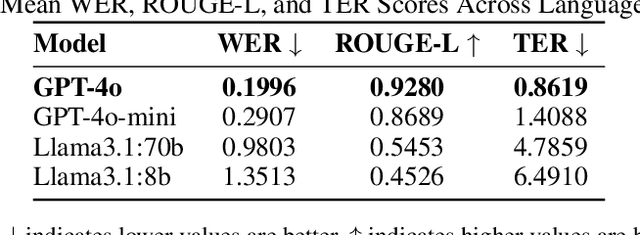
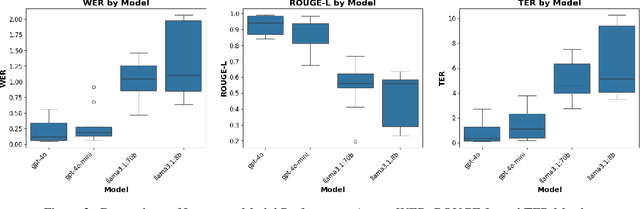
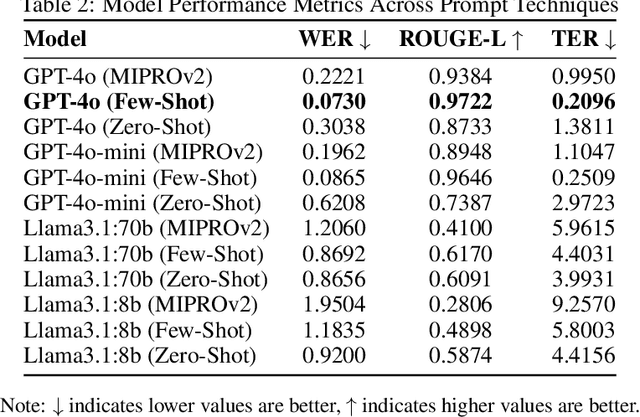
The exponential growth of unstructured text data presents a fundamental challenge in modern data management and information retrieval. While Large Language Models (LLMs) have shown remarkable capabilities in natural language processing, their potential to transform unstructured text into standardized, structured formats remains largely unexplored - a capability that could revolutionize data processing workflows across industries. This study breaks new ground by systematically evaluating LLMs' ability to convert unstructured recipe text into the structured Cooklang format. Through comprehensive testing of four models (GPT-4o, GPT-4o-mini, Llama3.1:70b, and Llama3.1:8b), an innovative evaluation approach is introduced that combines traditional metrics (WER, ROUGE-L, TER) with specialized metrics for semantic element identification. Our experiments reveal that GPT-4o with few-shot prompting achieves breakthrough performance (ROUGE-L: 0.9722, WER: 0.0730), demonstrating for the first time that LLMs can reliably transform domain-specific unstructured text into structured formats without extensive training. Although model performance generally scales with size, we uncover surprising potential in smaller models like Llama3.1:8b for optimization through targeted fine-tuning. These findings open new possibilities for automated structured data generation across various domains, from medical records to technical documentation, potentially transforming the way organizations process and utilize unstructured information.