 Add to Chrome
 Add to Firefox
 Add to Edge
AmbiDrop: Ambisonics-Based Array-Agnostic Neural Speech Enhancement
Jul 01, 2026
Multichannel Deep Neural Networks (DNNs) have significantly improved speech enhancement performance; however, they typically remain constrained by reliance on fixed microphone array geometries, leading to poor generalization on unseen or irregular configurations. Current array-agnostic approaches often rely on high-complexity architectures or massive, diverse datasets, yet they still struggle to generalize to out-of-distribution layouts. In this paper, we present an in-depth analysis of AmbiDrop, a recently proposed framework that achieves geometry independence by leveraging ideal Ambisonics as the DNN input. By employing a channel-wise dropout layer during training to simulate Ambisonics encoding errors, AmbiDrop decouples the learning process from the physical sensor arrangement. During inference, microphone signals from arbitrary array configurations are transformed into the Ambisonics domain via Ambisonics Signal Matching (ASM) before processing. Extensive experiments demonstrate that AmbiDrop maintains high robustness across a diverse suite of unseen simulated arrays and real-world recordings. Furthermore, our results show that the framework is resilient to sensor failures and remains effective even with reduced network scales, making it highly suitable for deployment on resource-constrained edge devices and versatile wearable hardware.

AmbiDrop: Array-Agnostic Speech Enhancement Using Ambisonics Encoding and Dropout-Based Learning
Sep 18, 2025
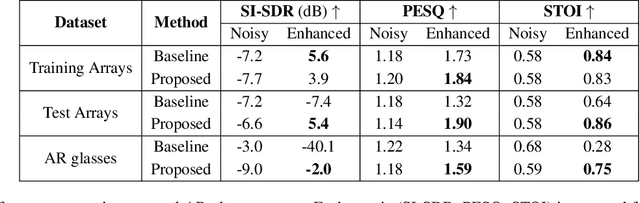
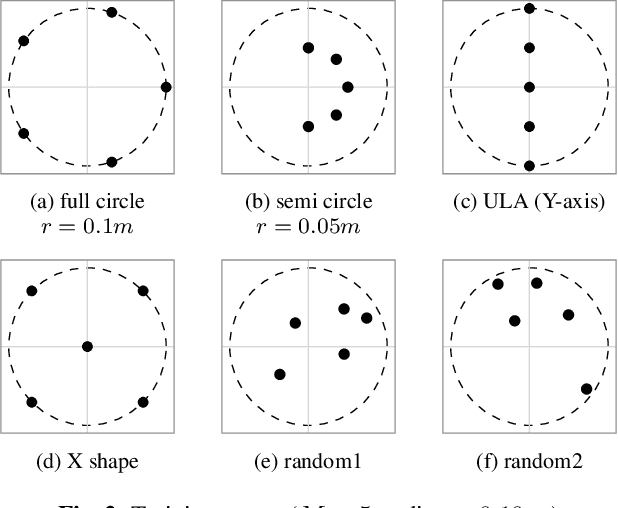
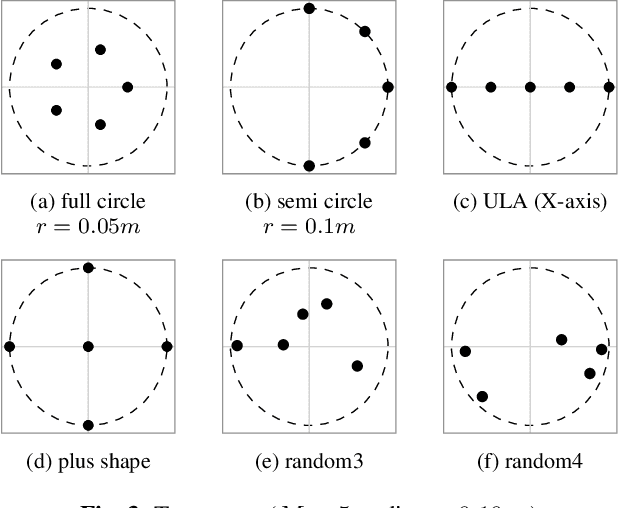
Multichannel speech enhancement leverages spatial cues to improve intelligibility and quality, but most learning-based methods rely on specific microphone array geometry, unable to account for geometry changes. To mitigate this limitation, current array-agnostic approaches employ large multi-geometry datasets but may still fail to generalize to unseen layouts. We propose AmbiDrop (Ambisonics with Dropouts), an Ambisonics-based framework that encodes arbitrary array recordings into the spherical harmonics domain using Ambisonics Signal Matching (ASM). A deep neural network is trained on simulated Ambisonics data, combined with channel dropout for robustness against array-dependent encoding errors, therefore omitting the need for a diverse microphone array database. Experiments show that while the baseline and proposed models perform similarly on the training arrays, the baseline degrades on unseen arrays. In contrast, AmbiDrop consistently improves SI-SDR, PESQ, and STOI, demonstrating strong generalization and practical potential for array-agnostic speech enhancement.