 Add to Chrome
 Add to Firefox
 Add to Edge
Real-time Range-Angle Estimation and Tag Localization for Multi-static Backscatter Systems
Feb 16, 2026
Multi-static backscatter networks (BNs) are strong candidates for joint communication and localization in the ambient IoT paradigm for 6G. Enabling real-time localization in large-scale multi-static deployments with thousands of devices require highly efficient algorithms for estimating key parameters such as range and angle of arrival (AoA), and for fusing these parameters into location estimates. We propose two low-complexity algorithms, Joint Range-Angle Clustering (JRAC) and Stage-wise Range-Angle Estimation (SRAE). Both deliver range and angle estimation accuracy comparable to FFT- and subspace-based baselines while significantly reducing the computation. We then introduce two real-time localization algorithms that fuse the estimated ranges and AoAs: a maximum-likelihood (ML) method solved via gradient search and an iterative re-weighted least squares (IRLS) method. Both achieve localization accuracy comparable to ML-based brute force search albeit with far lower complexity. Experiments on a real-world large-scale multi-static testbed with 4 illuminators, 1 multi-antenna receiver, and 100 tags show that JRAC and SRAE reduce runtime by up to 40X and IRLS achieves up to 500X reduction over ML-based brute force search without degrading localization accuracy. The proposed methods achieve 3 m median localization error across all 100 tags in a sub-6GHz band with 40 MHz bandwidth. These results demonstrate that multi-static range-angle estimation and localization algorithms can make real-time, scalable backscatter localization practical for next-generation ambient IoT networks.

The Patchkeeper: An Integrated Wearable Electronic Stethoscope with Multiple Sensors
Jul 16, 2024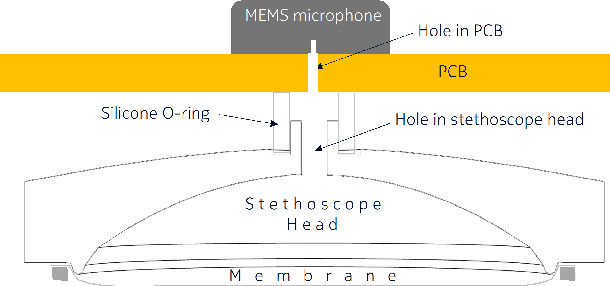
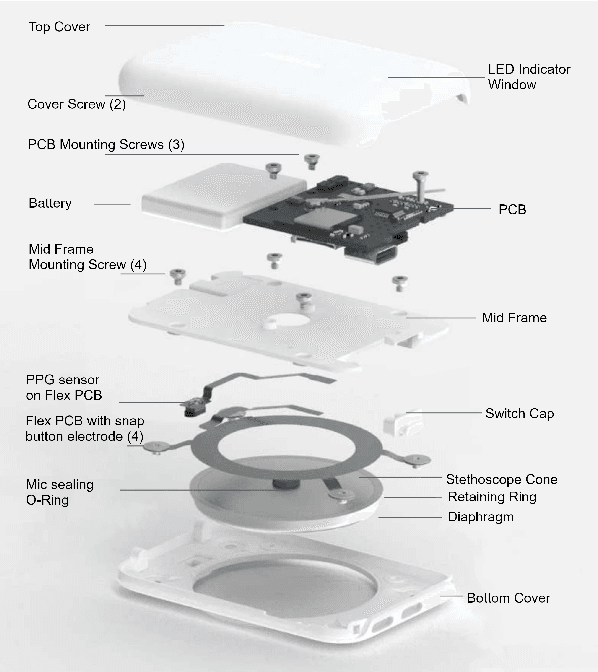
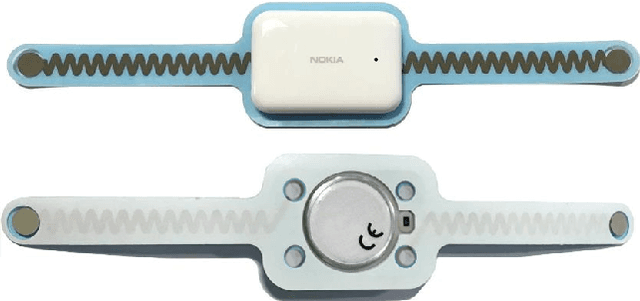
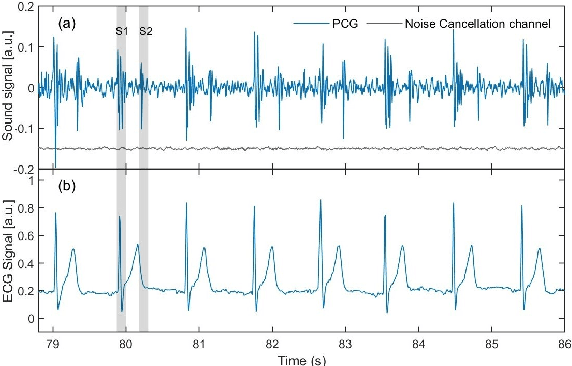
Many parts of human body generate internal sound during biological processes, which are rich sources of information for understanding health and wellbeing. Despite a long history of development and usage of stethoscopes, there is still a lack of proper tools for recording internal body sound together with complementary sensors for long term monitoring. In this paper, we show our development of a wearable electronic stethoscope, coined Patchkeeper (PK), that can be used for internal body sound recording over long periods of time. Patchkeeper also integrates several state-of-the-art biological sensors, including electrocardiogram (ECG), photoplethysmography (PPG), and inertial measurement unit (IMU) sensors. As a wearable device, Patchkeeper can be placed on various parts of the body to collect sound from particular organs, including heart, lung, stomach, and joints etc. We show in this paper that several vital signals can be recorded simultaneously with high quality. As Patchkeeper can be operated directly by the user, e.g. without involving health care professionals, we believe it could be a useful tool for telemedicine and remote diagnostics.
Natural Typing Recognition via Surface Electromyography
Sep 29, 2021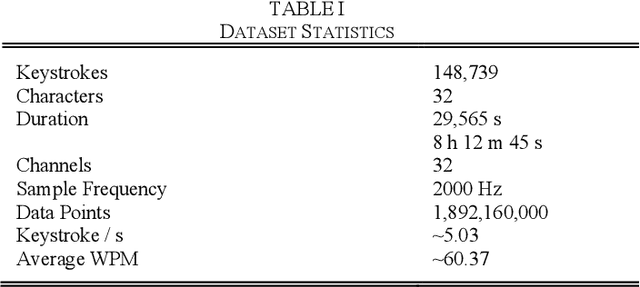
By using a computer keyboard as a finger recording device, we construct the largest existing dataset for gesture recognition via surface electromyography (sEMG), and use deep learning to achieve over 90% character-level accuracy on reconstructing typed text entirely from measured muscle potentials. We prioritize the temporal structure of the EMG signal instead of the spatial structure of the electrode layout, using network architectures inspired by those used for real-time spoken language transcription. Our architecture recognizes the rapid movements of natural computer typing, which occur at irregular intervals and often overlap in time. The extensive size of our dataset also allows us to study gesture recognition after synthetically downgrading the spatial or temporal resolution, showing the system capabilities necessary for real-time gesture recognition.