 Add to Chrome
 Add to Firefox
 Add to Edge
Energy-Efficient Hierarchical Federated Anomaly Detection for the Internet of Underwater Things via Selective Cooperative Aggregation
Mar 25, 2026
Anomaly detection is a core service in the Internet of Underwater Things, yet training accurate distributed models underwater is difficult because acoustic links are low-bandwidth, energy-intensive, and often unable to support direct sensor-to-surface communication. Standard flat federated learning therefore faces two coupled limitations in underwater deployments: expensive long-range transmissions and reduced participation when only a subset of sensors can reach the gateway. This paper proposes an energy-efficient hierarchical federated learning framework for underwater anomaly detection based on three components: feasibility-aware sensor-to-fog association, compressed model-update transmission, and selective cooperative aggregation among fog nodes. The proposed three-tier architecture localises most communication within short-range clusters while activating fog-to-fog exchange only when smaller clusters can benefit from nearby larger neighbours. A physics-grounded underwater acoustic model is used to evaluate detection quality, communication energy, and network participation jointly. In large synthetic deployments, only about 48% of sensors can directly reach the gateway in the 200-sensor case, whereas hierarchical learning preserves full participation through feasible fog paths. Selective cooperation matches the detection accuracy of always-on inter-fog exchange while reducing its energy by 31-33%, and compressed uploads reduce total energy by 71-95% in matched sensitivity tests. Experiments on three real benchmarks further show that low-overhead hierarchical methods remain competitive in detection quality, while flat federated learning defines the minimum-energy operating point. These results provide practical design guidance for underwater deployments operating under severe acoustic communication constraints.

Towards a Sustainable Internet-of-Underwater-Things based on AUVs, SWIPT, and Reinforcement Learning
Feb 21, 2023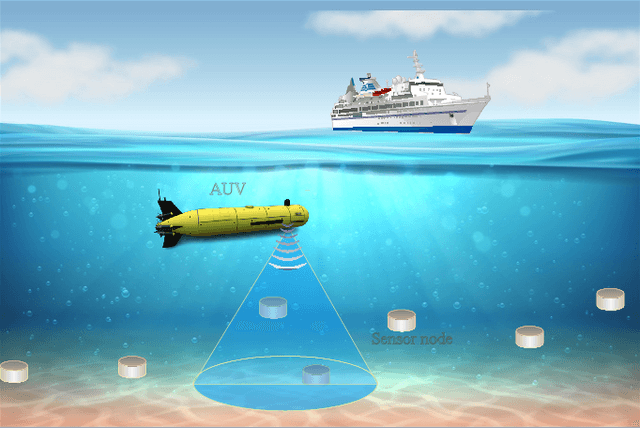
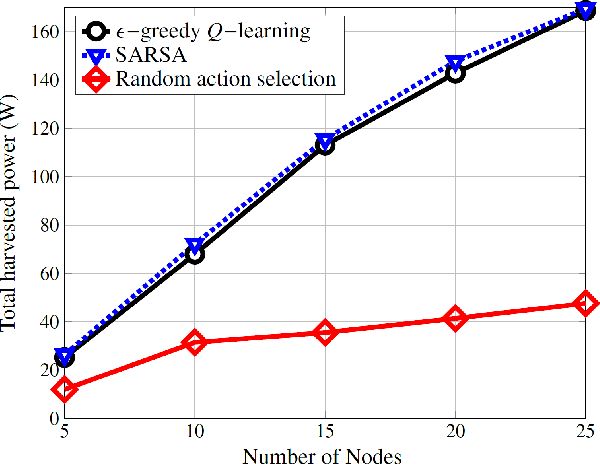
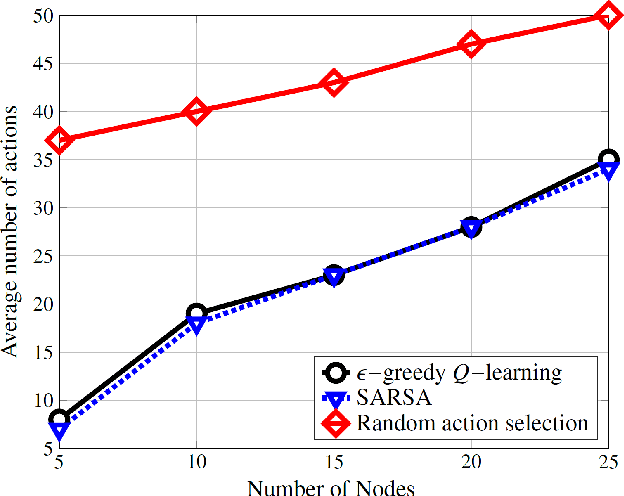
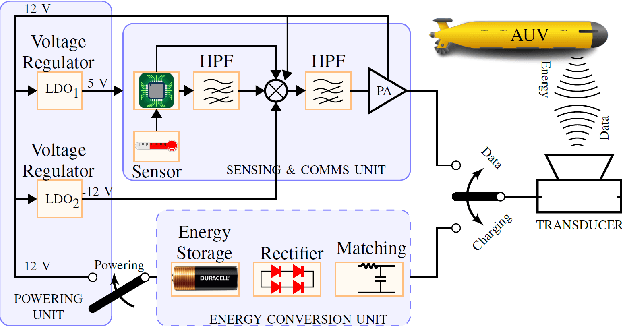
Life on earth depends on healthy oceans, which supply a large percentage of the planet's oxygen, food, and energy. However, the oceans are under threat from climate change, which is devastating the marine ecosystem and the economic and social systems that depend on it. The Internet-of-underwater-things (IoUTs), a global interconnection of underwater objects, enables round-the-clock monitoring of the oceans. It provides high-resolution data for training machine learning (ML) algorithms for rapidly evaluating potential climate change solutions and speeding up decision-making. The sensors in conventional IoUTs are battery-powered, which limits their lifetime, and constitutes environmental hazards when they die. In this paper, we propose a sustainable scheme to improve the throughput and lifetime of underwater networks, enabling them to potentially operate indefinitely. The scheme is based on simultaneous wireless information and power transfer (SWIPT) from an autonomous underwater vehicle (AUV) used for data collection. We model the problem of jointly maximising throughput and harvested power as a Markov Decision Process (MDP), and develop a model-free reinforcement learning (RL) algorithm as a solution. The model's reward function incentivises the AUV to find optimal trajectories that maximise throughput and power transfer to the underwater nodes while minimising energy consumption. To the best of our knowledge, this is the first attempt at using RL to ensure sustainable underwater networks via SWIPT. The scheme is implemented in an open 3D RL environment specifically developed in MATLAB for this study. The performance results show up 207% improvement in energy efficiency compared to those of a random trajectory scheme used as a baseline model.