 Add to Chrome
 Add to Firefox
 Add to Edge
Transfer Learning in Bayesian Optimization for Aircraft Design
Mar 30, 2026
The use of transfer learning within Bayesian optimization addresses the disadvantages of the so-called \textit{cold start} problem by using source data to aid in the optimization of a target problem. We present a method that leverages an ensemble of surrogate models using transfer learning and integrates it in a constrained Bayesian optimization framework. We identify challenges particular to aircraft design optimization related to heterogeneous design variables and constraints. We propose the use of a partial-least-squares dimension reduction algorithm to address design space heterogeneity, and a \textit{meta} data surrogate selection method to address constraint heterogeneity. Numerical benchmark problems and an aircraft conceptual design optimization problem are used to demonstrate the proposed methods. Results show significant improvement in convergence in early optimization iterations compared to standard Bayesian optimization, with improved prediction accuracy for both objective and constraint surrogate models.

Parallel Surrogate-assisted Optimization Using Mesh Adaptive Direct Search
Jul 26, 2021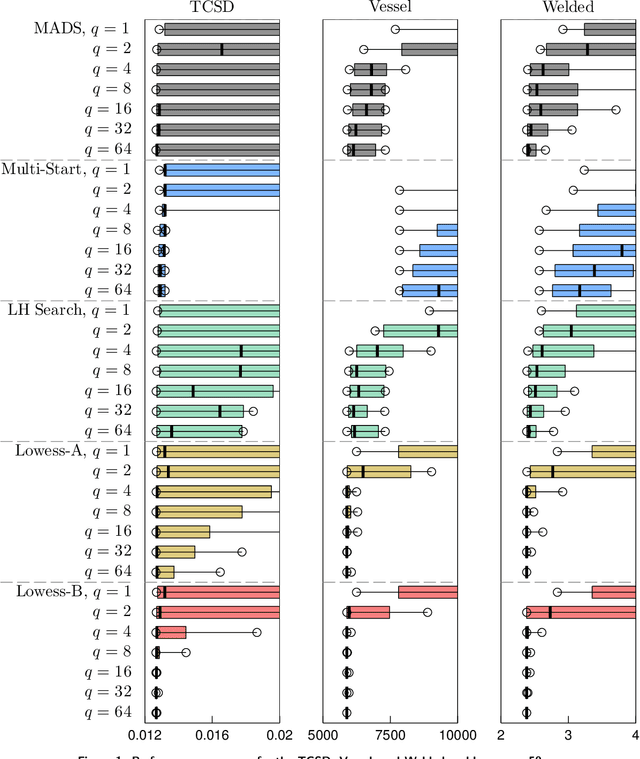


We consider computationally expensive blackbox optimization problems and present a method that employs surrogate models and concurrent computing at the search step of the mesh adaptive direct search (MADS) algorithm. Specifically, we solve a surrogate optimization problem using locally weighted scatterplot smoothing (LOWESS) models to find promising candidate points to be evaluated by the blackboxes. We consider several methods for selecting promising points from a large number of points. We conduct numerical experiments to assess the performance of the modified MADS algorithm with respect to available CPU resources by means of five engineering design problems.