 Add to Chrome
 Add to Firefox
 Add to Edge
Transfer Learning in Bayesian Optimization for Aircraft Design
Mar 30, 2026
The use of transfer learning within Bayesian optimization addresses the disadvantages of the so-called \textit{cold start} problem by using source data to aid in the optimization of a target problem. We present a method that leverages an ensemble of surrogate models using transfer learning and integrates it in a constrained Bayesian optimization framework. We identify challenges particular to aircraft design optimization related to heterogeneous design variables and constraints. We propose the use of a partial-least-squares dimension reduction algorithm to address design space heterogeneity, and a \textit{meta} data surrogate selection method to address constraint heterogeneity. Numerical benchmark problems and an aircraft conceptual design optimization problem are used to demonstrate the proposed methods. Results show significant improvement in convergence in early optimization iterations compared to standard Bayesian optimization, with improved prediction accuracy for both objective and constraint surrogate models.

SmOOD: Smoothness-based Out-of-Distribution Detection Approach for Surrogate Neural Networks in Aircraft Design
Sep 07, 2022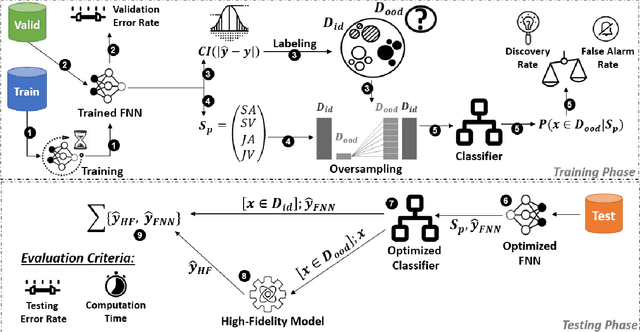

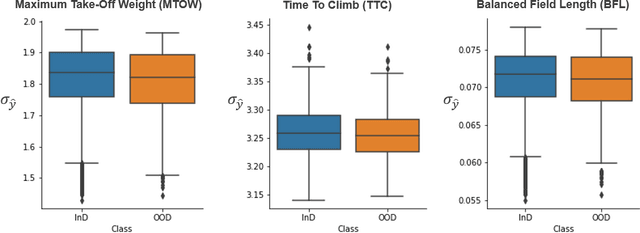
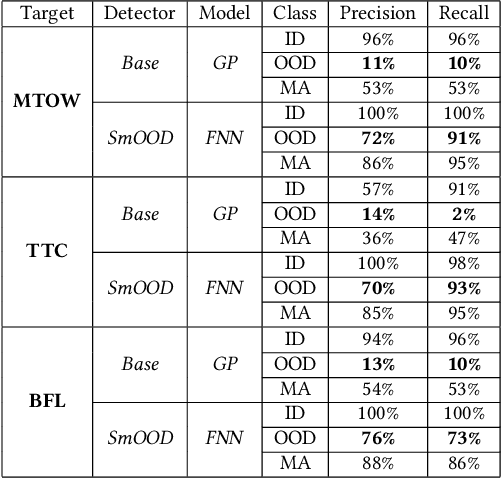
Aircraft industry is constantly striving for more efficient design optimization methods in terms of human efforts, computation time, and resource consumption. Hybrid surrogate optimization maintains high results quality while providing rapid design assessments when both the surrogate model and the switch mechanism for eventually transitioning to the HF model are calibrated properly. Feedforward neural networks (FNNs) can capture highly nonlinear input-output mappings, yielding efficient surrogates for aircraft performance factors. However, FNNs often fail to generalize over the out-of-distribution (OOD) samples, which hinders their adoption in critical aircraft design optimization. Through SmOOD, our smoothness-based out-of-distribution detection approach, we propose to codesign a model-dependent OOD indicator with the optimized FNN surrogate, to produce a trustworthy surrogate model with selective but credible predictions. Unlike conventional uncertainty-grounded methods, SmOOD exploits inherent smoothness properties of the HF simulations to effectively expose OODs through revealing their suspicious sensitivities, thereby avoiding over-confident uncertainty estimates on OOD samples. By using SmOOD, only high-risk OOD inputs are forwarded to the HF model for re-evaluation, leading to more accurate results at a low overhead cost. Three aircraft performance models are investigated. Results show that FNN-based surrogates outperform their Gaussian Process counterparts in terms of predictive performance. Moreover, SmOOD does cover averagely 85% of actual OODs on all the study cases. When SmOOD plus FNN surrogates are deployed in hybrid surrogate optimization settings, they result in a decrease error rate of 34.65% and a computational speed up rate of 58.36 times, respectively.