 Add to Chrome
 Add to Firefox
 Add to Edge
Learning biophysical models of gene regulation with probability flow matching
Apr 27, 2026
Cellular differentiation is governed by gene regulatory networks, the high-dimensional stochastic biochemical systems that determine the transcriptional landscape and mediate cellular responses to signals and perturbations. Although single-cell RNA sequencing provides quantitative snapshots of the transcriptome, current methods for inferring gene-regulatory dynamics often lack mechanistic interpretability and fail to generalize to unseen conditions. Here we introduce Probability Flow Matching (PFM), a scalable framework for learning biophysically consistent stochastic processes directly from time-resolved single-cell measurements. Applying PFM to three hematopoiesis datasets, we show that models with similar interpolation accuracy can encode fundamentally different dynamics, with only biophysically consistent formulations accurately capturing mechanisms of lineage transitions, fate specification, and gene perturbation responses. We further demonstrate that PFM accommodates unbalanced populations, enabling simultaneous inference of cellular proliferation and death dynamics. Together, these results establish PFM as a flexible, scalable framework for integrating mechanistic modeling with single-cell omics.

Stochastic force inference via density estimation
Oct 03, 2023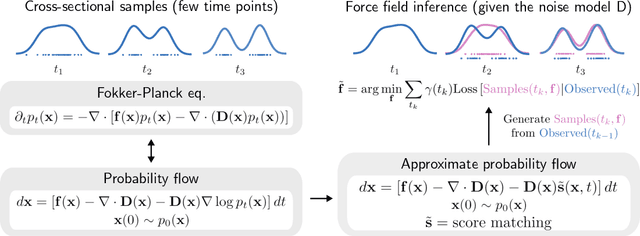
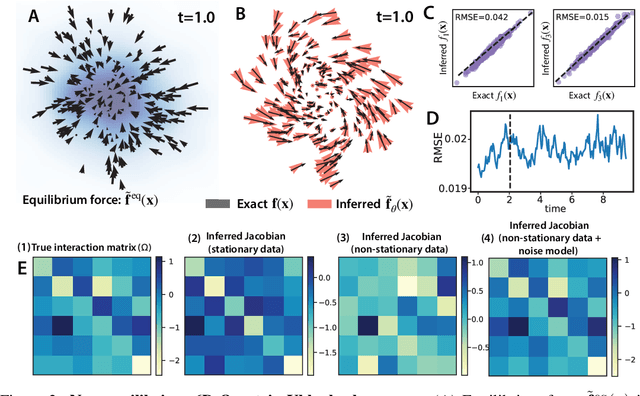
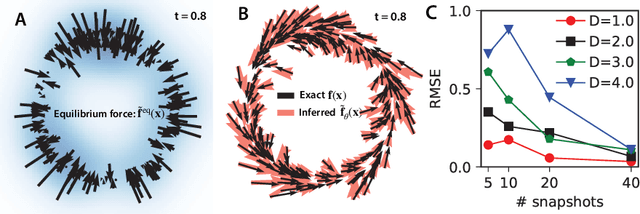
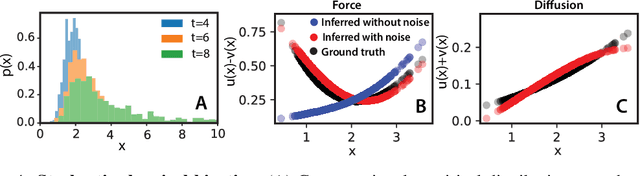
Inferring dynamical models from low-resolution temporal data continues to be a significant challenge in biophysics, especially within transcriptomics, where separating molecular programs from noise remains an important open problem. We explore a common scenario in which we have access to an adequate amount of cross-sectional samples at a few time-points, and assume that our samples are generated from a latent diffusion process. We propose an approach that relies on the probability flow associated with an underlying diffusion process to infer an autonomous, nonlinear force field interpolating between the distributions. Given a prior on the noise model, we employ score-matching to differentiate the force field from the intrinsic noise. Using relevant biophysical examples, we demonstrate that our approach can extract non-conservative forces from non-stationary data, that it learns equilibrium dynamics when applied to steady-state data, and that it can do so with both additive and multiplicative noise models.