 Add to Chrome
 Add to Firefox
 Add to Edge
PREVENT-JACK: Context Steering for Swarms of Long Heavy Articulated Vehicles
Apr 23, 2026
In this paper, we aim to extend the traditional point-mass-like robot representation in swarm robotics and instead study a swarm of long Heavy Articulated Vehicles (HAVs). HAVs are kinematically constrained, elongated, and articulated, introducing unique challenges. Local, decentralized coordination of these vehicles is motivated by many real-world applications. Our approach, Prevent-Jack, introduces the sparsely covered context steering framework in robotics. It fuses six local behaviors, providing guarantees against jackknifing and collisions at the cost of potential dead- and livelocks, tested for vehicles with up to ten trailers. We highlight the importance of the Evade Attraction behavior for deadlock prevention using a parameter study, and use 15,000 simulations to evaluate the swarm performance. Our extensive experiments and the results show that both the dead- and livelocks occur more frequently in larger swarms and denser scenarios, affecting a peak average of 27%/31% of vehicles. We observe that larger swarms exhibit increased waiting, while smaller swarms show increased evasion.

AVOID-JACK: Avoidance of Jackknifing for Swarms of Long Heavy Articulated Vehicles
Nov 11, 2025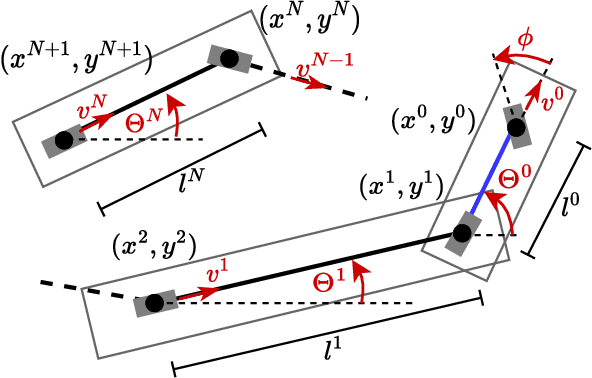
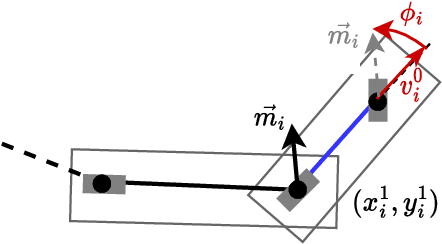
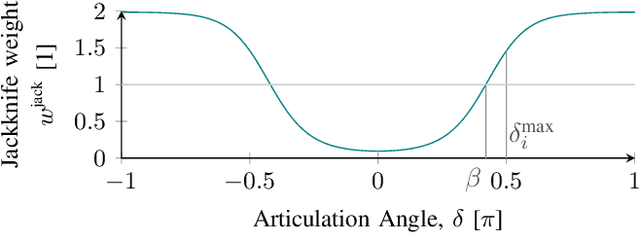
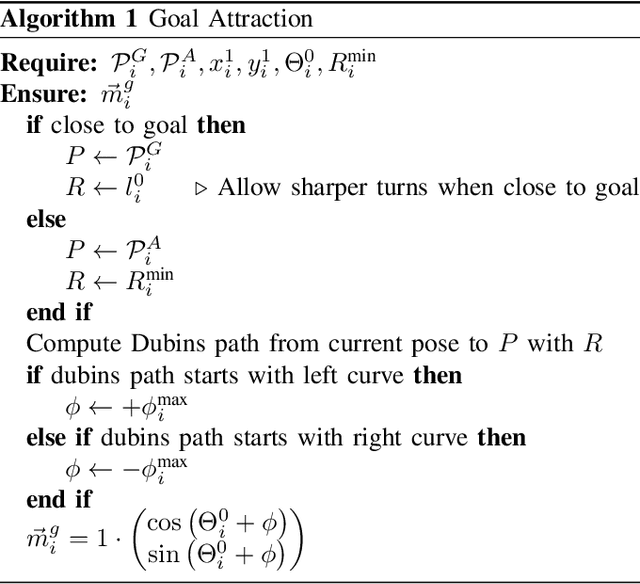
This paper presents a novel approach to avoiding jackknifing and mutual collisions in Heavy Articulated Vehicles (HAVs) by leveraging decentralized swarm intelligence. In contrast to typical swarm robotics research, our robots are elongated and exhibit complex kinematics, introducing unique challenges. Despite its relevance to real-world applications such as logistics automation, remote mining, airport baggage transport, and agricultural operations, this problem has not been addressed in the existing literature. To tackle this new class of swarm robotics problems, we propose a purely reaction-based, decentralized swarm intelligence strategy tailored to automate elongated, articulated vehicles. The method presented in this paper prioritizes jackknifing avoidance and establishes a foundation for mutual collision avoidance. We validate our approach through extensive simulation experiments and provide a comprehensive analysis of its performance. For the experiments with a single HAV, we observe that for 99.8% jackknifing was successfully avoided and that 86.7% and 83.4% reach their first and second goals, respectively. With two HAVs interacting, we observe 98.9%, 79.4%, and 65.1%, respectively, while 99.7% of the HAVs do not experience mutual collisions.