 Add to Chrome
 Add to Firefox
 Add to Edge
A Privacy by Design Framework for Large Language Model-Based Applications for Children
Feb 19, 2026
Children are increasingly using technologies powered by Artificial Intelligence (AI). However, there are growing concerns about privacy risks, particularly for children. Although existing privacy regulations require companies and organizations to implement protections, doing so can be challenging in practice. To address this challenge, this article proposes a framework based on Privacy-by-Design (PbD), which guides designers and developers to take on a proactive and risk-averse approach to technology design. Our framework includes principles from several privacy regulations, such as the General Data Protection Regulation (GDPR) from the European Union, the Personal Information Protection and Electronic Documents Act (PIPEDA) from Canada, and the Children's Online Privacy Protection Act (COPPA) from the United States. We map these principles to various stages of applications that use Large Language Models (LLMs), including data collection, model training, operational monitoring, and ongoing validation. For each stage, we discuss the operational controls found in the recent academic literature to help AI service providers and developers reduce privacy risks while meeting legal standards. In addition, the framework includes design guidelines for children, drawing from the United Nations Convention on the Rights of the Child (UNCRC), the UK's Age-Appropriate Design Code (AADC), and recent academic research. To demonstrate how this framework can be applied in practice, we present a case study of an LLM-based educational tutor for children under 13. Through our analysis and the case study, we show that by using data protection strategies such as technical and organizational controls and making age-appropriate design decisions throughout the LLM life cycle, we can support the development of AI applications for children that provide privacy protections and comply with legal requirements.

Vax-Culture: A Dataset for Studying Vaccine Discourse on Twitter
Apr 17, 2023
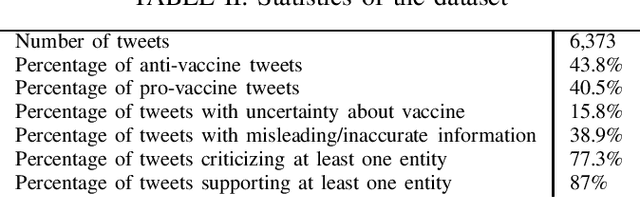
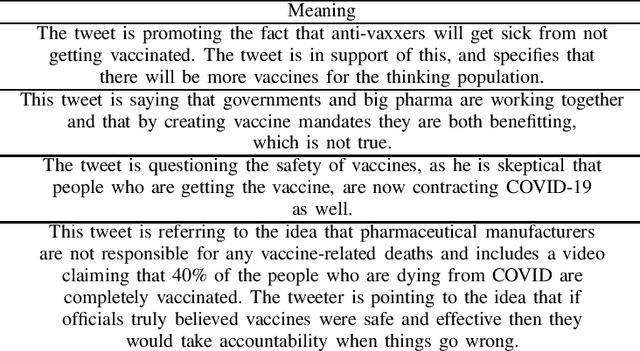
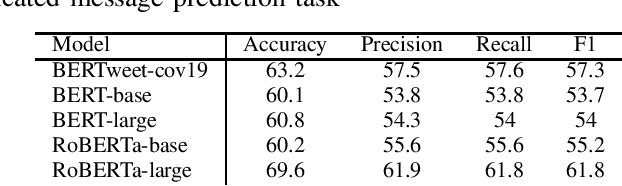
Vaccine hesitancy continues to be a main challenge for public health officials during the COVID-19 pandemic. As this hesitancy undermines vaccine campaigns, many researchers have sought to identify its root causes, finding that the increasing volume of anti-vaccine misinformation on social media platforms is a key element of this problem. We explored Twitter as a source of misleading content with the goal of extracting overlapping cultural and political beliefs that motivate the spread of vaccine misinformation. To do this, we have collected a data set of vaccine-related Tweets and annotated them with the help of a team of annotators with a background in communications and journalism. Ultimately we hope this can lead to effective and targeted public health communication strategies for reaching individuals with anti-vaccine beliefs. Moreover, this information helps with developing Machine Learning models to automatically detect vaccine misinformation posts and combat their negative impacts. In this paper, we present Vax-Culture, a novel Twitter COVID-19 dataset consisting of 6373 vaccine-related tweets accompanied by an extensive set of human-provided annotations including vaccine-hesitancy stance, indication of any misinformation in tweets, the entities criticized and supported in each tweet and the communicated message of each tweet. Moreover, we define five baseline tasks including four classification and one sequence generation tasks, and report the results of a set of recent transformer-based models for them. The dataset and code are publicly available at https://github.com/mrzarei5/Vax-Culture.