 Add to Chrome
 Add to Firefox
 Add to Edge
Reinforcement learning for ion shuttling on trapped-ion quantum computers
May 21, 2026
Scalable trapped-ion quantum computing is commonly realized with modular chips that feature distinct zones with specific functionalities, such as storage, state preparation, and gate execution. To execute a quantum circuit, the ions must be transported between these zones. This process is called ion shuttling. To achieve reliable computation results, the shuttling process must be optimized. However, as the number of ions increases, this becomes a high-dimensional optimization problem where optimal solutions cannot be computed efficiently. We demonstrate, to the best of our knowledge, the first use of reinforcement learning (RL) for the optimization of ion shuttling. RL is well-suited for such scenarios, as it enables learning a strategy through direct interaction with the problem. We show that our RL approach outperforms current state-of-the-art heuristic techniques, yielding a reduction in shuttling operations of up to 36.3 %. Furthermore, we show that our method is easily applicable to various chip architectures. Our approach offers a versatile method to study shuttling efficiency during chip design and, therefore, a highly relevant tool for future, more complex architectures.

Model-free reinforcement learning with noisy actions for automated experimental control in optics
May 24, 2024

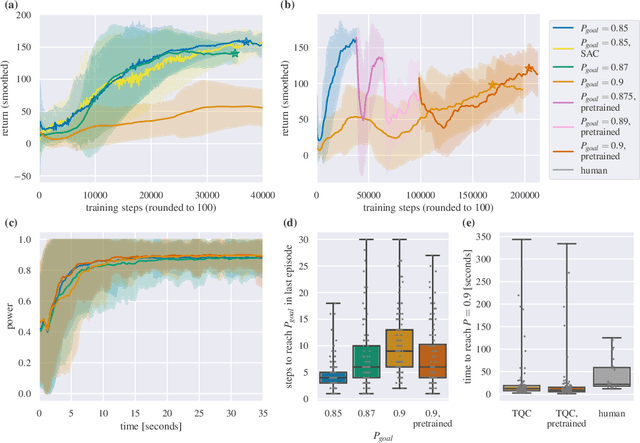

Experimental control involves a lot of manual effort with non-trivial decisions for precise adjustments. Here, we study the automatic experimental alignment for coupling laser light into an optical fiber using reinforcement learning (RL). We face several real-world challenges, such as time-consuming training, partial observability, and noisy actions due to imprecision in the mirror steering motors. We show that we can overcome these challenges: To save time, we use a virtual testbed to tune our environment for dealing with partial observability and use relatively sample-efficient model-free RL algorithms like Soft Actor-Critic (SAC) or Truncated Quantile Critics (TQC). Furthermore, by fully training on the experiment, the agent learns directly to handle the noise present. In our extensive experimentation, we show that we are able to achieve 90% coupling, showcasing the effectiveness of our proposed approaches. We reach this efficiency, which is comparable to that of a human expert, without additional feedback loops despite the motors' inaccuracies. Our result is an example of the readiness of RL for real-world tasks. We consider RL a promising tool for reducing the workload in labs.